New Armed Group Emerges in Iraq as Baghdad Pushes to Disarm Militias
Asaib al-Jihad announces its formation in Iraq as Baghdad pushes to bring militia weapons under state control by June 2027 after its Jurf al-Sakhar deployment.
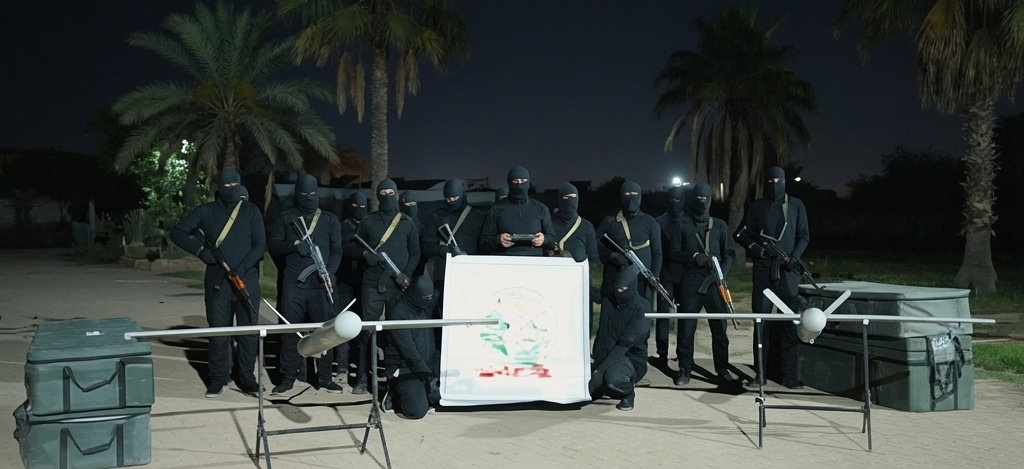
ERBIL (Kurdistan24) - A newly announced Iraqi armed group calling itself the "Islamic Resistance - Asaib al-Jihad" has declared its readiness to join an existing resistance coordination body, even as Baghdad presses ahead with a campaign to bring weapons outside government authority under state control by June 30, 2027.
The group announced its formation on Saturday, Nov. 21, through a video circulated on social media. Several masked gunmen appeared alongside two drones as the organization outlined its principles and invited people sharing its objectives to join.
The announcement presents a challenge for Iraqi Prime Minister Ali al-Zaidi's disarmament agenda: while his government seeks to reduce the number of independently armed factions, another organization is publicly declaring its existence and expressing interest in joining an armed resistance umbrella.
The footage establishes the group's public declaration but does not independently establish its membership, leadership, funding, operational capabilities or connections to existing factions. Nor does the appearance of drones demonstrate that it has conducted military operations.
In its founding statement, Asaib al-Jihad said it had established itself following consultations and as a continuation of previous pledges and commitments.
The organization outlined three principles governing its activities.
The first emphasized remaining committed to what it described as the path of jihad without compromise or deviation. The second stressed devotion to battlefield activity rather than personal interests or material gains.
Its third principle concerned loyalty to its sect and homeland, alongside continued commitment to those killed in previous struggles and their families.
The group invited individuals sharing its objectives to join its ranks, maintaining that changing circumstances, difficulties and competing interests had not altered its convictions.
The statement, dated the first of Jumada al-Thani, 1448 AH, concluded by formally expressing the group's readiness to join the Coordination Committee of the Islamic Resistance in Iraq.
However, the declaration does not establish whether the committee has accepted the organization or whether its members previously belonged to another armed faction.
Despite the similarity of their names, the available information also does not establish an organizational relationship between Asaib al-Jihad and Asaib Ahl al-Haq, an established Iraqi political and armed movement.
Disarmament Deadline
The timing of the announcement is particularly notable because Iraq has established a timetable for ending the possession of weapons outside the state's framework.
Baghdad designated Oct. 1, 2026, as the beginning of the practical phase of its disarmament initiative, setting June 30, 2027, as the final target for bringing armed factions under government authority.
The revised timetable followed difficulties implementing an earlier deadline of Sept. 30, 2026, associated with the end of the international anti-ISIS coalition's military mission in Iraq.
The government's phased proposal included an initial 90-day suspension of militia attacks, accompanied by restraint from the United States, before weapons would be transferred to state institutions.
Rather than immediately confronting every armed faction, Baghdad has pursued negotiations aimed at achieving disarmament while avoiding further instability.
The challenge extends beyond collecting weapons. Several armed factions operate within or alongside the Popular Mobilization Forces (PMF), which have formal recognition within Iraq's security institutions, while maintaining varying degrees of independent political influence and organizational authority.
Bringing weapons under government control therefore requires more than formal affiliation. It also involves determining who commands armed personnel, authorizes military activities and controls resources.
The emergence of another group raises questions about how Baghdad intends to regulate newly declared armed organizations while negotiating the disarmament of established factions.
Iraq's Armed Factions
The government's efforts have produced some indications of cooperation, although implementation remains incomplete.
On Nov. 9, Iraqi Foreign Minister Fuad Hussein announced understandings with four armed factions, including Asaib Ahl al-Haq and Kataib Sayyid al-Shuhada.
However, negotiations with Kataib Hezbollah and Harakat al-Nujaba continued, and Hussein did not announce that any faction had fully completed the disarmament process.
Baghdad has also pursued enforcement measures, including closing 71 unauthorized PMF facilities and expanding firearms registration.
In October, authorities registered weapons belonging to 38,549 citizens and confiscated 4,046 light weapons.
These measures demonstrate activity in controlling firearms, but civilian weapons registration should not be confused with the dismantling of organized militia arsenals.
Some factions continue to reject the government's demands outright.
Kataib Hezbollah, among Iraq's most powerful Iran-backed armed groups, has repeatedly refused to surrender its weapons, exposing the limits of negotiations with organizations determined to retain independent military capabilities.
Against that background, Asaib al-Jihad's announcement introduces another organization professing an armed resistance identity, although its actual strength and capacity remain unknown.
Jurf al-Sakhar Case
The dispute over weapons outside state control became particularly visible this week in Jurf al-Sakhar, a subdistrict in Babil province southwest of Baghdad.
The area was recaptured from ISIS in October 2014 but subsequently remained under Kataib Hezbollah's influence, with displaced residents unable to return for nearly 12 years.
The immediate confrontation intensified after an investigation into suspected oil smuggling and interference with the strategic Basra-Haditha pipeline.
A 19-page Iraqi intelligence report examined by Kurdistan24 documented allegations involving tanker movements and suspected pipeline breaches. The report referred to protection by an unnamed armed faction without establishing the identity of individual perpetrators or the precise quantity of oil allegedly stolen.
The investigation prompted the dismissal of senior security and oil-sector officials and instructions for judicial proceedings.
On Thursday, Nov. 19, a senior Kataib Hezbollah figure told Kurdistan24 that the organization would neither leave Jurf al-Sakhar nor surrender its weapons.
Nevertheless, federal security forces entered the subdistrict on Friday, Nov. 20, under a joint deployment arrangement involving the Federal Police, Energy Police and PMF formations.
The entry marked a change in the government's physical presence in an area long subject to restricted access.
However, the movement of government forces does not by itself establish that Kataib Hezbollah has disarmed, surrendered every position or relinquished its broader military influence.
Officials have outlined plans to protect oil infrastructure, reopen roads and create conditions for displaced residents eventually to return.
Whether those objectives will be implemented remains a separate measure of Baghdad's ability to exercise authority beyond the initial deployment.
Weapons Monopoly?
Asaib al-Jihad's founding statement did not directly address the Jurf al-Sakhar operation or declare an intention to confront Iraqi government forces.
There is consequently no established evidence connecting the new group's announcement to that particular confrontation.
Nevertheless, both developments concern the same unresolved question confronting Iraq's political and security institutions: whether armed organizations will operate under a unified state command or retain independent structures.
The new group's declaration does not prove that it possesses substantial military capabilities, territorial control or the means to challenge government forces.
It does, however, demonstrate that the public formation of groups committed to armed activity continues while Baghdad is attempting to consolidate its authority over existing factions.
For Iraq's disarmament program, the central measure of success will not simply be the number of organizations announcing cooperation, but whether authorities can establish effective control over weapons, command structures and military decisions.
With the June 30, 2027, deadline approaching, the emergence of Asaib al-Jihad adds another unanswered question to that process: how will Baghdad prevent new armed structures from developing while seeking to dismantle or integrate those already operating?
The new organization has declared its intentions, but its capabilities and future activities remain unverified. Iraq's effort to establish exclusive state authority over weapons remains unfinished.
Kurdistan24's news writer and journalist Jangawar Aziz contributed to this report.