
Dastan Galalaye
Editor
The Color of Mesopotamia: Qarani Jamil's Depiction of Kurdish Suffering
There are artists who paint to escape from reality, and there are those whose painting is a reflection of reality. Qarani Jamil (1954-2025) was none of them. He created his own reality through his paintings.
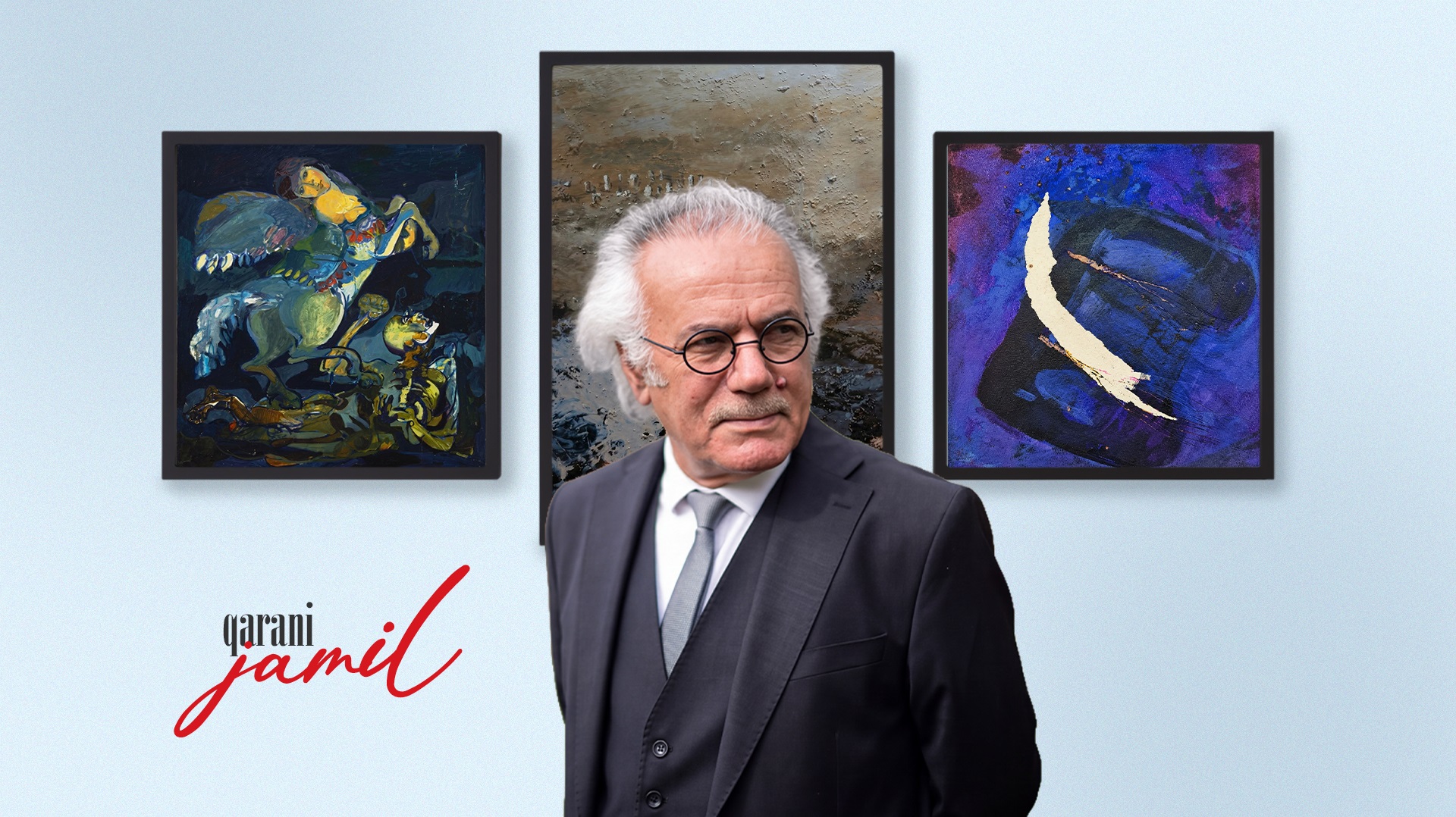
There are artists who paint to escape from reality, and there are those whose painting is a reflection of reality. Qarani Jamil (1954-2025) was none of them. He created his own reality through his paintings. Reality for Kurdish people is always hard to endure due to years of oppression by their adversaries. Jamil's realization of that urged him to create his own reality through his art. Also, he didn't restrict himself to one style of art but rather utilized different styles to convey the suffering of his people. "When I approach a work, I do not think of a specific style or school. Instead, I construct, or better still, visualize an idea in a technique that meets my approval," Jamil once said in an interview with Dara Rasoul Ola. He tried to use the colors that are particularly seen in Mesopotamia, his wife, Muna Ahmad told me. Thus, we can call his style of painting the Mesopotamian style.
This article briefly attempts to discover how the artist depicted the Kurdish people's suffering and struggle for freedom through three of his paintings, focusing on only one aspect of them. The interpretations below are not those of an art critic, as I am not one, but of someone passionate about art who tries to understand its implicit meaning. My readings of art schools and movements, as well as my literary background, contributed to this piece of writing.
Kurdistan as a cradle of civilization

Many historians believe that civilization emerged in Upper Mesopotamia, today's Kurdistan. The village of Jarmo, the monumental sanctuary of Gire Mirazan and many other archeological sites stand as proof of this. However, Kurdistan later witnessed significant oppression, which this abstract expressionist painting could be interpreted as representing of that.
The painting was created in the late 1980s. It evokes both life and destruction. Upon close observation of its colors, one feels the gloominess as well as the cheerfulness. The cobalt blue color of the painting and the cradle symbolize the beginning of life and the flourishing of human civilization. Blue is the color of water, and where there is water, there is life. It's also the color of the sky, which represents freedom, a thing that Kurdish people have long fought for. The tilted cradle we see in the painting can tell us that although civilization starts in the land of Kurdistan, it is now oppressed by those whom Kurdistan provided with basic tools of development. A crack or scratch can also be seen in the painting. It is the artist's skillful way to tell its audience about the war atrocities the Kurdish people endured throughout history.
The strength of Kurdish women

Kurdish women have always been at the forefront of the Kurdish people's uprisings for freedom. Without them, many of these uprisings would have been difficult to occur. They were not only fighters or military leaders but also intellectuals like Mastoureh Ardalan (1805-1848), who is considered to be the first female historian in the Middle East, and Hapsa Khan (1881-1953), a Kurdish feminist who founded the first women's school in Iraq. Other prominent names are Mir Khanzad (the ruler of the Soran Emirate), Adela Khanem (called the Princess of the Brave by the British), and Leyla Qasim, to name a few. Also, the discovery of clay figures depicting pregnant women in Jarmo village suggests that the early inhabitants of Kurdistan practiced goddess worship. Meanwhile, the most celebrated mythical creature among Kurds is Shamaran, which has the body of a snake and the head of a woman.
This Expressionist painting—which also has strong affinities with Surrealism—reflects upon the same history mentioned above. The painting was created in 1976 when Jamil was a student at the College of Fine Arts in Baghdad. The Kurdish centauride we see in the painting suggests the bravery, hope, and sharp-mindedness of Kurdish women. Even if Kurdish men fall, Kurdish women still rise. The skeleton-shaped man seems to have been pounded into the earth, appears defeated and hopeless, and stares up at his only and last hope. The phrase "behind every great man is a woman" has been proven untrue here in this painting; Kurdish women are not only behind great men, but they are also great themselves. They are flying above men and guide them to the path of triumph, as this painting evokes.
The Kurdish centauride is not trying to be free, as she is already free. Nor is she escaping from anything; rather, she wants to face obstacles. Upon close examination, one can see fearlessness in her eyes, in contrast to the man's eye, which appears to be goggling with panic. Meanwhile, the woman wears colorful Kurdish attire while the man seems to be naked. This can indicate that men are limbless without women. overall, the image of Kurdish women in this piece of art is powerful, dignified, and resilient.
Jamil’s attempt to depict Anfal campaign

The Anfal campaign was one of the most brutal genocides in human history, an act of ethnic cleansing perpetrated by the Iraqi Ba'athist regime against the Kurdish people in the Kurdistan Region. The campaign, which began in 1983 and continued until 1988, resulted in an estimated 50,000 to 182,000 deaths. Many of the victims, including women and children, were buried in mass graves, and the remains of many casualties have yet to be found.
Depicting such a brutal genocide is challenging for any artist. Even imagining it is difficult. Thus, this abstract expressionist painting by Jamil, created in 2016, is only a small attempt to portray this massacre.
The painting has gloomy colors. Upon first looking at it, we sense its devastated atmosphere. The most prominent colors of the painting are deep black and muddy brown, which can tell us a lot about the Anfal campaign. The women who lost their family or a member of their family during the campaign always wear black. The muddy brown symbolizes the mass graves of the campaign. The tombstones that are visible at the upper section of the painting represent the remains of those that have been found, but the barely visible human figure below them is not looking at them; rather, he looks at the black and ashy land below him. He seems to be standing at the top of a mountain, and the faraway land looks apocalyptic. The skull we see in it can represent the remains of those who haven't been found yet.
On the whole, the painting tells a lot about the Anfal campaign: the brutality of the campaign, its effect through the mourning of women and those who are waiting for the remains of their beloved, as well as the silence of the international community about this genocide, through its mixture of different dark colors that one has to closely examine the painting to see its implicit meaning clearly.
The views expressed in this article are those of the author and do not necessarily reflect the views of Kurdistan24.