Trump: US Forces Will Strike 'Extremely Hard' Over Next Two to Three Weeks if No Deal Reached
Trump declared continued war against Iran, citing major military gains, warning of further strikes, and stating US objectives under Operation Epic Fury are nearing completion.
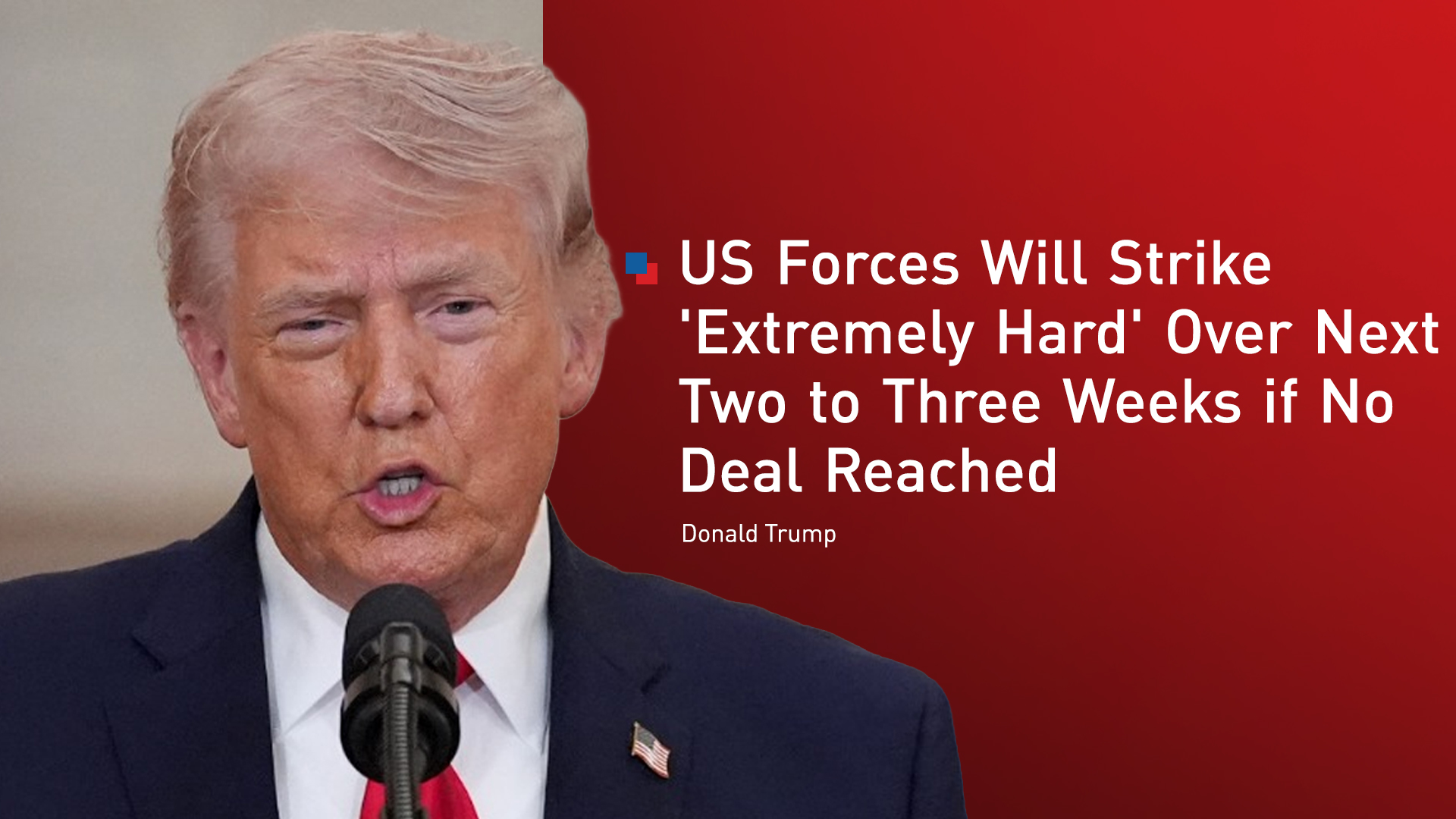
ERBIL (Kurdistan24) - In a wide-ranging primetime address, US President Donald Trump signaled the continuation of military operations against Iran, declaring sweeping battlefield gains while warning of further escalation in the coming weeks.
On Thursday, Trump began his address by congratulating NASA and the Artemis 2 astronauts on their successful launch, describing the mission as unprecedented in its distance and ambition, as it travels beyond the moon and returns from a range never achieved before. He praised the four astronauts as “brave people” and extended his blessing to them.
Turning to the war, Trump stated that one month had passed since the United States launched Operation Epic Fury against Iran, which he described as “the world’s number one state sponsor of terror.” He said that in four weeks, US forces had achieved “swift, decisive, overwhelming victories on the battlefield.”
Trump declared that Iran’s navy was “gone,” its air force “in ruins,” and that most of its leadership had been killed. He added that the command and control of the Islamic Revolutionary Guard Corps was being “decimated,” while the country’s ability to launch missiles and drones had been “dramatically curtailed.” He further stated that weapons factories and rocket launchers were being destroyed, leaving “very few of them left.”
“Never in the history of warfare has an enemy suffered such clear and devastating large-scale losses in a matter of weeks,” Trump said, adding, “Our enemies are losing, and America… is winning bigger than ever before.”
In his remarks, Trump also referenced a previous US military action, stating that US forces had “taken the country of Venezuela in a matter of minutes,” describing the operation as “quick, lethal, violent, and respected.” He added that the United States is now working with Venezuela as “joint venture partners” in the production and sale of oil and gas, noting that the country holds the second-largest reserves after the United States.
Trump emphasized that the United States is now “totally independent of the Middle East,” adding that while it does not need regional oil, it remains engaged “to help our allies.”
He reiterated that the core purpose of Operation Epic Fury is to ensure the safety of the United States and the “security of the free world,” stressing that he had long vowed not to allow Iran to acquire nuclear weapons.
The US president accused Iran of decades of hostility, referencing slogans against the United States and Israel, and linking Tehran to past attacks, including the Beirut barracks bombing, roadside bomb attacks on US forces, the USS Cole attack, and the October 7 events in Israel. He also claimed that Iranian authorities had killed 45,000 of their own citizens during protests.
“For these terrorists to have nuclear weapons would be an intolerable threat,” Trump said, warning that such capabilities would enable “terror, coercion, conquest, and mass murder.”
Trump defended past decisions, including the killing of General Qasem Soleimani during his first term, describing him as “an evil genius” and “the father of the roadside bomb.” He also criticized the Iran nuclear deal under former President Barack Obama, calling it “a disaster,” and alleging that $1.7 billion in cash payments failed to secure Iranian compliance.
He stated that diplomacy had been his “first preference,” but claimed Iran continued pursuing nuclear weapons and rejected all agreements. He referenced a prior operation, “Operation Midnight Hammer,” in which US B-2 bombers targeted Iranian nuclear facilities, saying they were “totally obliterated.” He added that Iran attempted to rebuild its nuclear program at another location.
Trump further warned that Iran had been expanding its ballistic missile capabilities, including long-range systems capable of reaching the US, Europe, and other regions. He said US forces had neutralized these capabilities, stating, “We took them all out.”
He reiterated that US objectives include dismantling Iran’s ability to threaten the United States, eliminating its navy, weakening its air force and missile program, and destroying its defense industrial base. “We’ve done all of it,” he said, adding that these objectives are “nearing completion.”
The president paid tribute to 13 US service members killed during the conflict, stating he had visited Dover Air Force Base twice to meet their families. He said their relatives urged him to “finish the job,” adding, “And we are going to finish it very fast.”
Trump thanked regional allies, including Israel, Saudi Arabia, Qatar, the UAE, Kuwait, and Bahrain, pledging continued support and protection.
Addressing economic concerns, he attributed rising gasoline prices to Iranian attacks on oil tankers and neighboring countries. He insisted the United States is well-positioned economically, citing strong production under his “drill baby drill” policy and claiming the US produces more oil and gas than Saudi Arabia and Russia combined. He also noted additional supplies from Venezuela.
Trump emphasized that the US imports “almost no oil” through the Strait of Hormuz, stating that other countries dependent on the route should “take care of that passage” themselves. He urged them to “build up some delayed courage” and secure the strait, adding that the US would remain supportive but expects others to lead.
He said that once the conflict ends, the strait will “open up naturally,” as Iran seeks to resume oil exports. He predicted that energy prices would decline and markets recover.
On the military front, Trump declared that operations would continue until all objectives are achieved. “We’re going to hit them extremely hard over the next two to three weeks,” he said, warning that if no agreement is reached, the US could target Iran’s electric infrastructure and potentially its oil sector.
He stated that US forces had refrained from striking oil facilities but could do so if necessary, noting that Iran’s air defenses and radar systems had been “100% annihilated.”
Trump said the destroyed nuclear sites remain under “intense satellite surveillance,” warning that any attempt to rebuild would be met with further strikes.
He acknowledged that discussions toward a potential deal are ongoing, adding that while regime change was not an official objective, it had effectively occurred due to the deaths of Iran’s leadership. He described the new leadership as “less radical and much more reasonable.”
Comparing the conflict to past wars, Trump noted that the current operation has lasted 32 days, contrasting it with the longer durations of World War I, World War II, Korea, Vietnam, and Iraq. He described the campaign as “so powerful, so brilliant,” claiming Iran is “no longer a threat” and “no longer the bully of the Middle East.”
Concluding his address, Trump said the operation represents “an investment in your children and your grandchildren’s future,” asserting that the United States is “on the cusp of ending Iran’s sinister threat.” He added that once the conflict ends, the country will be “safer, stronger, more prosperous and greater than it has ever been before.”