US, Indonesia Forge ‘Major’ Defense Partnership Amid Intensifying Indo-Pacific Rivalry
The agreement focuses on military modernization, capacity building, joint exercises, professional military education, and enhanced operational coordination
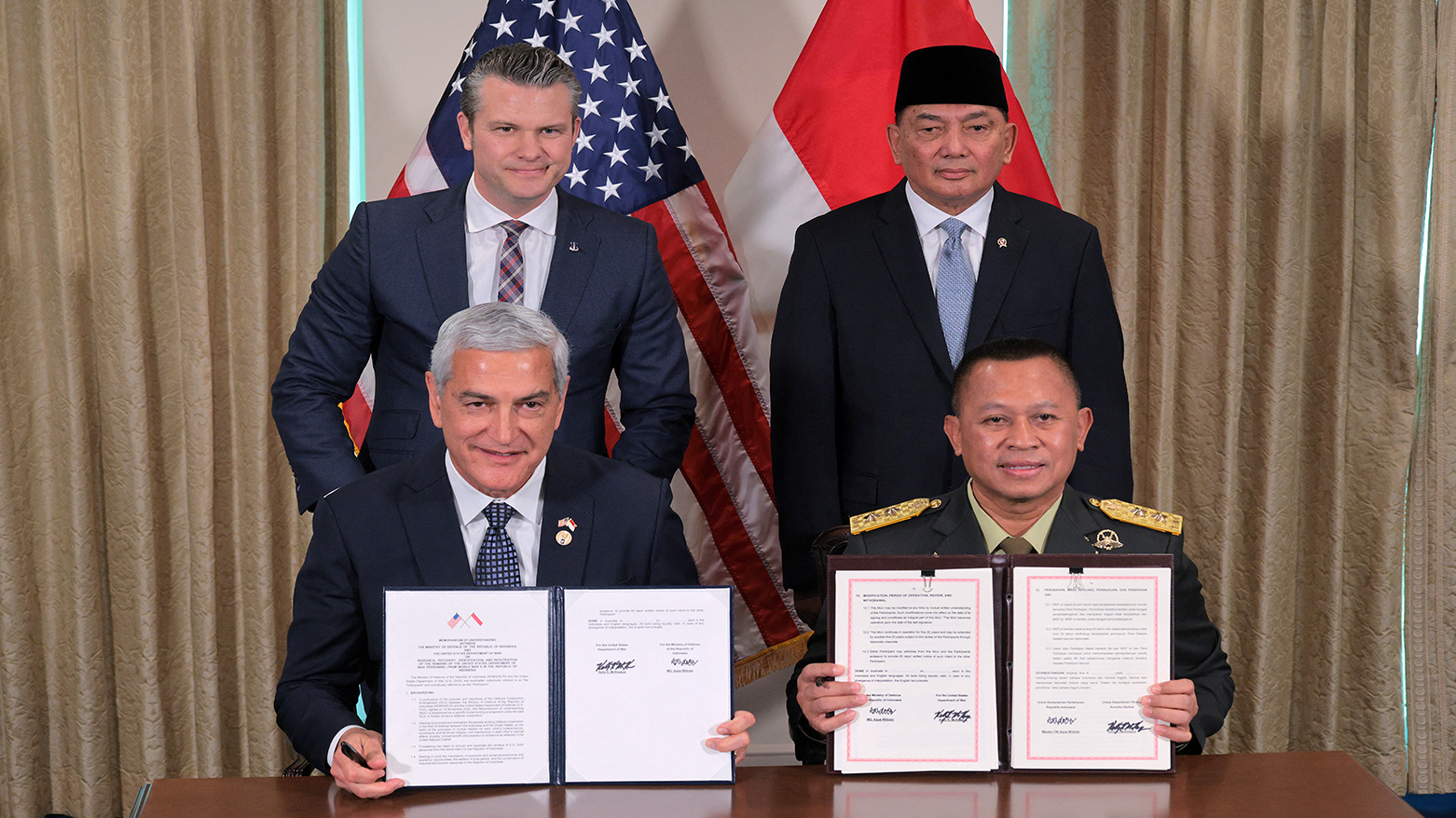
ERBIL (Kurdistan24) — US Defense Secretary Pete Hegseth on Tuesday announced a “major” defense partnership with Indonesia, marking a significant step in Washington’s efforts to deepen security ties in the Indo-Pacific as global power competition accelerates.
Following talks at the Pentagon with his Indonesian counterpart, Hegseth said the two countries would elevate relations to a “Major Defense Cooperation Partnership,” citing the expanding scope and strategic importance of bilateral defense ties.
According to a joint statement, the agreement will focus on military modernization, capacity building, joint exercises, and professional military education, alongside enhanced operational coordination.
Both sides reaffirmed a shared commitment to maintaining peace and stability in the Indo-Pacific—a region increasingly central to global geopolitical competition.
Indonesia, represented by President Prabowo Subianto, welcomed the agreement as an opportunity to strengthen its national defense capabilities, while reiterating its long-standing doctrine of a “free and active” foreign policy.
Jakarta emphasized that any cooperation would remain grounded in national sovereignty and independent decision-making.
Notably, Indonesia confirmed that a US proposal seeking access for American military aircraft over its airspace remains under review, underscoring Jakarta’s cautious approach to deeper military alignment with Washington.
It was an honor to host Indonesian Defense Minister @sjafriesjams at the Pentagon today.
— Secretary of War Pete Hegseth (@SecWar) April 13, 2026
I was proud to announce that we are elevating our relationship to a Major Defense Cooperation Partnership, in recognition of the strength and potential of our bilateral defense ties. pic.twitter.com/eyo3Jh1cWF
Strategic Geography and Military Significance
Indonesia’s importance in the emerging global order is rooted in both geography and capability. As Southeast Asia’s strongest military power, it occupies a pivotal position along the Strait of Malacca—one of the world’s most critical shipping lanes, through which a significant portion of global oil and trade flows.
Control and security of this corridor are vital not only for regional economies but also for global energy markets, making Indonesia a key player in ensuring maritime stability.
For Washington, strengthening defense ties with Jakarta forms part of a broader strategy to counterbalance China’s expanding influence across the Indo-Pacific.
The United States has been actively building a network of security partnerships aimed at preserving freedom of navigation and deterring potential disruptions in key waterways.
Implications for the Global Power Race
Despite the deepening partnership, Indonesia continues to pursue a carefully calibrated foreign policy, balancing relations among major powers.
Jakarta’s recent decision to join the BRICS—alongside China and Russia—highlights its engagement with alternative global economic structures.
At the same time, President Prabowo has maintained close ties with the United States, including signing trade agreements with President Donald Trump and participating in Washington-led diplomatic initiatives.
Indonesia’s parallel outreach to Moscow was also evident this week, as Prabowo held talks with Russian President Vladimir Putin focused on energy cooperation, further illustrating Jakarta’s multi-vector diplomacy.
The newly announced partnership reflects a broader shift toward intensified competition between major powers in shaping the future of the Indo-Pacific.
For the United States, securing closer defense ties with Indonesia strengthens its strategic footprint along vital maritime routes and enhances interoperability with a key regional military.
For Indonesia, the agreement offers access to advanced military training, technology, and institutional development, potentially accelerating the modernization of its armed forces without formally aligning with any single bloc.
At a systemic level, the move underscores the emergence of a more fragmented and multipolar global order, where middle powers like Indonesia play increasingly decisive roles.
Rather than choosing sides outright, such states are leveraging their strategic importance to extract benefits from competing powers while preserving autonomy.
As geopolitical rivalries intensify—from US-China competition to broader alignments involving Russia and emerging economies—the US-Indonesia defense partnership highlights how regional actors are becoming central to the balance of power, shaping not only security dynamics in Asia but also the trajectory of the global order.