SDF Chief Sits Down with Al-Sharaa as Syria Moves to Absorb Kurdish Forces into Its Military
SDF commander Mazloum Abdi met Syrian President Ahmad al-Sharaa in Damascus on April 16 to advance a deal requiring SDF forces to individually merge into Syria's Defense and Interior ministries, a process that has already led to senior Kurdish government appointments.
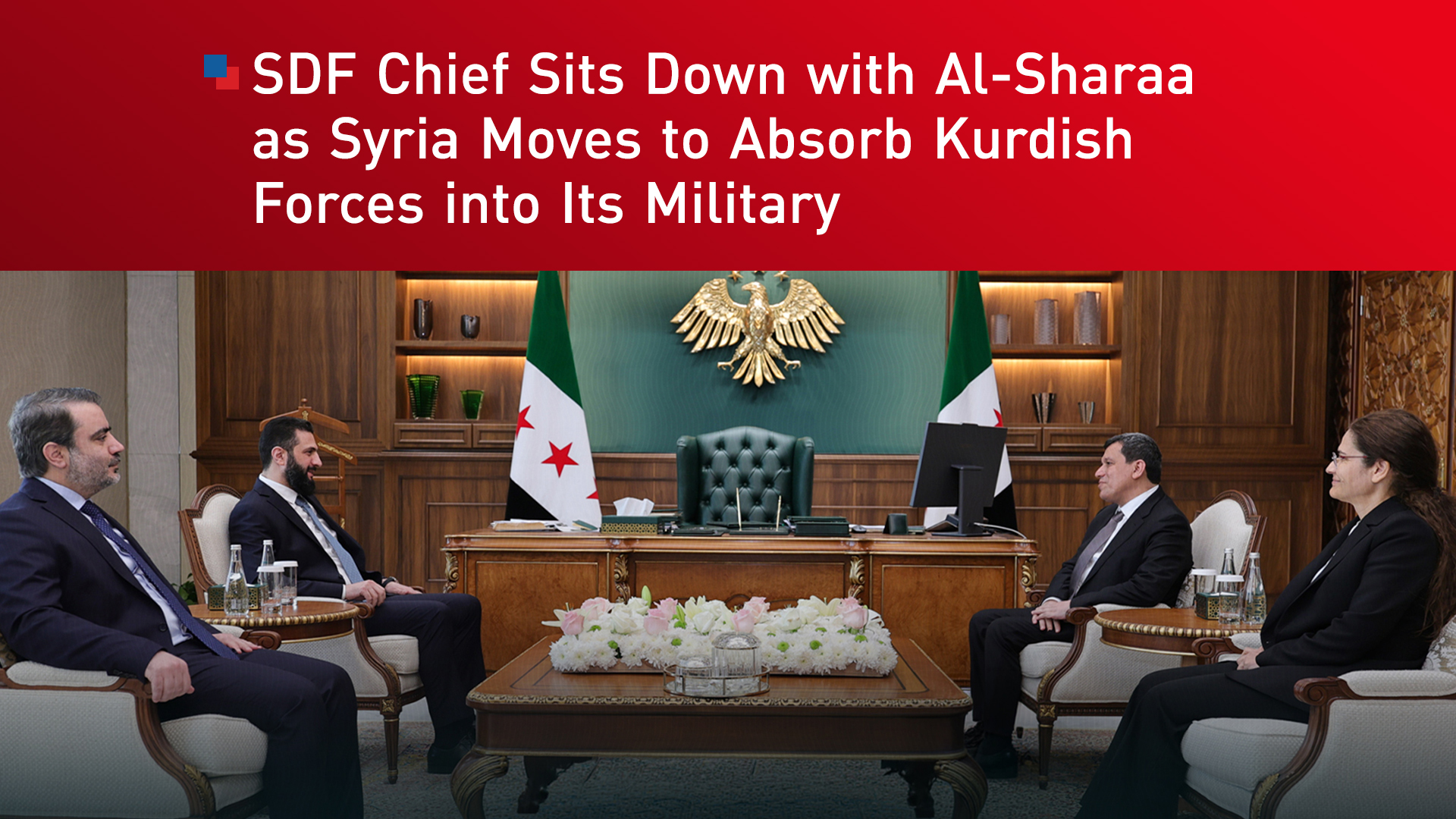
ERBIL (Kurdistan24) - Syria's ongoing effort to bring the Kurdish-led Syrian Democratic Forces (SDF) into the fold of the central state took a significant step forward on Thursday, when Syrian President Ahmad al-Al-Sharaa received SDF commander Mazloum Abdi and senior Kurdish political figure Ilham Ahmed in Damascus.
According to Syria's state news agency SANA, the meeting was held in the presence of Foreign Minister Asaad Hassan al-Shaibani and presidential envoy Ziad al-Ayyash, who is tasked with overseeing the agreement's implementation.
Discussions focused on mechanisms to accelerate the merger of SDF military units and civil administrations into Syria's formal state institutions — a process aimed at ensuring the country's territorial unity and sovereignty.
The road that led here
Thursday's meeting is the latest chapter in a turbulent process that began with armed confrontation before arriving, painfully, at negotiation.
Fighting between the Syrian army and the SDF reignited at the start of this year, following mounting pressure and US-mediated calls for the SDF to withdraw from parts of northeastern Syria (Western Kurdistan) it controls.
Syrian President Al-Sharaa declared Kurdish-majority areas in Aleppo under SDF control "closed military zones" and moved to reclaim them. The SDF responded by shelling army positions, ending months of fragile calm.
On Jan. 16, Syria's Defense Ministry urged SDF fighters to defect and place themselves under the Syrian army's protection.
The same day, Al-Sharaa issued Presidential Decree No. 13, recognizing Kurdish cultural and linguistic rights, acknowledging Kurdish as a national language, and committing to address civil and property rights accumulated over previous decades — a significant symbolic gesture aimed at winning Kurdish public opinion.
A ceasefire agreement of 14 points was announced on Jan. 18, requiring the individual integration of SDF fighters into Syria's Defense and Interior ministries after security vetting, SDF withdrawal to areas east of the Euphrates, and government takeover of border crossings and oil and gas fields.
The agreement also called for the evacuation of heavy military presence from Kobani, the formation of a local security force from the city's own residents, and a commitment by the SDF to expel non-Syrian PKK elements from Syrian territory.
The ceasefire did not hold beyond 24 hours. Fighting resumed near two SDF-run prisons, killing at least nine SDF fighters and allowing around 120 ISIS detainees to escape — most of whom were later recaptured. A new understanding was announced on Jan. 20, reinstating a four-day ceasefire and reaffirming the Jan. 18 agreement.
A more durable arrangement was eventually reached on Jan. 29, forming the basis for the integration process now being implemented.
Kurdish figures enter the Syrian state
The agreement has since produced concrete results. In March, Damascus announced the appointment of Siban Hamo — one of the most prominent Kurdish military commanders and a key figure in the negotiations — as Assistant to the Syrian Minister of Defense for the Eastern Region.
Hamo, originally from Afrin and a founding member of the People's Protection Units (YPG), which formed the backbone of the SDF in its war against ISIS, played a central role in the talks that produced the January agreement.
In February, President Al-Sharaa issued a presidential decree appointing Nour al-Din Ahmad Issa, a Kurdish figure from Qamishlo, as governor of Hasaka province — another provision of the January deal. The agreement also calls for the formation of a military division comprising three SDF brigades within the Syrian army in northeastern Syria, alongside a separate brigade for the Kobani area.
US withdrawal reshapes the landscape
Parallel to the political track, the presence of US forces in Syria has undergone a series of redeployments, culminating in a full withdrawal from key bases.
On Thursday, April 16, Kurdistan24’s correspondent in Syria confirmed that the withdrawal of US forces from the Qasrak military base had been completed, with all forces vacating the site and heading toward Jordan.
According to available information, the Syrian army is set to take control of the base, with the “60th Division” expected to be deployed there. The division is composed in part of former SDF elements, now operating within this structure and tasked with securing the facility.
The Syrian Defense Ministry also announced that its forces had taken over Qasrak airbase in Hasaka countryside following the withdrawal of the US-led coalition.
Phased withdrawal and shifting control
The withdrawal process unfolded in stages. On Feb. 23, 2026, a second US convoy departed from Qasrak toward the Iraqi border, consisting of dozens of military vehicles, including armored units and heavy transport trucks.
Other bases have also seen changes in control. The Shaddadi base had previously been evacuated, partially dismantled, and handed over to Syrian authorities.
The Tal Baydar base, located near Qasrak, had already been vacated, with SDF forces indicating it would be repurposed as a headquarters for one of their brigades.
Following these developments, the Kharab al-Jir base, located between Tal Kocher and Rmelan, remains the only site where US forces are still present.
Thursday's meeting in Damascus suggests the process, however contested, is continuing — with both sides now sitting across a table rather than across a frontline.