'They Were Very Close to Having A Nuclear Weapon Twice,' Says Trump
U.S. President Donald Trump asserted that Iran came close to obtaining a nuclear weapon twice, blaming past U.S. policies for enabling Tehran's ambitions.
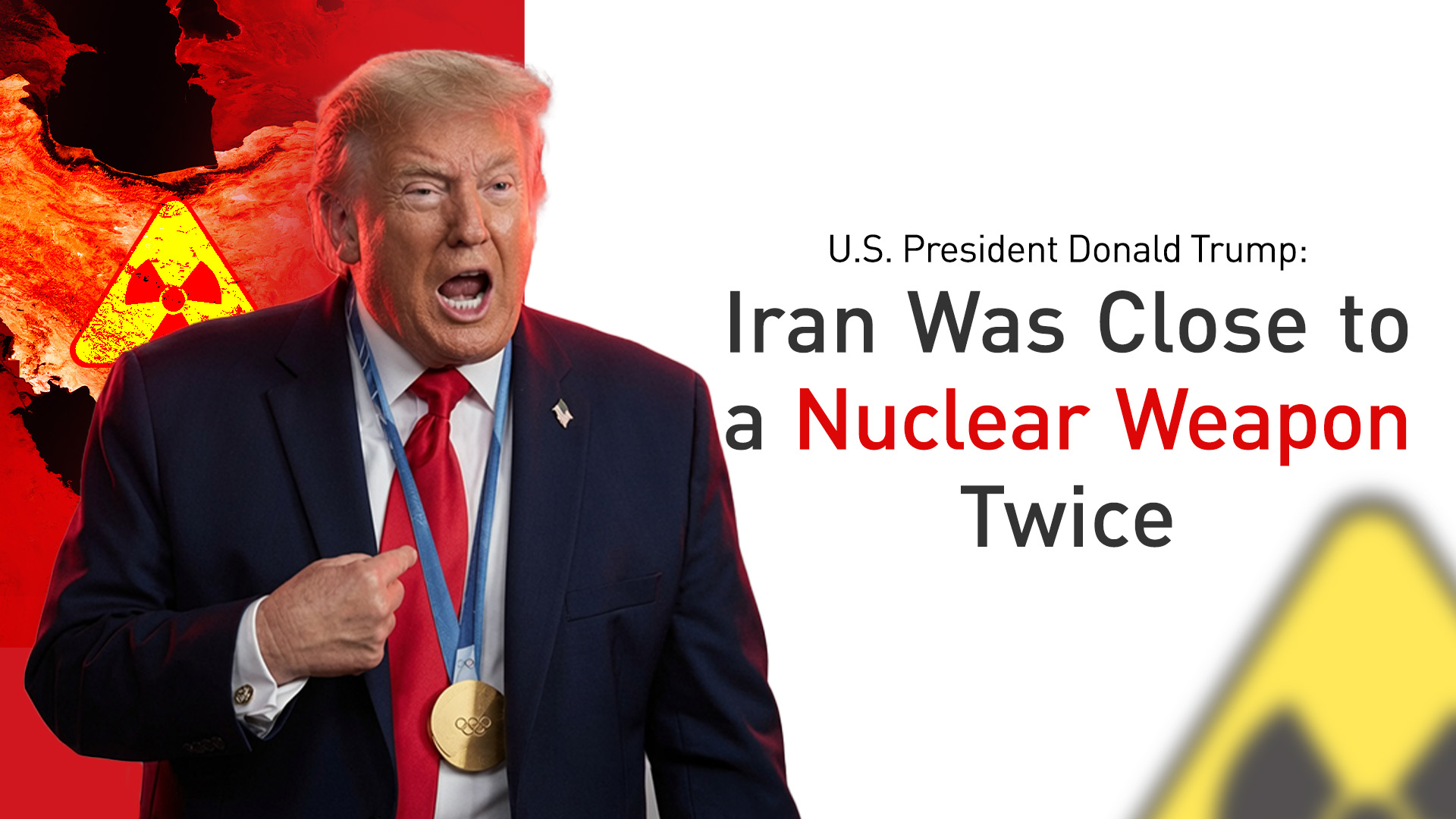
ERBIL (Kurdistan24) - President Donald Trump sharply defended the pace of ongoing negotiations and military operations against Iran, arguing that aggressive American action was necessary because past U.S. administrations had twice allowed Tehran to come dangerously close to obtaining a nuclear weapon.
In an exclusive interview on NBC News' "Meet the Press" with moderator Kristen Welker, Trump offered a blunt assessment of the conflict, which has entered its fourth month.
Asked why Iran has not yet agreed to a comprehensive deal despite intense military and economic pressure, Trump attributed the delay to Iranian pride and the regime's historical ability to outmaneuver past U.S. leadership.
"They're strong, they're proud. There are things they never thought they'd be doing that they're going to have to do," Trump said during the sit-down interview in Chippewa Falls, Wisconsin. "They've got no choice. And it takes a little while."
The Nuclear Argument
The president used the interview, reported by NBC News' Alexandra Marquez, to frame the current confrontation as the inevitable result of decades of foreign policy failures.
He specifically targeted the 2015 Joint Comprehensive Plan of Action (JCPOA), brokered under President Barack Obama, describing it as a "road to a nuclear weapon" rather than a safeguard against one.
"They were very close to having a nuclear weapon twice," Trump claimed, linking one of those instances to the period before he withdrew the United States from the JCPOA during his first term.
"That deal was tantamount to giving them a nuclear weapon... They would have had a nuclear weapon five years ago."
When challenged on why his administration did not immediately secure a replacement agreement after tearing up the 2015 deal, Trump argued that the absence of strict enforcement allowed Tehran to rapidly escalate its enrichment of uranium.
The administration has repeatedly cited preventing Iran from crossing the nuclear threshold as the primary justification for the current military campaign.
Assessing the Battlefield
Trump pushed back forcefully against criticism that the conflict and subsequent negotiations are dragging on, comparing the timeline to prolonged historical engagements.
"I'm moving very fast. I'm into three months. You know, Vietnam lasted 19 years," Trump told Welker. "I'm into my third month, and all I do is say, 'Well, when are you going to win?' If I were a Democrat, nobody would be talking that way."
The president asserted that the U.S. military has fundamentally crippled Iran's conventional capabilities, systematically dismantling its defense infrastructure.
"We have totally destroyed their military," he said, noting that U.S. forces have neutralized the majority of Iran's drone factories, launching pads, and missile manufacturing areas.
However, he acknowledged that Tehran retains a diminished but potent arsenal.
Pressed for specific figures, Trump estimated that Iran possesses "maybe 21 percent, 22 percent of their missiles" compared to its stockpile at the start of the conflict. "It's a lot of missiles. But it's not what it was when we first attacked," he added.
Tensions and Economic Pressures
Trump's remarks come at a highly volatile moment in the standoff. While Washington and Tehran agreed to a ceasefire in April that has been extended multiple times, the arrangement remains fragile.
Recent days have seen sudden escalations, with U.S. and Iranian forces trading strikes near the Strait of Hormuz.
Iran recently demonstrated its remaining capabilities by launching a series of attacks across the Persian Gulf, including strikes that hit Kuwait International Airport.
The U.S. administration maintains that its recent military actions are strictly retaliatory.
According to NBC News, Secretary of State Marco Rubio told lawmakers earlier in the week that "Operation Epic Fury" had officially concluded, characterizing the latest U.S. strikes as a necessary response to Iranian attacks on shipping.
"These are completely defensive in nature," Rubio said. "If they don't shoot at those ships, we don't shoot, but we have to respond."
The ongoing disruptions around the Strait of Hormuz, a vital maritime chokepoint, continue to exert immense pressure on the global economy.
Iran's closure of the strait has sparked soaring international oil prices and rising gas costs domestically, creating political headwinds for Trump and Republican leaders demanding a swift resolution.
Despite these economic pressures, Trump suggested that the current strategy of blockade and sanctions may eventually run its course.
In a separate podcast interview earlier in the week, he noted that the U.S. blockade on Iran would "unlikely" remain in place by late summer.
Yet, the president also issued a stark warning regarding the failure of diplomacy.
Suggesting that the U.S. retains alternative options if Tehran refuses to finalize an agreement, Trump presented a grim binary choice: "Do we sign a deal or we do it the other way? And the other way is not nice."
|
Summary President Trump estimated that Iran retains roughly a fifth of its missile stockpile after three months of conflict, while defending the pace of ongoing negotiations aimed at securing a final agreement. President Donald Trump asserted that Iran came close to obtaining a nuclear weapon twice, blaming past U.S. policies for enabling Tehran's ambitions. In an interview with NBC News, Trump defended the ongoing conflict and negotiations, estimating that Iran's missile stockpile has been severely degraded. |