Kurdistan Region President Nechirvan Barzani Backs US-Iran Agreement, Welcomes US Envoy
In an exclusive statement to Kurdistan24, Kurdistan Region President emphasized the necessity of the agreement's swift implementation to ensure a conflict-free environment and greater stability for the region's populations.
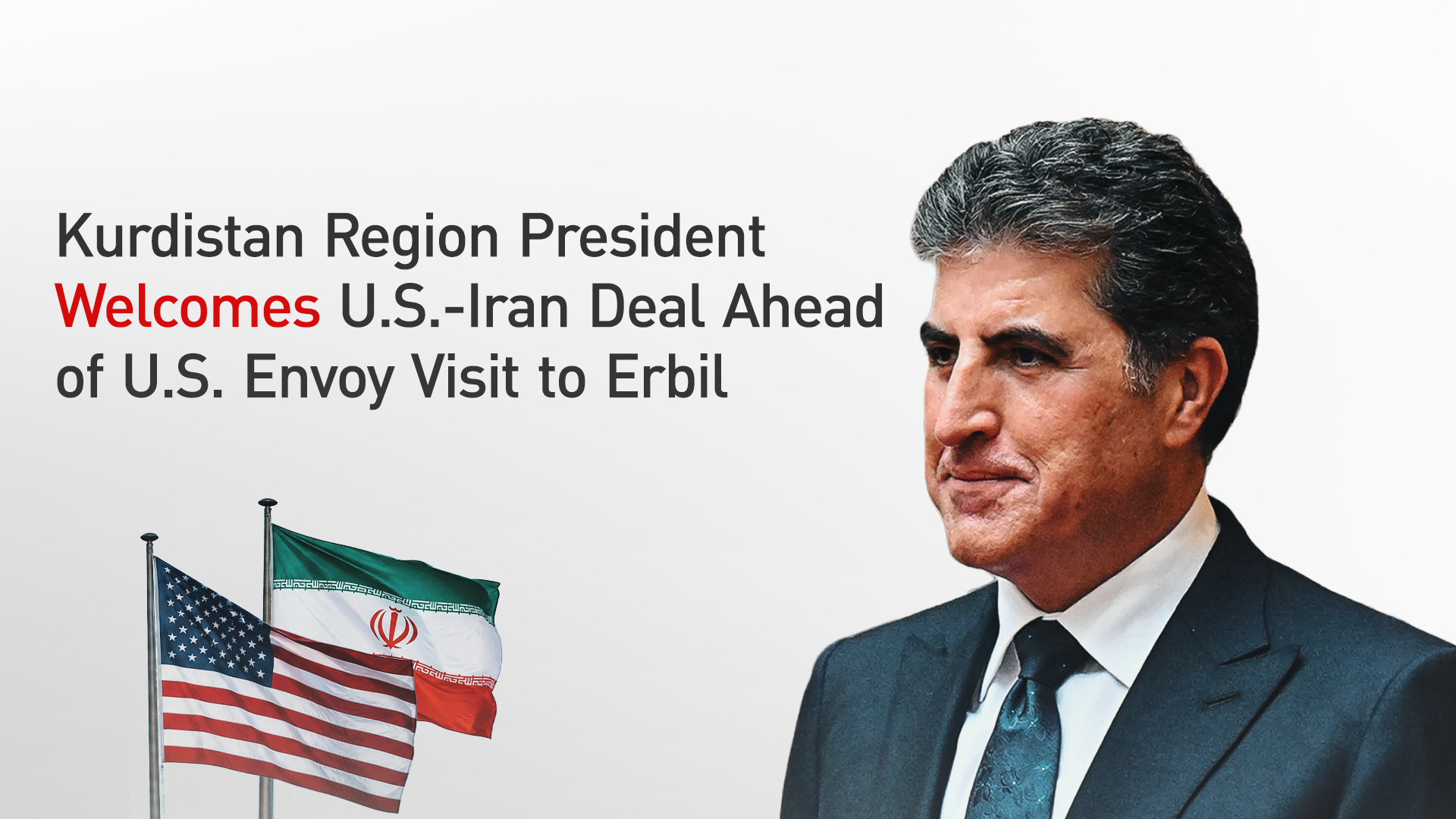
ERBIL (Kurdistan24) - Kurdistan Region President Nechirvan Barzani signaled a major diplomatic opening for the Kurdistan Region on Monday, expressing full support for a sweeping U.S.-Iran agreement while detailing the high-stakes agenda awaiting U.S. Special Envoy Tom Barrack in Erbil and Baghdad. The upcoming visit represents a significant moment of recalibration for Washington's policy in the Middle East, occurring just as the region attempts to emerge from months of intense military escalation.
In an exclusive statement provided to Kurdistan24 on Monday, President Barzani characterized the arrival of Ambassador Barrack, his first official trip to Erbil in his capacity as the U.S. Presidential Special Envoy for Iraq and Syria, as a critical inflection point.
The President indicated that the visit, scheduled for Tuesday, June 16, will serve as a platform for a wide-ranging dialogue intended to foster deeper coordination among regional and federal stakeholders in the wake of a historic diplomatic breakthrough between Washington and Tehran.
A Tectonic Shift in Regional Diplomacy
The President's optimism is rooted in the "historic and comprehensive" accord concluded between the United States and Iran earlier this week.
The agreement, which aims to end a conflict that has rattled global energy markets and claimed thousands of lives since February, includes a permanent cessation of hostilities in Lebanon and the reopening of the strategically vital Strait of Hormuz.
In a public message shared via his official X account, President Barzani welcomed the announcement of the deal, framing it as an essential step toward long-term security.
He urged all participating nations to implement the terms in good faith, emphasizing that the ultimate goal is a region where prosperity can prevail for all its peoples.
He also extended his appreciation to the international mediators who facilitated the breakthrough.
"I extend my sincere appreciation to all those who played a role in facilitating and supporting this achievement," the President stated.
I welcome the announcement of the deal between the United States and Iran.
— Nechirvan Barzani (@IKRPresident) June 15, 2026
I hope all parties will work in good faith toward the full implementation of the agreement, aiming to strengthen regional stability, security, and prosperity.
I extend my sincere appreciation to all…
The geopolitical significance of the agreement was immediately reflected in global financial centers.
As news of the potential reopening of the Strait of Hormuz spread, oil prices fell sharply in Asian trading, while major stock indices responded with a surge of investor confidence.
For the Kurdistan Region, which has faced significant economic and security pressures throughout the four-month conflict, the prospect of a stabilized energy market and a conflict-free regional corridor is viewed as a vital economic lifeline.
Barrack's Agenda: From De-escalation to Coordination
The visit of Tom Barrack to Erbil and Baghdad is expected to focus on the practicalities of this new regional order.
According to President Barzani's exclusive remarks to Kurdistan24 correspondent Hoshmand Sadiq, the discussions will encompass the full spectrum of political, security, and economic issues affecting both the Kurdistan Region and federal Iraq.
A primary objective for Washington appears to be ensuring that the de-escalation framework reached in the U.S.-Iran talks is mirrored by strengthened coordination between Erbil and Baghdad.
The U.S. envoy is expected to facilitate dialogue on several unresolved files, including the management of energy resources and the security architecture required to protect critical infrastructure as the regional war ends.
Observers suggest that Barrack's mission will also involve providing reassurances to America's regional partners.
While the U.S.-Iran agreement includes provisions for the release of $24 billion in frozen Iranian assets and a 60-day window for final negotiations over Tehran's nuclear program, many regional actors remain cautious about the long-term durability of the truce.
Amb. Barrack's presence in Erbil serves to reinforce the message that the United States remains deeply invested in the stability and sovereignty of the Kurdistan Region as a cornerstone of its Middle East strategy.
Internal Unity as a Strategic Prerequisite
Crucially, President Barzani linked the success of this international diplomacy to the necessity of internal political cohesion.
He utilized the interview to address the ongoing political dialogue within the Kurdistan Region, specifically citing the recent initiative proposed by Kurdish leader President Masoud Barzani to resolve the regional government-formation deadlock.
The President affirmed that the initiative is "timely and appropriate," noting that the Presidency remains in constant communication with all political factions to advance the process.
In his view, a unified Kurdish political front is not merely a domestic requirement but a strategic prerequisite for effectively engaging with Baghdad and international partners like the United States during this transformative period.
As the diplomatic focus shifts toward Switzerland, where the U.S.-Iran agreement is scheduled for its formal signing on Friday, the arrival of Tom Barrack in Erbil marks the beginning of a new chapter in U.S.-Kurdistan relations.
For President Nechirvan Barzani, the visit represents an opportunity to transition away from the "dark corridor" of the recent conflict toward a future defined by institutional coordination and regional peace.
The coming days of high-level meetings in Erbil and Baghdad will likely determine how the Kurdistan Region positions itself within the new Middle Eastern architecture.
By championing both the international peace process and domestic reconciliation, the Kurdistan Region President is positioning Kurdistan as a proactive partner in the broader effort to secure a stable and prosperous future for the region.
|
Summary President Nechirvan Barzani welcomed the U.S.-Iran deal and detailed the high-stakes agenda for U.S. Envoy Tom Barrack's visit to Erbil and Baghdad. The President emphasized regional stability and the need for internal Kurdish unity as the Middle East transitions toward a permanent ceasefire. |
This article was updated on Monday, June 15, 2026, at 12:09pm.