Between the River and the Renaissance: Zaxo's Ascent as a Cultural Citadel
In the shadow of the ancient Delal Bridge, a city once defined by its border-post status is recasting itself through a prism of strategic modernization and archaeological discovery, anchored by a new museum that bridges ten millennia of history.
ERBIL (Kurdistan24) - For centuries, the waters of the Khabur River have whispered past the stone foundations of the Delal Bridge, carrying the secrets of the countless empires that have vied for control over this strategic gateway. Yet today, the air in Zaxo (Zakho) is filled with a different sound: the vibrant hum of a city in the midst of a profound architectural and cultural renaissance.
Once viewed primarily as a pragmatic transit point between the northern and southern reaches of Kurdistan, the frontier between Iraq and Türkiye, Zaxo has emerged from a comprehensive modernization campaign with a new identity as a sophisticated guardian of antiquity.
This transformation is not merely aesthetic; it is a calculated effort to weave the city's immense archaeological depth into its modern civic fabric.
From the sprawling new corniche that lines the riverbanks to the bustling, refurbished historic bazaar, Zaxo is signaling to the world that it is no longer just a place to pass through, but a place to remain.
The Anchor of the Rebirth
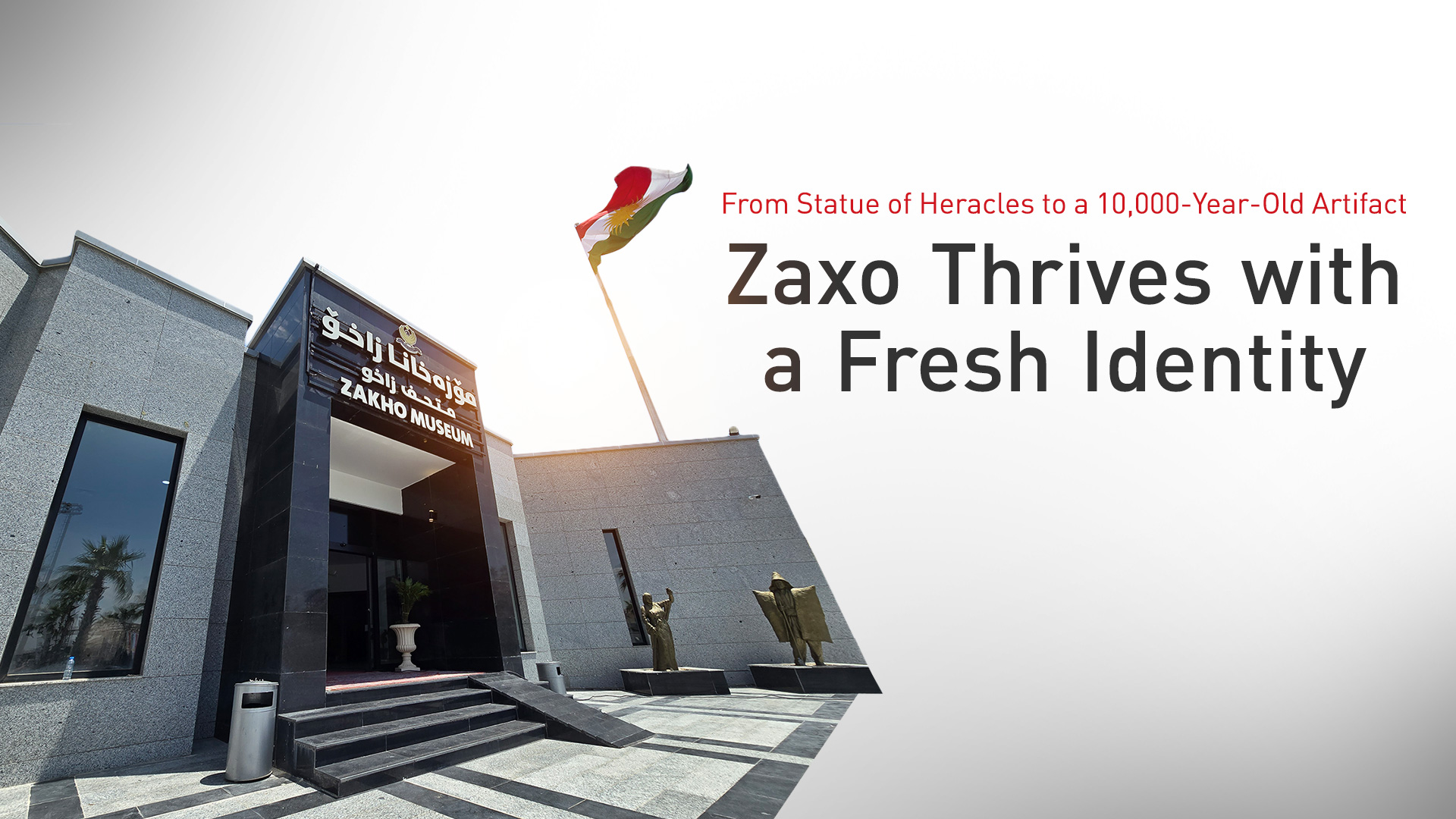
At the heart of this urban evolution sits the Zaxo Museum, a structure that has quickly become a landmark of Kurdish heritage preservation.
Inaugurated on Feb. 15, 2024, the museum was established by a decree from Kurdistan Region Prime Minister Masrour Barzani.
Under the close supervision of Guhdar Shekho, the Head of the Zaxo Independent Administration, the project was envisioned as the intellectual and cultural anchor for the city's broader reconstruction.
Managed by Lana Abdulsalam Ezzat, the institution operates with a level of accessibility that reflects its role as a public education platform.
Open seven days a week from the morning until midnight, the museum seeks to democratize history for a population increasingly curious about its roots.
"Our team of specialized experts and staff are fully prepared to receive visitors and answer any historical inquiries they may have," Ezzat told Kurdistan24's journalist Kawa Jam.
She emphasizes that the museum serves as a critical stage for the "accurate introduction" of the region's complex history to both locals and international observers.
A Journey Through the Human Story
The museum's interior is meticulously divided into two distinct realms: Archaeology and Ethnography. Entering the archaeological wing is a visceral experience in chronological travel. Within its walls, 300 invaluable artifacts chart the trajectory of human civilization in Mesopotamia.
The crown jewel of the collection is the "Obsidian Stone." Dating back nearly 10,000 years to the Neolithic era, the artifact serves as a silent witness to the dawn of settled life in the region.
The gallery further unfolds into a vivid tableau of subsequent eras, displaying significant relics from the Hellenistic period, the Assyrian Empire, and the Mitanni civilization, the latter of which remains one of the most intriguing and least understood powers of the ancient Near East.
Among the 300 pieces, three rare finds have become the focus of intense visitor interest: a statue of the mythological hero Heracles (Hercules), the "Mother Statue," and a massive sarcophagus-style grave dating back to 3,000 BCE.
Mohammed Ahmed, Director of the Zaxo Antiquities Department, offers a compelling narrative for these pieces.
The Heracles statue, he notes, likely traces its origins to the Roman military campaigns that once pierced deep into Mesopotamia.
Discovered near the city alongside ancient skeletal remains, the statue's diminutive scale and intricate craftsmanship suggest it may have been a personal votive or a portable talisman for a Roman officer.
The "Mother Statue" offers an even deeper psychological connection to the land.
Ahmed explains to Kurdistan24 that such figurines have been unearthed across the broader Kurdistan Region, representing a prehistoric era where the "Mother" was venerated as the primary source of life and the fundamental manifestation of existence.
These artifacts provide a tangible link between the spiritual life of ancient inhabitants and the modern Kurdish reverence for the land and the family.
The Miniature Zaxo
While the archaeological wing deals in millennia, the ethnographic section focuses on the textured reality of the last several centuries. This part of the museum functions as a comprehensive mirror of local social and cultural life.
It features a curated selection of authentic Kurdish attire, antique weaponry used in regional defense, and traditional agricultural tools that once tilled the fertile valleys surrounding the Khabur.
Crucially, the ethnographic displays also highlight the city's historical identity as a mosaic of faiths.
Artifacts representing the peaceful coexistence between various religious and ethnic communities, Muslims, Christians, and Jews who once thrived in the Zaxo bazaar, are presented as a central tenet of the city's heritage.
In this sense, Ezzat describes the museum as a "miniature Zaxo" encapsulated within four walls, offering a blueprint for the tolerance the city hopes to project in the 21st century.
The Economic Engine of Culture
The rebirth of Zaxo as a cultural hub is yielding more than just intellectual dividends; it has become a powerful economic driver. The city's transition into an independent administration has allowed for an acceleration of development that is reflected in the tourism data.
"Before Zaxo became an independent administration and its development was accelerated, the city received approximately 400,000 tourists annually," Biwar Omar Fattah, Director of Public Relations and Media for the Zaxo Tourism Directorate, informed Kurdistan24. "Today, that figure has more than doubled."
The Zaxo Museum has proved to be a cornerstone of this surge. While visitor numbers vary between the seasons, Fattah notes that the museum experiences its peak attendance during the summer months, as families from across the Kurdistan Region and abroad seek out the cooler northern climates and the city's new amenities.
The museum's success illustrates a broader regional trend: the "commodification" of history as a sustainable alternative to traditional resource-based economies. By investing in its past, Zaxo has secured a new revenue stream for its future.
A Bridge Between Eras
As the sun sets over the Khabur River, the silhouette of the Delal Bridge remains the city's most iconic image. But today, it is joined by the modern profile of a city that has reclaimed its narrative.
Zaxo is no longer just a dot on a map of trade routes; it is a living laboratory of cultural endurance.
The Zaxo Museum is far more than a simple repository for broken pots and weathered statues.
It is a manifestation of civic pride and a sturdy, modern bridge connecting a formidable past to a bright, revitalized future.
In the eyes of the KRG leadership and the people of Zaxo, the city's rebirth serves as a powerful reminder that while empires may rise and fall like the river's tides, the history of this land is an indestructible foundation upon which a new, modern Kurdistan is being built.
|
Summary Zaxo is undergoing a historic rebirth, transforming from a border outpost into a sophisticated cultural hub. Anchored by the new Zaxo Museum and a doubling of tourist arrivals, the city's revitalization combines ancient Mesopotamian heritage with a bold vision for modern Kurdish identity. |
Kurdistan24's journalist, Kawa Jam, contributed to this report.