Erdogan Calls Iraqi Kurds "Brothers," Advances Historic Peace Bill, and Vows to Visit Syria
Turkish president delivers his most sweeping statement on Kurdish relations in decades, pairing domestic peace legislation with praise for Iraqi Kurdish neutrality and a pledge to visit Damascus personally
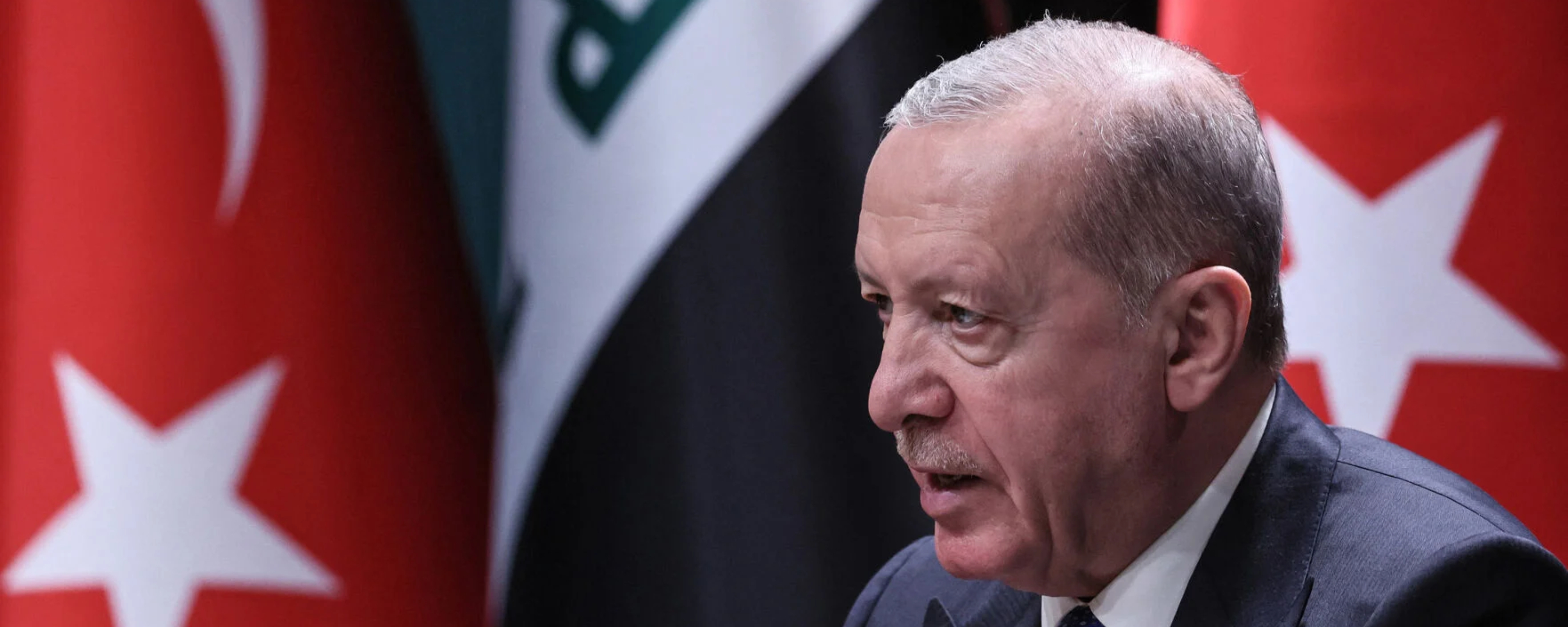
ERBIL (Kurdistan 24) - Turkish President Recep Tayyip Erdogan delivered what may be his most significant public statement on the Kurdish question in decades in a wide-ranging interview with Al Jazeera, pairing historic domestic peace legislation with warm praise for Iraqi Kurds, an announcement of a personal visit to Syria, and endorsement of the Makkah agreement's collective defense framework, in remarks that together signal a fundamental repositioning of Türkiye's relationship with Kurdish communities across the region.
Erdogan's Historic Shift on the Kurds
The most consequential element of Erdogan's Al Jazeera interview was his language on the Kurds, which departed sharply from the hardline posture that has defined Ankara's approach to Kurdish political identity for much of the past two decades. Erdogan praised Iraqi Kurds as "our brothers," commending the Kurdistan Region's leadership for its refusal to be drawn into the US-Iran war and for not allowing Kurdish territory to be used as a launch pad for attacks on neighboring countries.
"Greater strife that could have harmed our Kurdish brothers and sisters has been prevented," Erdogan said, as Middle East Eye confirmed on June 25, 2026. He went further, framing the outcome of the regional conflict as a shared achievement that transcended national and ethnic boundaries. "It will become much clearer just how bloody and insidious a scheme we have thwarted together as Turks, Kurds, Arabs and Iranians," he said, placing Kurds explicitly alongside Turks as co-authors of a regional security outcome rather than as a threat to be managed.
The language is striking in its historical context. For most of Erdogan's more than two decades in power, Ankara framed Kurdish political movements, whether in Türkiye, Iraq, or Syria, primarily through the lens of the PKK's armed campaign and the threat it posed to Turkish territorial integrity. The characterization of Iraqi Kurds as brothers who thwarted a scheme together with Turks represents a qualitative shift in that framing, one that has direct implications for the KRG's relationship with Ankara and for the broader question of how Türkiye positions itself toward Kurdish governance structures across the region.
The Historic Peace Bill: Pardons, Legislation, and Walking Together
Erdogan's words toward the Kurds in the interview are inseparable from the most significant domestic Kurdish policy development of his entire tenure. His ruling AKP party filed a bill in the Turkish parliament on Wednesday, August 5, 2026, to advance a peace initiative aimed at ending the decades-long armed conflict with Kurdish militants, including a provision for an effective pardon for former PKK fighters, as the Washington Post confirmed on the same date.
In language that would have been politically inconceivable from the same leader who spent years branding pro-Kurdish parties as terrorist extensions, Erdogan declared that his ruling coalition will "walk together" with pro-Kurdish lawmakers in parliament to pass the legislation. The formulation signals not merely a policy change but a fundamental realignment in how Erdogan views the role of Kurdish political representation within Türkiye's democratic institutions.
The peace bill represents the most concrete legislative step yet toward formalizing the transformation that began when PKK founder and leader Abdullah Ocalan, imprisoned on an island in the Marmara Sea since 1999, ordered the group to disband and end its armed struggle. The PKK subsequently destroyed its weapons in a ceremony held in Sulaimani in the Kurdistan Region of Iraq on July 11, 2025, bringing a formal end to a four-decade armed campaign that claimed more than 40,000 lives and consumed enormous resources on both sides of the conflict.
Making peace with the PKK, something no Turkish leader managed across four decades of warfare, is a singular political achievement for Erdogan, one that frees Türkiye from the burden of an exhausting, expensive conflict and gives Ankara the strategic bandwidth to focus on its growing ambitions as a regional powerhouse. His willingness to legislate a pardon framework and build a cross-party Kurdish coalition to pass it reflects both the political space opened by Ocalan's historic order and Erdogan's own calculation that consolidating peace with the Kurds will further cement his grip on Türkiye's political landscape ahead of any future constitutional changes.
Syria: "We Will Not Leave It Alone"
Erdogan also announced a personal visit to Syria in the near future, pledging that Ankara will do everything in its power to support the country's stability. "I will visit Syria in the coming period," he told Al Jazeera. "Syria will not be left alone, and we will do everything in our power to support its stability."
A personal visit to Damascus would mark the highest-level Turkish engagement with Syria since Assad's fall, signaling that Ankara views the new Syrian governing authorities as legitimate interlocutors worthy of head-of-state diplomacy. Türkiye hosts the world's largest Syrian refugee population, estimated at between three and four million people, giving Erdogan a direct political and economic stake in Syria achieving the stability needed for large-scale voluntary return. The visit, when it takes place, will also carry a message to the Kurdish-led areas of northeastern Syria, where Türkiye has consistently pressed for the integration of the Syrian Democratic Forces into Syrian state structures, a process Erdogan said in February 2026 he is closely monitoring and providing guidance on.
The Makkah Agreement: A Message to the World
Erdogan also praised the Makkah agreement in the interview, describing it as sending a message of profound significance that extends beyond its immediate signatories. "The Makkah agreement sends an important message to the world, and calls on the signatory countries to take unified steps if one of them is subjected to an external attack," he said.
His endorsement of the agreement's collective defense dimension positions Ankara as a supporter of the emerging Gulf-led architecture of regional security cooperation and reflects Türkiye's broader alignment with the post-Iran war regional order being constructed by Saudi Arabia and the Organization of Islamic Cooperation.
A Regional Vision Centered on Kurdish Reconciliation
Taken together, Erdogan's Al Jazeera interview describes a Turkish president who has placed the Kurdish question, domestic and regional, at the heart of a foreign policy vision that is more confident, more engaged, and more personally invested than at any previous point in his tenure. The peace bill, the praise for Iraqi Kurdish neutrality, the Syria visit, and the Makkah endorsement are not separate stories. They are components of a single strategic posture in which Erdogan is attempting to transform the Kurdish relationship from Türkiye's most persistent liability into one of its most powerful regional assets.
Whether that transformation proves durable, or whether it follows the pattern of Erdogan's previous Kurdish peace initiatives, all of which ultimately collapsed, will depend on whether the legislative, diplomatic, and personal gestures of this moment are backed by the institutional and constitutional reforms that Kurdish political leaders have consistently identified as the minimum conditions for a genuine and lasting settlement.