Washington Signals Strategic Reset in Erbil as U.S. Envoy Urges End to Kurdish Political Deadlock
During the meeting U.S. Presidential Envoy Tom Barrack explicitly conveyed that U.S. President Donald Trump holds deep respect for the Kurdish people, the Kurdistan Region, and the historic leadership of President Masoud Barzani.
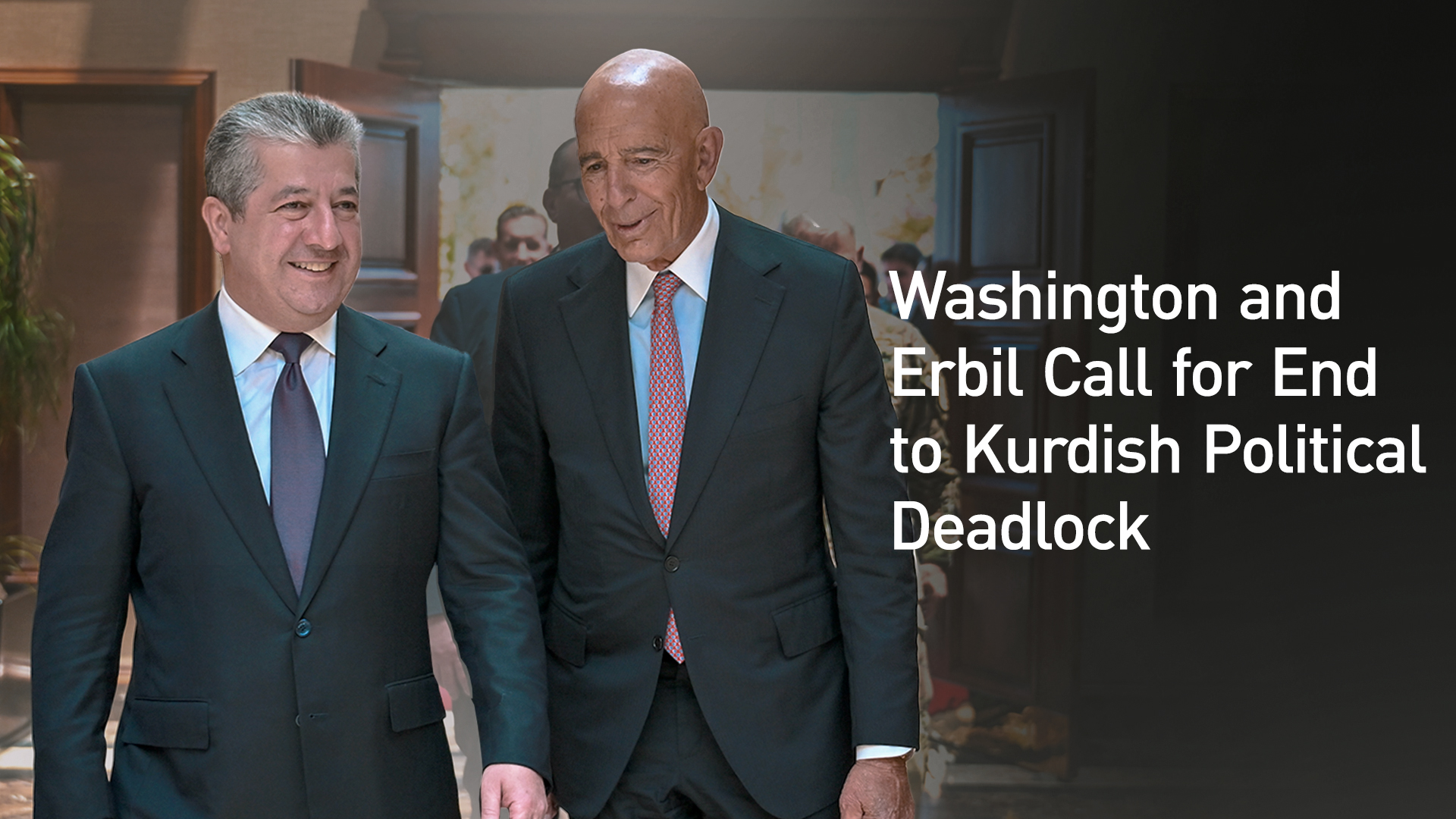
ERBIL (Kurdistan24) - Against the backdrop of a major diplomatic realignment in the Middle East, a high-level American delegation led by U.S. Presidential Special Envoy Tom Barrack arrived in Erbil on Tuesday, to engage in critical security and political consultations with Kurdistan Regional Government (KRG) Prime Minister Masrour Barzani.
The meeting marks a key moment in Washington's evolving posture toward Iraq and the broader region, arriving just as the international community processes a landmark diplomatic breakthrough between the United States and Iran.
According to information obtained by Kurdistan24, the discussions prioritized resolving the lingering political gridlock within the Kurdistan Region, cementing Erbil-Baghdad cooperation, and charting a proactive economic and security agenda for the post-conflict era.
The Erbil summit featured prominent figures from both administrations, signaling the immense weight Washington places on the stability of the Kurdistan Region.
Joining Envoy Barrack, who concurrently serves as the U.S. Ambassador to Türkiye, were Joshua Harris, Chargé d'Affaires of the U.S. Embassy in Baghdad, and Major General Kevin Lambert, Commanding General of the Special Operations Joint Task Force-Operation Inherent Resolve (OIR).
Together, the officials analyzed the delicate security matrix spanning the Kurdistan Region, federal Iraq, and the wider Middle East, parsing the opportunities presented by a rapidly shifting geopolitical landscape.
Breaking the Political Deadlock in Erbil
A central pillar of the high-stakes dialogue focused directly on the domestic governance of the Kurdistan Region.
Following months of institutional inertia, Prime Minister Masrour Barzani and Envoy Barrack reached a strong consensus on the absolute urgency of reactivating the Kurdistan Parliament and accelerating the formation of the next regional cabinet.
Kurdistan24 has learned that both leaders emphasized that overcoming the current political stalemate is an immediate priority, essential not only for internal stability but also for reinforcing the Kurdistan Region's leverage on the international stage.
During the proceedings, Prime Minister Barzani expressed profound gratitude for Washington's enduring security and political support, noting that a consolidated Kurdish government is foundational to the region's long-term resilience.
For his part, Envoy Barrack praised the KRG's ongoing development, governance initiatives, and reconstruction efforts. Amb. Barrack explicitly conveyed that U.S. President Donald Trump holds deep respect for the Kurdish people, the Kurdistan Region, and the historic leadership of President Masoud Barzani.
The envoy's visit is widely interpreted by regional analysts as an intentional American endorsement of the KRG's institutional continuity, providing critical diplomatic momentum as Erbil works through its internal political fractions.
A New Blueprint for Economic and Energy Cooperation
Beyond the immediate concerns of local governance, the Erbil consultations delved extensively into expanding the commercial and strategic architecture connecting Washington, Baghdad, and Erbil.
The delegates underscored a shared desire to significantly increase the footprint of American enterprises in the regional market, particularly within the lucrative and vital energy sector.
This economic push coincides with a dramatic shift in global financial metrics; Information obtained by Kurdistan24 indicates that a recent comprehensive accord between the U.S. and Iran has already triggered a sharp drop in oil prices across Asian trading floors while rejuvenating investor confidence globally.
For the Kurdistan Region, which has long borne the brunt of regional economic volatility, anchoring American corporate commitment is viewed as an indispensable economic lifeline.
The conversations emphasized that true stability cannot rely solely on security agreements; it requires a deep, institutionalized financial partnership. Both parties agreed that robust trade ties and American technical investments in critical infrastructure would insulate the regional economy against future shocks.
The Broader Diplomatic Mission: From Baghdad to Erbil
Envoy Barrack's arrival in Erbil represents the second leg of an ambitious, multi-city diplomatic tour designed to fundamentally reshape American foreign policy in the region.
On Monday, Amb. Barrack initiated his mission in Baghdad, meeting with Iraqi Prime Minister Ali al-Zaidi to deliver an official message of support from the Trump administration.
Read More: Iraq, U.S. Reaffirm Strategic Partnership, Discuss Security, Energy, and Investment Cooperation
According to Kurdistan24 correspondents, the White House is seeking to transition away from the reactive security postures of previous years toward an interest-based, proactive partnership focused on the consolidation of Iraqi state authority.
Crucially, both Envoy Barrack and Prime Minister Masrour Barzani stressed the necessity of backing Prime Minister al-Zaidi's newly established federal government.
The leaders noted that a stable administration in Baghdad is vital for equitable economic growth that serves all of Iraq's diverse ethnic components.
Furthermore, the delegation reiterated that long-standing, unresolved disputes between Erbil and the federal government must be systematically settled through structured dialogue, strictly in accordance with the Iraqi Constitution.
Read More: U.S. Envoy Barrack Launches Iraq Diplomacy Push on Baghdad-Erbil Visit
This dual focus highlights Washington's strategy to use its diplomatic leverage to anchor Baghdad and Erbil as complementary pillars of a unified, stable state capable of deterring non-state actors.
Geopolitical Realignments and the Imperative of Kurdish Unity
The broader regional backdrop lends a profound sense of urgency to Barrack's first official visit to Erbil as special envoy.
The high-level talks occurred just as the Middle East begins navigating the implementation of a sweeping U.S.-Iran agreement, which includes a permanent cessation of hostilities in Lebanon and the reopening of the strategic Strait of Hormuz.
In an exclusive statement provided to Kurdistan24 correspondent Hoshmand Sadiq, Kurdistan Region President Nechirvan Barzani voiced his unreserved endorsement of the diplomatic breakthrough, calling it an essential framework for establishing a conflict-free environment.
Read More: Kurdistan Region President Nechirvan Barzani Backs US-Iran Agreement, Welcomes US Envoy
President Nechirvan Barzani noted that the impending formal signing of the accord in Switzerland represents a major transition point. However, Kurdish leaders recognize that international diplomacy cannot succeed in a vacuum.
In his remarks to Kurdistan24, the President linked international progress directly to domestic cohesion, praising a recent initiative launched by Kurdish leader Masoud Barzani to mend internal political rifts.
"A unified Kurdish political front is not merely a domestic requirement but a strategic prerequisite for effectively engaging with Baghdad and international partners like the United States during this transformative period," President Nechirvan Barzani asserted.
As Envoy Barrack prepares for subsequent individual audiences with both President Masoud Barzani and Kurdistan Region President Nechirvan Barzani, the diplomatic roadmap is clear. Washington's "new direction" for the region demands institutional reliability.
By positioning the Kurdistan Region as a proactive participant in both global economic stabilization and regional defense coordination alongside OIR forces, the KRG leadership aims to secure a prosperous, stable future amidst the crumbling structures of past regional conflicts.
|
Summary KRG Prime Minister Masrour Barzani and U.S. Envoy Tom Barrack met in Erbil to discuss regional stability and a "new direction" for ties. They emphasized the urgent need to reactivate the Kurdistan Parliament and form a new cabinet, signaling a major U.S. push for Kurdish political unity. |