'Friends Being Honest With Friends': Hegseth Pushes NATO to Do More on Defense Spending
Hegseth urges candid burden-sharing talks as Europe accelerates military investment ahead of key Trump summit
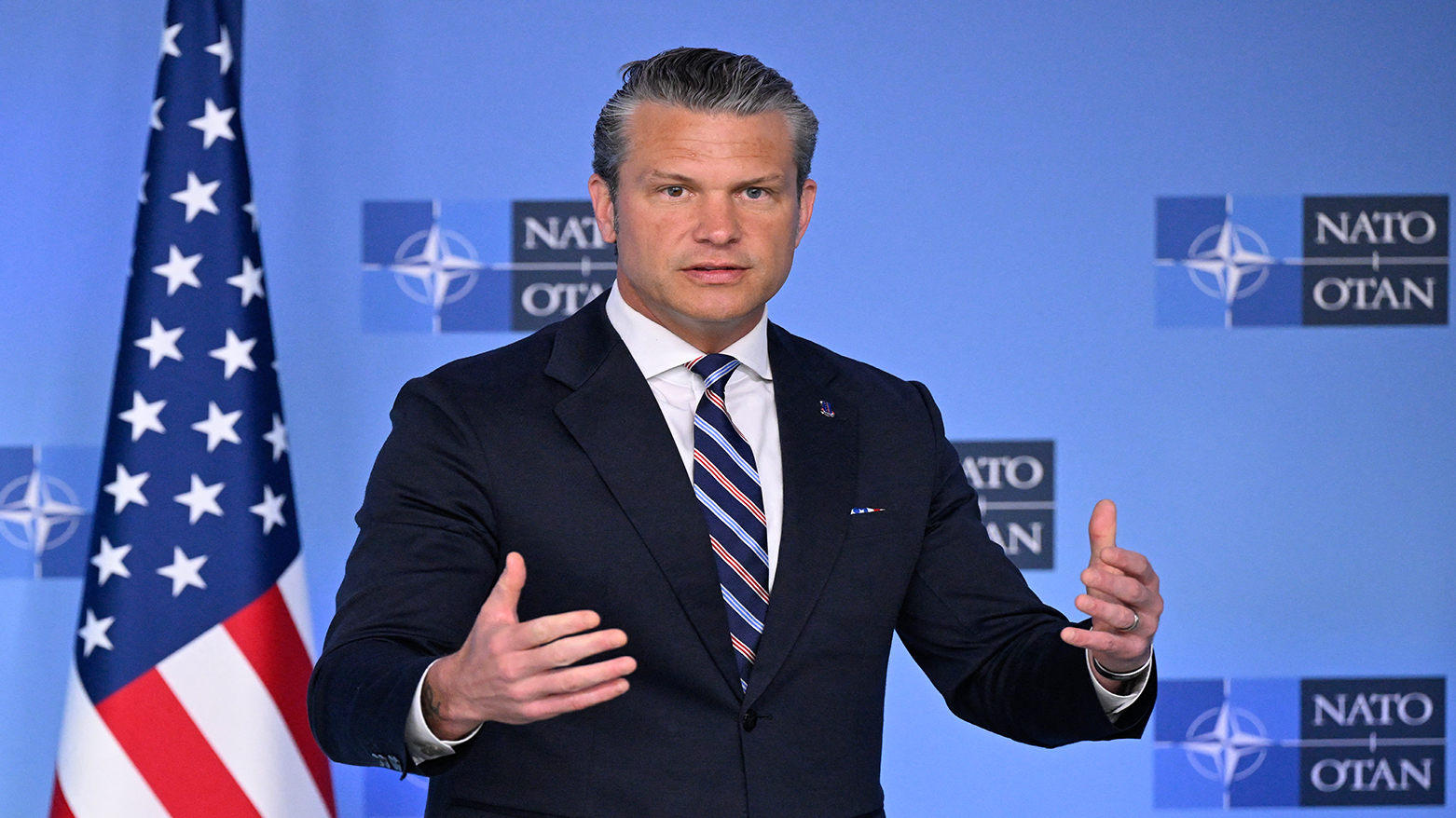
ERBIL (Kurdistan24) — US War Secretary Pete Hegseth on Thursday welcomed what he described as significant progress by NATO allies in meeting defense spending commitments, while stressing that some member states still need to increase their contributions, striking a notably conciliatory tone during alliance talks in Brussels.
Speaking ahead of a meeting of NATO defense ministers, Hegseth said alliance members were broadly moving in the right direction but insisted that discussions on burden-sharing must remain frank.
“Many countries [are] following through, some that still need to do more, and we will be candid about that, both in private and in public,” he said.
“I think that's important — friends being honest with friends.”
His remarks come at a sensitive moment for the alliance, as NATO prepares for a high-stakes summit with U.S. President Donald Trump next month. European allies are seeking to demonstrate tangible progress on defense spending commitments, following Trump’s repeated criticism of what he views as insufficient European contributions to collective security.
The alliance has set an ambitious target for members to eventually reach defense-related spending equivalent to 5 percent of GDP, with officials hoping to show measurable gains ahead of the summit.
NATO Secretary General Mark Rutte said financial commitments were rising sharply across Europe and Canada, describing the increase as “staggering.”
“When it comes to spending, what we are seeing is staggering amounts of money coming in,” Rutte said. “Europe and Canada spending in 2025 more than $90 billion extra compared to 2024, which is almost a 20 percent increase in defense spending.”
Despite this momentum, NATO officials acknowledged that not all members are on track to meet key benchmarks. A senior alliance official said that at least three European countries, including Slovenia and the Czech Republic, are likely to fall short of the 2 percent GDP defense spending threshold this year.
Washington has repeatedly urged European allies to assume greater responsibility for their own conventional defense capabilities, as the United States increasingly shifts strategic attention toward the Indo-Pacific region and competition with China.
As part of that realignment, the Pentagon has informed NATO partners that it is reducing certain military assets made available to alliance operations worldwide.
The reported adjustments include a reduction of roughly one-third of the 150 U.S. F-15 and F-16 aircraft assigned to NATO missions, as well as the withdrawal of select refueling, reconnaissance, bomber, and drone assets.
Reports also suggest that a cruise missile-capable submarine and one of two aircraft carrier strike groups previously designated for NATO operations are being removed from alliance force planning.
The changes have triggered concern among some European officials, who warn that rapid reductions could expose capability gaps at a time of heightened tension with Russia.
German Defense Minister Boris Pistorius said Europe could eventually compensate for the lost capabilities but warned that time would be required.
“By and large, we’ll be able to compensate for many things. But we need a bit more time, and that is the clear message,” Pistorius said. “It is difficult and dangerous for the security of NATO territory in Europe if capabilities are withdrawn very quickly without it being clear when they can be offset.”
Despite the internal adjustments, NATO leaders sought to emphasize unity and deterrence. Rutte stressed that U.S. force reductions should not be interpreted as a withdrawal of commitment to collective defense.
While acknowledging that some adjustments are being implemented “immediately,” he insisted that NATO’s core defense guarantee remains unchanged.
“If NATO were attacked, all allies — including the U.S. — will max out what they can do to make sure we can fight the war,” he said.
Alongside defense spending discussions, NATO ministers are also focusing on continued support for Ukraine as the war with Russia persists.
Ukrainian President Volodymyr Zelenskyy is expected to attend meetings with Kyiv’s military partners at NATO headquarters before heading to a separate European Union summit.
Kyiv is seeking to build on what officials described as a positive recent meeting between Zelenskyy and Trump at the G7 summit in Evian, hoping to secure additional military and financial assistance in its ongoing defense against Russian forces.
As NATO balances internal burden-sharing debates with external security challenges, the alliance is aiming to present a unified front ahead of next month’s summit — where defense spending, transatlantic cohesion, and support for Ukraine are expected to dominate the agenda.