America's Nuclear Revival Begins with Reactors Small Enough to Fit on a Truck
Compact reactors designed for AI data centers, military bases and remote communities mark the first new U.S. reactor designs to reach operation in nearly 50 years
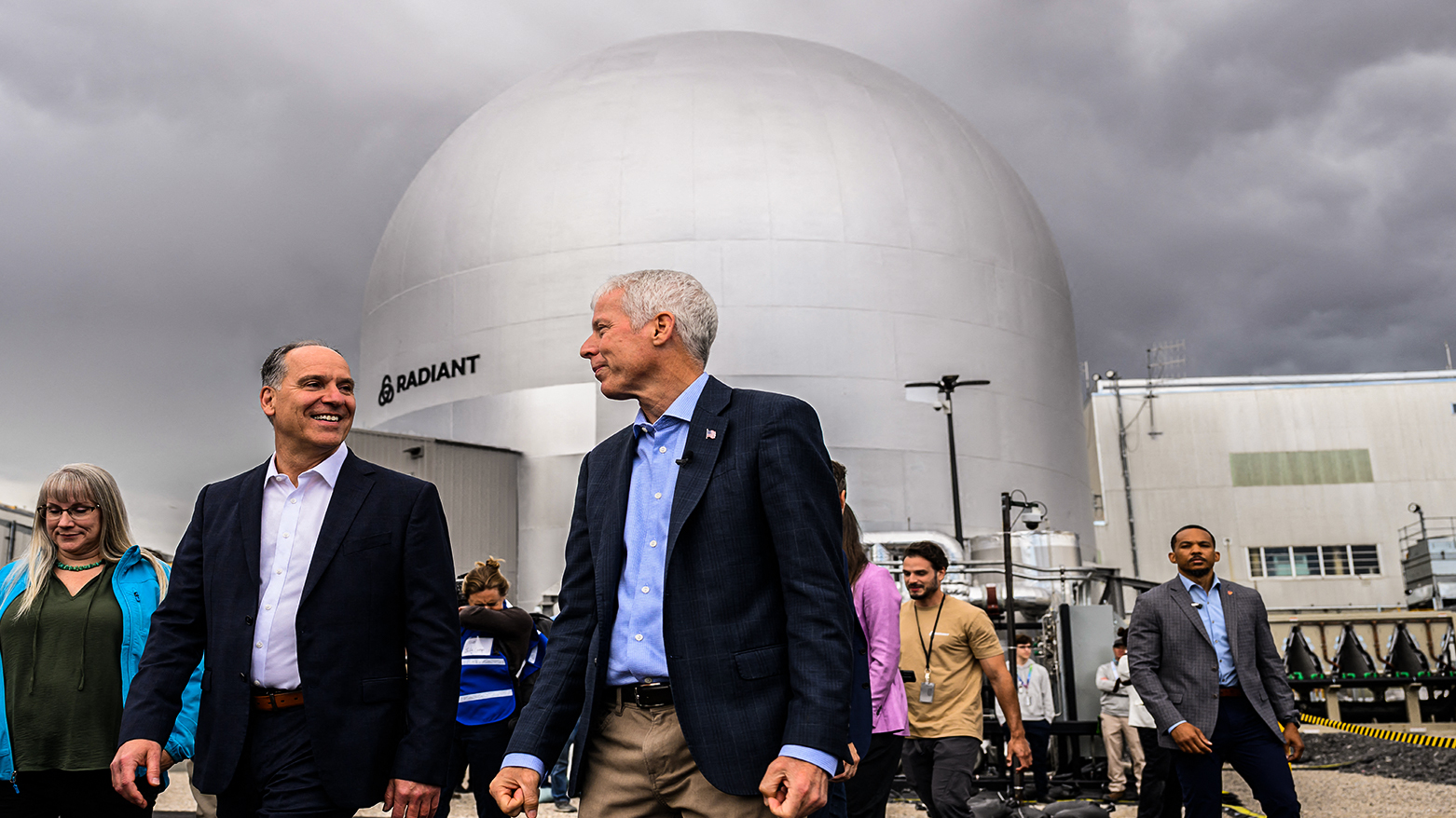
ERBIL (Kurdistan24) — A new era of American nuclear power is beginning to take shape in the Idaho desert, where a new generation of compact reactors is emerging with ambitions far beyond traditional power plants—promising to fuel everything from artificial intelligence data centers and military bases to remote communities while strengthening U.S. competition with China.
The milestone marks the first time in nearly five decades that newly designed nuclear reactors have begun operating in the United States, signaling what industry leaders describe as the start of a long-awaited "nuclear renaissance."
The breakthrough comes after years of government backing and billions of dollars in private investment aimed at reviving an industry that largely stalled following the Three Mile Island accident in 1979 and the 1986 Chernobyl disaster.
At the center of the effort is the Idaho National Laboratory (INL), a highly secured federal research facility where startup Antares became the first company on June 4 to successfully operate a new-design reactor in the United States in almost 50 years.
"This is the first real moment in this new nuclear renaissance," Antares CEO Jordan Bramble said.
More companies are rapidly following. Startup Aalo Atomics is expected to reach the same milestone within days at the Idaho site, while Valar Atomics announced that its prototype reactor in Utah achieved "criticality" on June 18—the point at which a reactor can sustain its own nuclear chain reaction.
Although these reactors are still prototypes, the progress represents a major shift for an industry that has spent decades focused largely on maintaining aging nuclear plants rather than building new ones.
Unlike the enormous reactors that dominate today's nuclear stations, these new systems—known as Small Modular Reactors (SMRs)—are designed to be factory-built, transported by truck, and assembled quickly where electricity is needed.
One prototype delivered to the Idaho site was small enough to be hauled by a pickup truck. That portability could dramatically change how nuclear power is used.
Instead of constructing massive multi-billion-dollar facilities over many years, SMRs could be deployed much faster to provide reliable electricity for isolated military installations, mining operations, industrial sites, disaster zones, and the rapidly expanding AI industry, whose enormous data centers require constant, around-the-clock power.
The explosion in artificial intelligence has become one of the biggest drivers behind renewed interest in nuclear energy, as technology companies search for dependable carbon-free electricity that solar and wind alone cannot always provide.
The war in Ukraine also reshaped global energy priorities, prompting both former President Joe Biden and President Donald Trump to accelerate support for civilian nuclear power as countries seek more secure domestic energy supplies.
Beyond funding, the federal government has opened the Idaho National Laboratory's world-class testing facilities to private developers, allowing startups to build and test reactors with the support of scientists whose institution has developed more than 50 reactor prototypes since the 1950s.
The laboratory also built the world's first reactor to generate usable electricity in 1951. Developers argue the new reactor designs are fundamentally different from conventional nuclear plants.
Rather than relying on the massive containment structures associated with older reactors, many next-generation designs incorporate passive safety systems intended to prevent the kinds of cascading failures that occurred at Three Mile Island and Chernobyl.
"The whole plant can get simpler. We don't need to have several feet thick of concrete and steel-lined containment," said Yasir Arafat, President and Chief Technology Officer of Aalo Atomics. Industry leaders nevertheless stress that safety standards remain central to commercialization.
Tori Shivanandan, President and Chief Operating Officer of Radiant Nuclear, said maintaining rigorous regulatory oversight is essential despite political pressure to speed deployment.
"The team at the lab—they hold the line, and we want them to, because ultimately, if we don't make safe products, we'll never sell reactors," she said. Reaching criticality does not mean the reactors are ready for widespread commercial use.
Each design must still receive approval from the U.S. Nuclear Regulatory Commission (NRC), with current prototypes operating under special government authorization. Despite that hurdle, U.S. Energy Secretary Chris Wright predicted deployment could happen far sooner than many expect.
Speaking to AFP during what he described as a "celebration of the golden age of nuclear energy" in Idaho Falls, Wright said the administration expects the first of these reactors to begin producing electricity for practical use as early as next year.
"We'll have hundreds by the end of the decade. In fact, our aggressive goal is we will have some of these reactors producing electricity for beneficial use next year," he said.
If those timelines are met, Antares and Radiant plan to supply reactors to U.S. military installations, while Aalo intends to power AI data centers.
The technology could also become a significant geopolitical asset. With China currently the only other country operating a small modular reactor, Washington sees next-generation nuclear technology as a strategic export capable of expanding American influence while helping allies strengthen their energy security.
"Every country I go to asks about the next-generation American nuclear technology," Wright said. "It's happening right now." "This will be a massive American export a decade from now," he added.