Kurdistan24 Reaches the Strait of Hormuz at the Center of Energy Tension
Kurdistan24 reaches the Strait of Hormuz, capturing a critical maritime chokepoint as U.S.-Iran diplomacy and energy markets remain on edge.
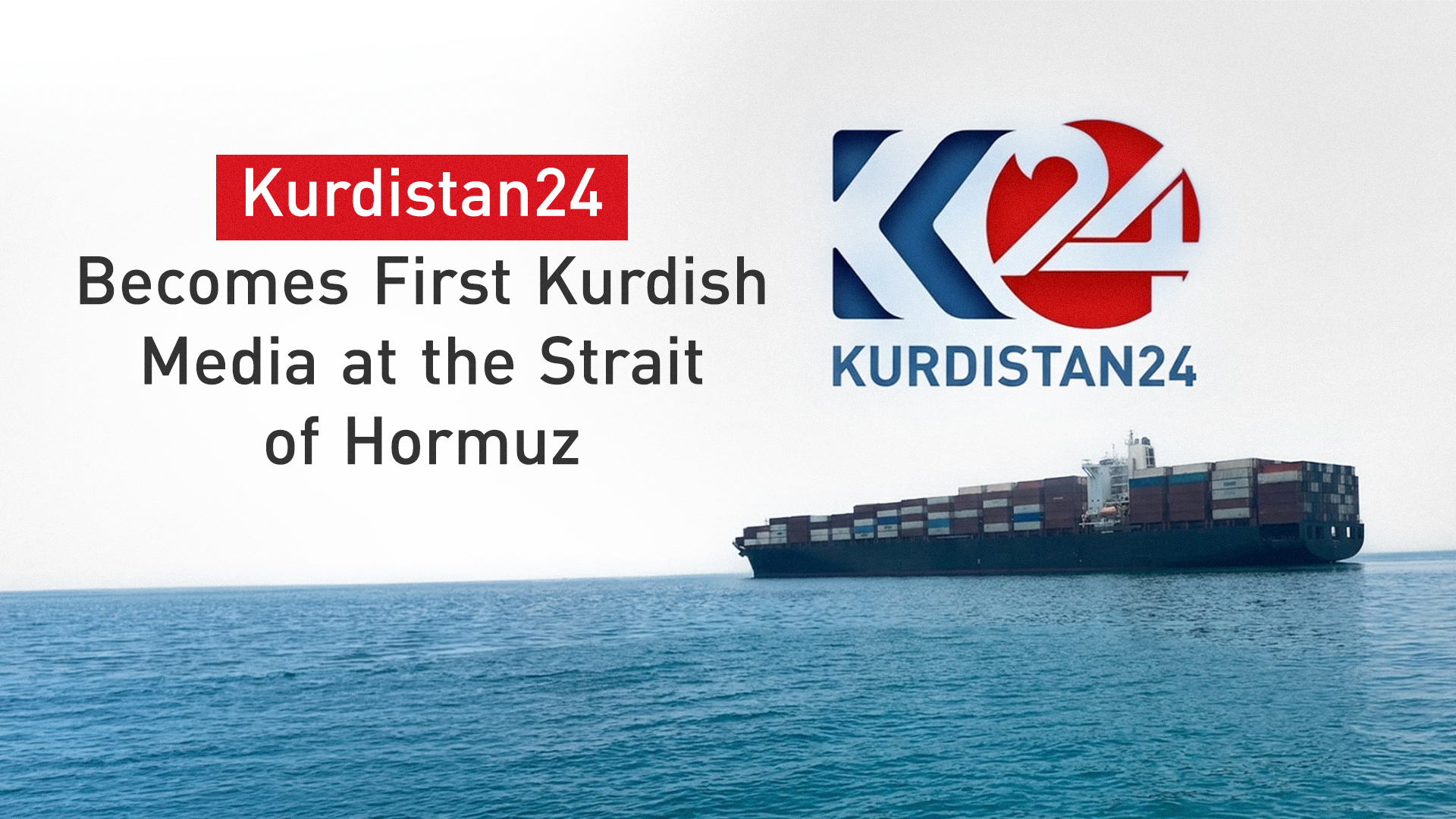
ERBIL (Kurdistan24) - On a waterway where every mile carries geopolitical weight, Kurdistan24 has become the first Kurdish media organization to report directly from the Strait of Hormuz, placing viewers at the narrow passage through which a large share of the world's oil and liquefied natural gas still flows.
The exclusive footage, gathered on a journey from Bandar Abbas into the strait, captures more than a shipping lane.
It shows a maritime corridor under constant scrutiny: giant tankers moving carefully through confined waters, warships positioned at a distance, and a horizon shaped as much by deterrence as by commerce.
In a region where the movement of ships can affect fuel prices far beyond the Gulf, the Strait of Hormuz remains one of the world's most consequential strategic chokepoints.
Kurdistan24's reporting from the scene arrives at a moment when the waterway is once again tied to broader diplomatic calculations.
On Tuesday, indirect and partially disputed contacts between Washington and Tehran were due to continue in Doha, underscoring how quickly the Strait's security can become entangled with negotiations over escalation, maritime access, and the fragile mechanics of de-escalation.
That convergence matters because the Strait is not merely a geographic crossing. It is a pressure point where military signaling, regional politics, and global energy markets meet. Any interruption, or even the credible threat of one, can ripple outward through shipping insurance, supply expectations, and fuel prices in economies far removed from the Gulf.
Kurdistan24's images show the passage in its most revealing form: not as an abstraction in a diplomatic communique, but as a living artery of the international economy.
More than 20 million barrels of oil move through the strait each day, according to widely cited estimates, accounting for roughly one-fifth of global consumption.
That alone makes the waterway central to energy security. What gives it added significance is the narrowness of the corridor and the military presence around it, both of which magnify the consequences of every incident.
The vessels seen in the exclusive footage pass with deliberate caution.
The distance between commerce and confrontation in these waters is far smaller than the scale of the markets that depend on them. A tanker's course here is not just a navigational choice; it is a signal to traders, governments, and militaries watching for the slightest shift in regional risk.
That is why attention to the Strait of Hormuz tends to intensify when diplomacy heats up.
According to Agence France-Presse, President Donald Trump said Iran had requested a meeting in Qatar, even as Tehran denied that direct talks with Washington were planned.
AFP teams in Tehran, Washington and Dubai reported that both sides said they were sending delegations to the Gulf state, but their public descriptions of the contacts diverged sharply on timing, purpose, and format.
The disagreement did not erase the underlying reality: the two governments remain in touch, even amid contradictory public messaging.
Iranian foreign ministry spokesman Esmaeil Baqaei said the country would send experts to Doha but insisted, “We have not yet entered the stage of negotiating a final agreement,” adding that there would be no direct meetings with the U.S. side at any level in the coming days.
President Trump, meanwhile, used his Truth Social account to suggest that Iran had sought the meeting, reflecting the tension between public denials and quiet diplomatic movement.
Such contradictions are common in high-stakes negotiations, especially when the subject is a maritime passage as sensitive as Hormuz.
The strait has long occupied a unique place in regional strategy because it links the Gulf to the Sea of Oman and, beyond that, the Indian Ocean. It is both a trade route and a bargaining space, a narrow passage whose political value often exceeds its physical dimensions.
That value becomes even more pronounced when military activity rises.
AFP reported that recent clashes had repeatedly strained the preliminary understanding to reopen the waterway, while traffic patterns suggested lingering caution among shippers. Commodity vessel movements slowed after a vessel was struck while transiting the strait, and tracking data showed a drop in crossings over the weekend.
In practical terms, that means even without a formal closure, uncertainty itself can alter the rhythm of global trade.
The consequence is a market that watches the Strait of Hormuz the way central banks watch inflation data: continuously, nervously, and with little room for surprise. Tankers do not need to be turned away for the effects to be felt.
Delays, rerouting, and reduced traffic all have the potential to affect supply expectations. When shipping volumes fall or insurers perceive greater risk, prices can adjust before a single barrel is lost.
Kurdistan24's reporting makes that vulnerability visible.
The footage is a reminder that global energy stability often depends on a handful of tightly controlled maritime corridors where the margin for error is small and the political stakes are immense.
The ships in the strait carry commodities, but they also carry the assumptions on which markets function: that routes remain open, that navigation remains possible, and that escalation stays below the threshold of closure.
The military dimension is impossible to separate from that equation. Warships seen in the distance underline the fact that the strait is not governed only by commercial logic.
It is also shaped by deterrence, surveillance, and the language of force. In that setting, the strategic question is rarely whether the route matters. It is whether political actors can keep it stable enough for the world economy to absorb.
Diplomacy, too, now plays out under that shadow.
The reported Doha contacts illustrate how energy security and regional talks increasingly move in tandem. Even when public statements differ, the broader objective remains unchanged: prevent renewed escalation from spilling into a waterway that could unsettle global markets within hours.
The Strait of Hormuz has seen this pattern before. Its importance is enduring precisely because it sits at the intersection of conflict and commerce.
Countries far from the Gulf cannot control its currents, but they are exposed to its consequences. That is why the lane visible in Kurdistan24's exclusive footage is never only local or regional. It is global infrastructure by another name.
For Kurdistan24, reaching that point on the map marks a journalistic milestone. For audiences, it offers something rarer: a direct view of the place where energy dependence, military caution, and diplomatic maneuvering converge.
In an era when so much of international politics is discussed in abstractions, the Strait of Hormuz remains stubbornly concrete. Tankers still have to pass through it. Warships still watch it. Markets still price it. And now, for the first time, Kurdistan24 has reported from its heart.
|
Summary Kurdistan24 has reached the Strait of Hormuz, reporting from the world's most sensitive energy corridor as U.S.-Iran contacts continue in Doha. Exclusive footage shows tankers, warships, and the scale of a chokepoint whose stability matters far beyond the Gulf. |