Trump Uses 250th Anniversary Speech to Cast America as Renewed Global Power
President Trump used America’s 250th anniversary address to outline his vision of U.S. history, military strength, constitutional values and future leadership.
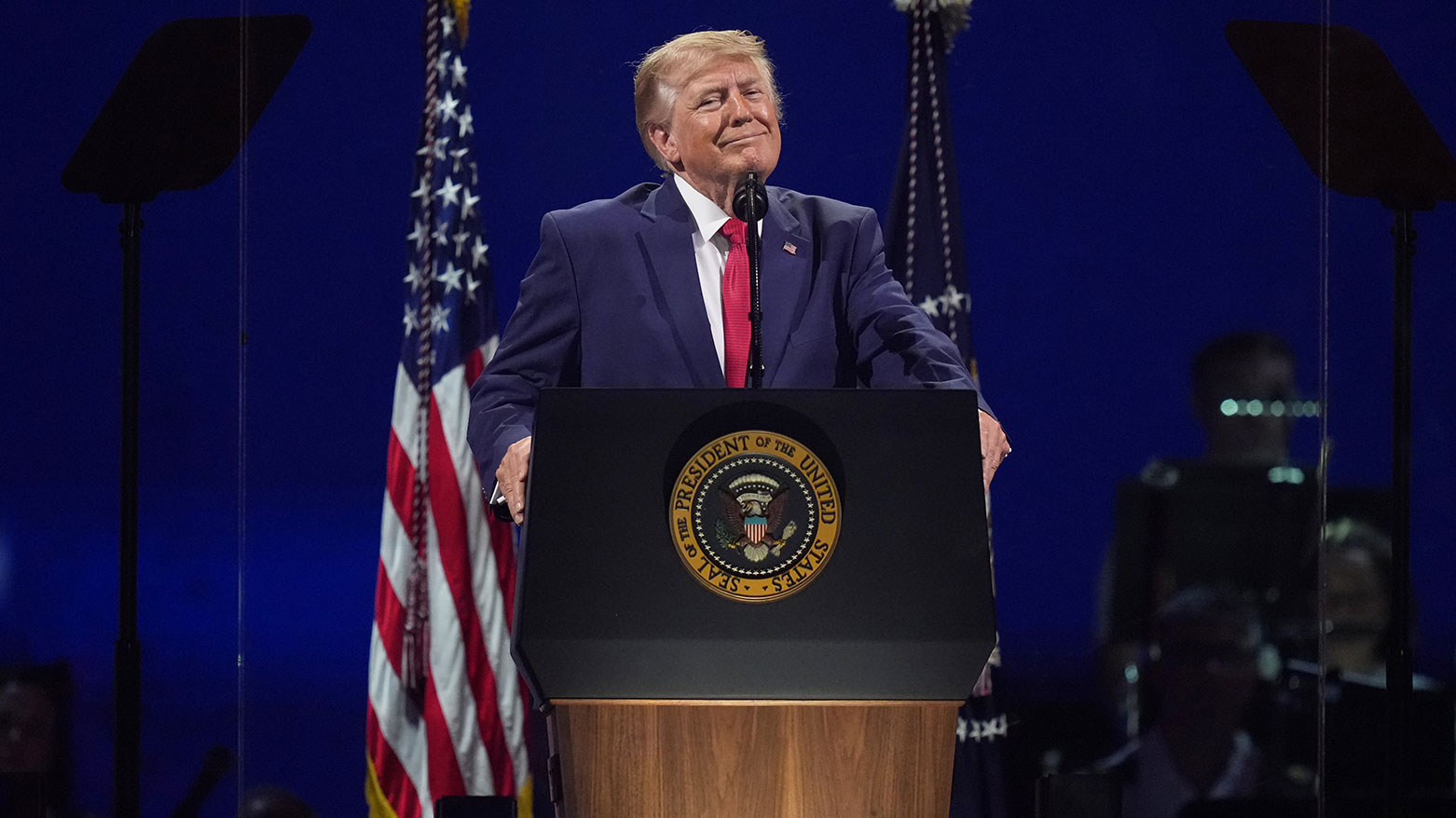
ERBIL (Kurdistan24) - President Donald Trump used the United States' 250th Independence Day celebration on Friday to deliver a sweeping vision of the country's past and future, declaring that America was entering what he called a new "Golden Age" while portraying the quarter-millennium milestone as both a celebration of the nation's founding and a statement of its ambitions at home and abroad.
Speaking before tens of thousands gathered on the National Mall after thunderstorms delayed the festivities, Trump argued that "the best is yet to come," casting the anniversary not as the culmination of American history but as the beginning of its next chapter.
The address blended patriotic commemoration with political messaging, using two and a half centuries of history to frame his administration's vision of national renewal and continued global leadership.
More than a ceremonial Fourth of July speech, the address offered Trump's interpretation of America's identity at a defining historical moment.
By weaving together the Declaration of Independence, the Constitution, military sacrifice, economic confidence and technological ambition, he sought to present the country's 250th birthday as an opportunity to reaffirm the principles he believes should guide the United States through its next century.
The result was a speech that functioned as both a national celebration and a declaration of how the administration sees America's place in an increasingly competitive world.
Throughout the evening, Trump repeatedly portrayed the United States as an exceptional nation whose influence extends well beyond its borders.
Calling America "the home of freedom" and "the land of liberty," he described the republic as "the hope, the promise, the light and the glory among all of the nations of the world," arguing that its democratic institutions remain a model for others despite mounting global uncertainty.
That narrative rested heavily on the country's founding documents. Trump praised the Declaration of Independence as the moment that transformed the course of history and described the Constitution as "the most righteous political document ever conceived."
He argued that the freedoms guaranteed by the Constitution, including freedom of speech, religious liberty and the right to bear arms, remain the foundation of American democracy after 250 years.
Rather than recounting history chronologically, Trump connected generations of Americans through a shared story of sacrifice.
References to Revolutionary War victories at Saratoga and Yorktown evolved into tributes to those who fought in the Civil War, World War II, Korea and Vietnam, portraying each generation as defending the same ideals established in 1776.
"Americans will never let anyone take our freedom away," he said, presenting the nation's history as a continuous defense of liberty against external threats.
Among those highlighted was Civil War hero William Carney, the first African American recipient of the Medal of Honor, whose determination to keep the American flag from touching the ground under enemy fire was presented as a symbol of patriotism transcending race and generation.
Trump also recognized Medal of Honor recipient Col. Paris Davis and numerous veterans whose service, he argued, reflected an enduring commitment to the country's founding principles.
Military service occupied a central place in the speech.
Veterans of Pearl Harbor, D-Day, Iwo Jima, the Korean War and Vietnam were honored alongside historic American flags associated with those conflicts, reinforcing the administration's effort to connect national memory with contemporary strength.
Trump argued that American power "is not something to be ashamed of. It is something that we are very, very proud of," portraying military capability as both a deterrent and a guarantor of peace.
For international audiences, those references carried broader strategic significance. Trump's repeated invocation of the "Greatest Generation," together with tributes to the liberation of Europe and the defeat of fascism, reinforced a longstanding American narrative that U.S. military leadership has shaped the international order.
The speech also suggested that Washington intends to maintain that role amid intensifying geopolitical competition.
Ideological rivalry featured prominently as well.
Trump framed communism as fundamentally incompatible with America's constitutional tradition, declaring that "America will never be a communist country" and arguing that "the communist system is the opposite of the American system."
Referring to the Cold War and the fall of the Berlin Wall, he presented those events as evidence that democratic institutions ultimately prevail over authoritarian ideologies.
Domestic political themes were woven into that broader historical narrative. Trump argued that preserving the republic requires secure borders, election integrity and continued confidence in American institutions.
While discussing voting procedures and citizenship requirements, he presented those priorities as part of a wider effort to safeguard the constitutional system established by the country's founders, reflecting his administration's broader political agenda.
Economic performance also formed a recurring theme.
Trump asserted that "the American Dream is back," pointing to investment, manufacturing, employment and financial markets as evidence that the country has regained momentum. He further claimed that the United States was "winning like never before," presenting economic strength as inseparable from national confidence and international influence.
The president also devoted considerable attention to scientific achievement and exploration, portraying technological leadership as the modern extension of America's frontier spirit.
Referencing the Wright brothers, the Apollo program and NASA's Artemis II mission, he argued that innovation has long distinguished the United States. Looking ahead, Trump said, "We're going to Mars very soon," presenting lunar exploration and future missions to Mars as symbols of continued American leadership in science and technology.
That emphasis also reflected broader geopolitical considerations.
By highlighting the Space Force and competition with China and Russia in space, Trump portrayed technological innovation as an arena where strategic leadership will increasingly be measured, suggesting that exploration beyond Earth carries implications not only for science but also for national security and global influence.
Throughout the address, historical artifacts, including Revolutionary War flags, banners flown during pivotal military campaigns, the flag recovered after Pearl Harbor and one destined for a future mission to the Moon, served as visual reminders of the continuity Trump sought to emphasize.
Rather than treating those symbols as museum pieces, he used them to argue that successive generations have inherited and renewed the same national mission.
Closing the speech, Trump returned to the anniversary's broader significance, arguing that America's constitutional republic remains resilient after two and a half centuries because of what he called the courage of its founders and the sacrifices of those who followed them.
Declaring that "our country is just getting started," he said the nation's quarter-millennium anniversary should be viewed as "only the dawn of the Golden Age of America."
For observers beyond the United States, the address underscored how presidential anniversary speeches often serve as statements of national identity as much as commemorations.
Trump's remarks offered a window into how his administration seeks to define America's history, its democratic traditions, its military posture and its aspirations for the future, projecting an image of a nation that sees constitutional ideals, economic vitality, technological innovation and strategic strength as mutually reinforcing pillars of continued U.S. leadership in an increasingly contested international landscape.
|
Summary President Donald Trump marked America’s 250th Independence Day with a wide-ranging address linking the nation’s founding ideals to military power, constitutional freedoms, economic confidence and future ambitions, offering both a celebration of U.S. history and a broader statement of America’s role in the world. |