Jordan Downs Four Iranian Missiles as Gulf Conflict Widens
Jordan says it intercepted four Iranian missiles while escalating military activity across the Gulf and new political moves in Tehran underscore the widening regional crisis.
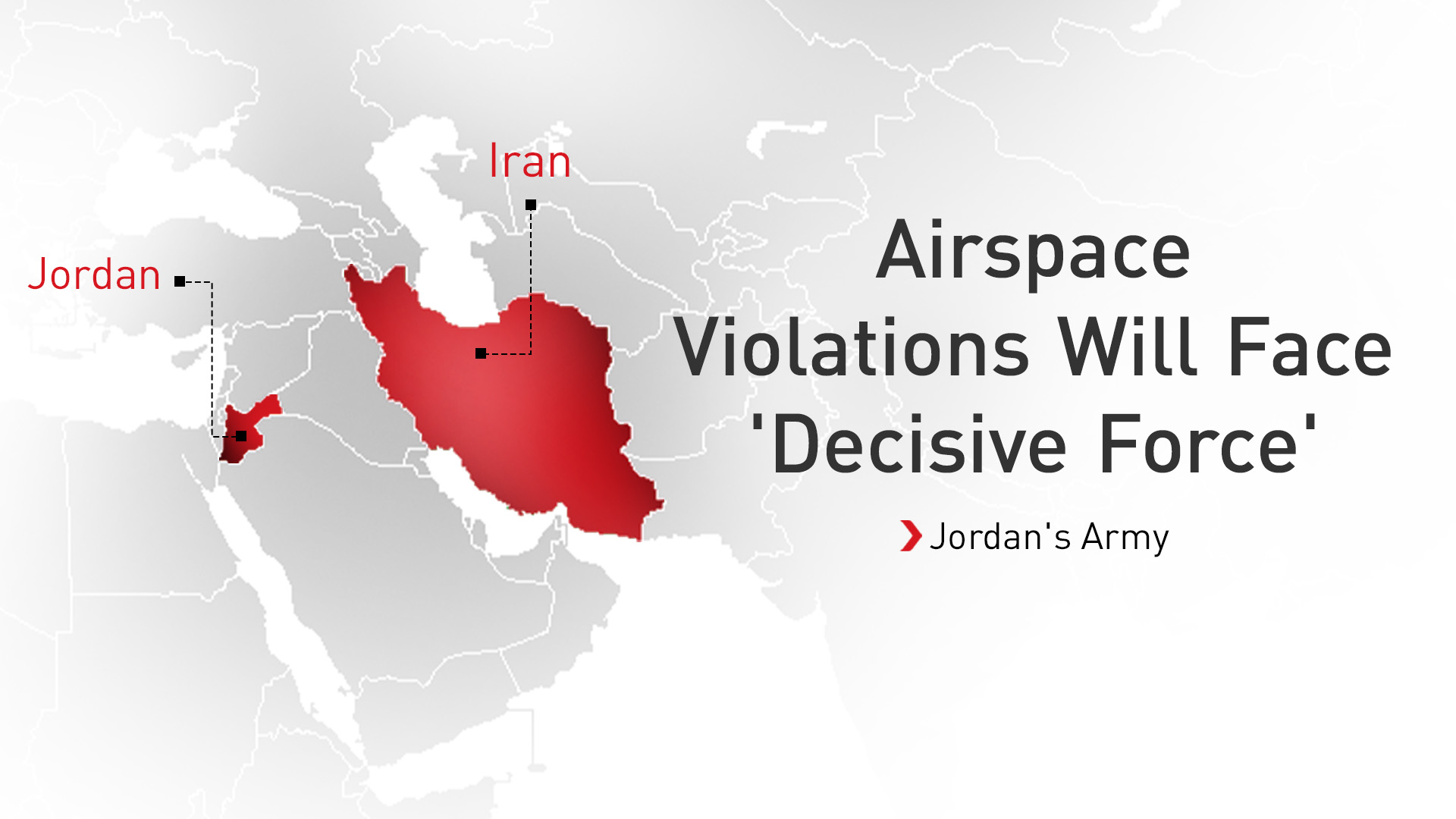
ERBIL (Kurdistan24) - Jordan's interception of four Iranian missiles after they entered its airspace has become one of the clearest indications that the confrontation between Tehran and Washington is no longer confined to the two adversaries. As military exchanges ripple across the Gulf, neighboring states are increasingly being drawn into a conflict that is reshaping the region's security landscape and testing governments' ability to protect their territory while avoiding a broader war.
According to Jordan's armed forces, air defense units destroyed the four missiles after they crossed into Jordanian airspace from Iran early Tuesday.
Jordan's state-run News Agency (Petra) also reported that "an official military source at the General Command of the Jordan Armed Forces-Arab Army said that national air defense systems successfully intercepted and shot down four missiles that entered Jordanian airspace from Iranian territory early Tuesday morning."
Jordanian authorities said the interceptions resulted in no casualties or material damage, reinforcing Amman's longstanding position that protecting national sovereignty and the safety of its citizens remains its foremost priority.
Petra further reported that teams from the Royal Engineering Corps "handled the fallen debris across several locations in accordance with approved technical and security protocols, taking all necessary precautions to secure the sites and ensure public safety."
The military source stressed that the Jordan Armed Forces remain fully prepared to "counter any threat targeting the Kingdom's security or airspace."
Petra added that "any attempt to undermine state sovereignty or violate Jordanian airspace will be met with decisive force under established rules of engagement and national interests," reaffirming that the military "will not hesitate to take all necessary measures to protect the homeland."
The incident unfolded as tensions spread across multiple Gulf states.
Agence France-Presse (AFP) reported that Iran's Revolutionary Guards announced missile and drone strikes against Bahrain, while an AFP journalist in Manama described explosions after air raid sirens sounded repeatedly across the capital.
Taken together, the developments illustrate how military activity linked to the Iran-United States confrontation is increasingly affecting regional partners, placing additional pressure on governments whose territory now lies closer to the front lines of an expanding crisis.
Jordanian officials moved quickly to reject Iranian assertions that the missiles were directed at a U.S. military base inside the kingdom.
Authorities reiterated that Jordan hosts no foreign military bases, explaining that only limited international personnel operate within Jordanian military facilities under established training and cooperation agreements.
Military officials also emphasized the precision of the interception, presenting it as evidence of the country's readiness to defend its airspace.
They warned that any future violations of Jordanian sovereignty would receive an immediate response under the military's established rules of engagement.
The firm public messaging reflects Amman's longstanding effort to prevent regional conflicts from spilling onto its territory while maintaining stability amid an increasingly volatile neighborhood.
With missile trajectories now extending beyond the immediate battlefield, Jordan's role has become more significant as both a frontline state and a barometer of how rapidly the regional security environment is changing.
Beyond the immediate military developments, political decisions in Tehran are adding another dimension to the confrontation.
Iran's parliament has resumed work after being suspended during the conflict and has immediately turned its attention to the Strait of Hormuz, one of the world's most strategically important maritime corridors.
According to AFP, lawmakers introduced legislation titled the Strategic Action for the Security and Sustainable Progress of the Strait of Hormuz and the Persian Gulf, signaling Tehran's intention to reinforce its position over the waterway as disputes with Washington deepen.
Ebrahim Azizi, head of the Iranian parliament's security committee, described the proposal as the beginning of a broader legislative effort, saying Iran remained committed to defending what it considers its "red lines" concerning management of the strait.
His remarks suggest that Tehran is increasingly pairing military responses with legislative action as it seeks to shape the next phase of the confrontation.
The parliamentary initiative also highlights growing debate within Iran itself. Lawmakers returned to session after months of interruption with renewed questions about negotiations with Washington, while some members have reportedly expressed concern over parliament's limited role in decisions surrounding an earlier memorandum of understanding with the United States.
Those discussions illustrate how domestic political institutions are becoming more directly involved in national security policymaking as tensions intensify.
The Strait of Hormuz remains central to these developments because of its importance to international commerce and global energy supplies. Continued disagreements between Tehran and Washington over the waterway's future have coincided with rising concern over maritime security.
AFP also reported that a tanker was struck off the coast of Oman, adding to anxiety over commercial navigation in waters already under heightened military scrutiny.
Taken together, missile interceptions over Jordan, attacks reported in Bahrain, maritime security incidents, and Iran's renewed legislative focus on the Strait of Hormuz demonstrate how diplomatic, military, and political developments are becoming increasingly interconnected.
Decisions made in parliament, actions taken at sea, and military operations across national borders are now influencing one another with growing speed.
For Jordan, the interception of the four missiles represents more than a successful air defense operation.
It reflects the reality that neighboring states are increasingly being forced to respond directly to a widening regional confrontation, balancing the protection of their sovereignty with the broader challenge of maintaining stability as one of the Middle East's most consequential security crises continues to evolve.
|
Summary Jordan's interception of four Iranian missiles highlights how the Iran-US confrontation is increasingly affecting neighboring states. As Bahrain reports attacks and Iran advances a Strait of Hormuz bill, military operations and political decisions are converging to reshape regional security across the Gulf. |