KRG Interior Minister Reaffirms Neutrality, Calls for Stronger Crisis Cooperation at Disaster Initiative Ceremony
He highlighted a joint project launched in January 2024 by Expertise France, the Ministry of Interior, and the Joint Crisis Coordination Centre (JCC), with financial support from the European Union.
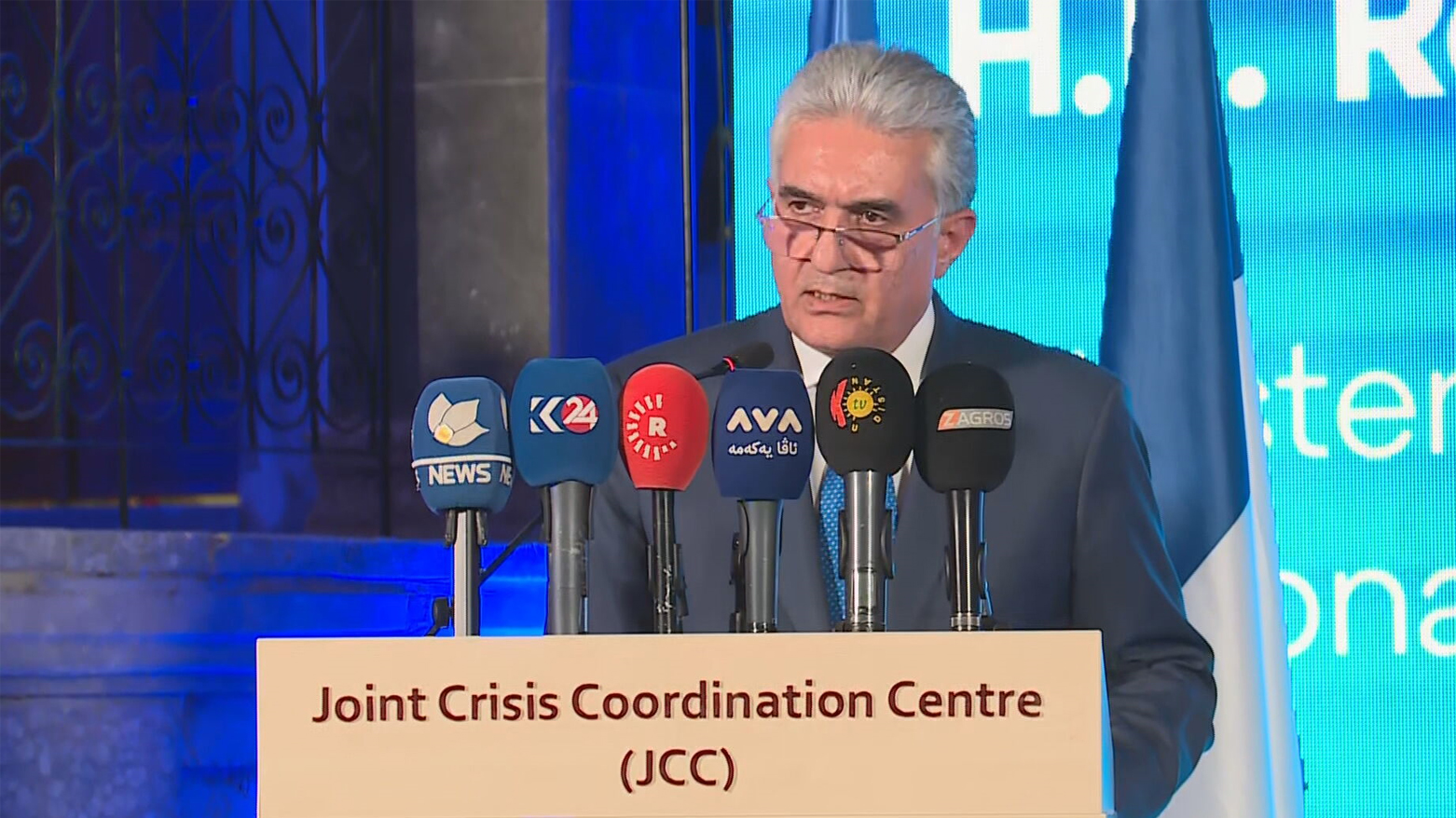
ERBIL (Kurdistan24) – Kurdistan Region Interior Minister Rebar Ahmed on Tuesday praised the Kurdistan Region's growing partnership with France in civil protection and disaster response, while reaffirming the Kurdistan Regional Government's (KRG) neutral stance amid regional tensions and urging stronger action against armed groups operating outside state control.
Speaking at the closing ceremony of the first phase of the Disaster Risk Reduction Initiative in the Kurdistan Region, Ahmed said cooperation between the Kurdistan Region and France has expanded beyond political, military, and humanitarian ties into a strategic partnership focused on civil protection, crisis management, and humanitarian disaster response.
He highlighted a joint project launched in January 2024 by Expertise France, the Ministry of Interior, and the Joint Crisis Coordination Centre (JCC), with financial support from the European Union. The initiative aims to strengthen the Kurdistan Region's disaster preparedness by drawing on French expertise in crisis management, improving rapid response capabilities, and enhancing the delivery of essential services.
Ahmed said the project had produced "strong and successful results" and reflected Prime Minister Masrour Barzani's vision of adopting international expertise and expanding global partnerships to strengthen the Kurdistan Region's institutions.
The minister said the Ministry of Interior has made crisis management a priority, particularly in response to climate change and natural disasters. He noted that the Crisis Management Operations Room and the JCC, which includes representatives from 17 ministries, all provinces, and independent administrations, coordinate emergency response through a unified mechanism.
Ahmed added that the ministry is also engaging citizens, the private sector, media organizations, humanitarian groups, and educational institutions to build a more resilient society, supported by an advanced volunteer management system.
He said these efforts have enabled the Kurdistan Region to participate in international humanitarian assistance missions in recent years, providing emergency support to people affected by disasters in Turkey, Syria, and Lebanon.
The interior minister called for the continuation of the initiative through a second phase to further strengthen the Region's disaster preparedness.
Following the ceremony, Ahmed told reporters that France has consistently supported the Kurdistan Region through critical periods, particularly during the war against ISIS, and continues to play an important role today.
"We appreciate France's positions and support," he said.
Addressing the recent drone attacks targeting the Kurdistan Region, Ahmed reiterated that the KRG has maintained a policy of neutrality since regional tensions escalated.
"From the beginning of the recent regional tensions, we emphasized that the Kurdistan Region is neutral and has not allowed its territory to be used to create problems for any neighboring country," he said. "Unfortunately, the Region has come under attack from all sides and has been deliberately targeted."
He said the attacks had killed civilians, Peshmerga members, and security personnel, while causing significant damage to homes and property.
Ahmed stressed that the Kurdistan Region would not become part of the ongoing regional conflict.
Commenting on coordination with Baghdad, the minister said relations with Iraqi Prime Minister Ali al-Zaidi and Iraq's security institutions remain positive, but urged stronger action to address attacks originating from Iraqi territory.
"We have requested their cooperation, but so far, no practical measures have been taken," he said.
Ahmed also criticized the activities of armed groups operating outside the state authority, saying their actions damage Iraq's economy and political agreements.
"Weapons should be exclusively in the hands of the government, and all armed groups should hand over their weapons to the state," he said.
On domestic affairs, the minister announced that employee promotions have now entered the implementation phase, including previously delayed promotions for officers, which he said were made possible through the direct support of Prime Minister Masrour Barzani.