KRG Ministry Presses Baghdad on Barzani Genocide Compensation
The KRG Ministry of Martyrs and Anfal Affairs marks the 43rd anniversary of the Barzani Genocide by urging Baghdad to fulfill its legal obligations, compensate victims' families, and continue efforts to recover the missing.
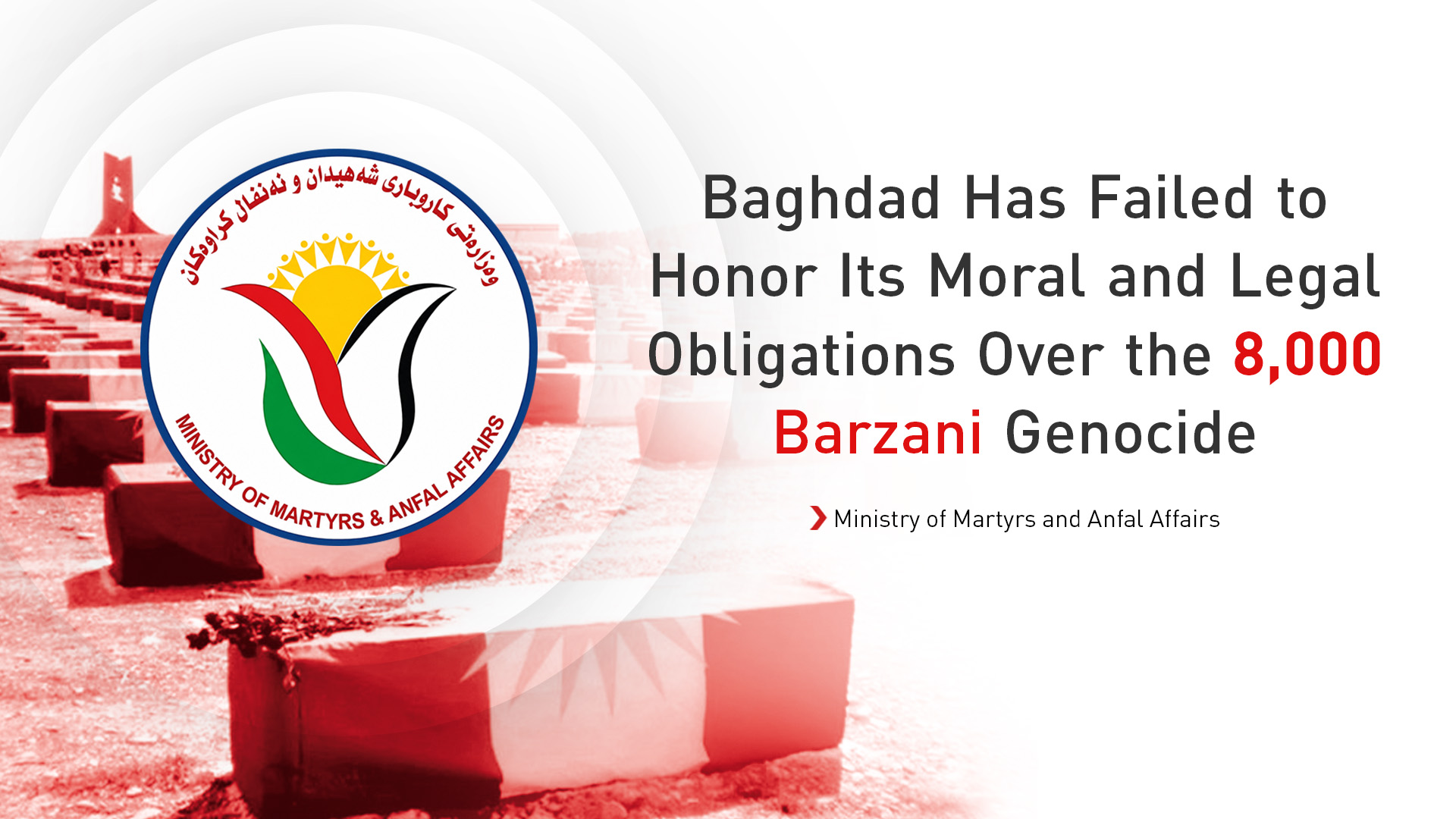
ERBIL (Kurdistan24) - The Kurdistan Regional Government's Ministry of Martyrs and Anfal Affairs has used the 43rd anniversary of the Barzani Genocide to renew its call for justice, urging Iraq's federal government to fulfill what it describes as its enduring legal and moral responsibilities toward thousands of victims and their families.
In an official anniversary statement, the Ministry said the passage of more than four decades has not diminished the need for accountability.
While the crimes committed against the Barzanis have received judicial recognition, it argued that meaningful implementation remains incomplete without formal reparations, official acknowledgment from Baghdad, and continued efforts to recover those who remain missing.
The Ministry stressed that the Iraqi state has yet to provide either a formal apology or comprehensive compensation to the families affected by the campaign, despite the Iraqi High Criminal Court's 2011 ruling that recognized the forced disappearance and killing of the Barzanis as genocide.
That decision, it noted, established the legal basis for addressing the consequences of one of the gravest crimes committed under the former Ba'ath regime, yet many of the obligations arising from the judgment remain unresolved.
Beyond compensation, the statement highlighted the humanitarian dimension of the Ministry's work.
It reaffirmed its commitment to locating additional mass graves, exhuming victims, identifying remains through the appropriate legal and forensic procedures, and returning them to the Kurdistan Region for dignified burial.
The Ministry described those efforts as an essential responsibility owed to families who have spent decades seeking certainty about the fate of their loved ones.
It pledged to continue pursuing reparations while remaining committed to recovering the remaining victims, emphasizing that remembrance must be accompanied by practical action.
The Ministry also observed the anniversary by paying tribute to the families of the martyrs, reaffirming that preserving the memory of those killed remains central to its mission.
The significance of those appeals is rooted in the enduring legacy of the Barzani Genocide, widely regarded as the opening chapter of the broader Anfal campaign carried out against the Kurdish people.
According to the Kurdistan24 historical background report, coordinated security operations launched in late July 1983 resulted in the mass arrest and forced disappearance of more than 8,000 Barzani men and boys following years of forced displacement and confinement in collective settlements established by the former Iraqi regime.
Many of those detained were transported to southern Iraq, where they were executed and buried in mass graves. Years later, investigators discovered burial sites in Iraq's Busayyah Desert, providing long-awaited evidence of the victims' fate and allowing some families to begin a process of mourning that had been denied for years.
The gradual return of victims' remains has become one of the most tangible expressions of that effort to restore dignity.
According to the Ministry, hundreds of remains have been repatriated in successive stages since 2005 through cooperation between Iraqi authorities and the KRG Ministry of Martyrs and Anfal Affairs.
The most recent recovery, completed in 2022, enabled another group of victims to be laid to rest at the Barzani Genocide Memorial Cemetery in the Barzan region.
While those recoveries have provided a measure of closure for some families, the broader legal and political process remains unfinished.
The Iraqi High Criminal Court's ruling in 2011 formally classified the crimes against the Barzanis as genocide, placing them alongside other atrocities committed against the Kurdish people under the former regime.
Yet, according to the Kurdistan24 background report, Iraq's federal parliament has not formally recognized the genocide, and many families continue to await the compensation and legal rights they believe should follow from the court's decision.
Against that backdrop, the Ministry's anniversary statement framed remembrance as inseparable from justice. It argued that honoring the victims requires more than annual commemorations; it demands sustained legal, humanitarian, and governmental action to address the consequences of the genocide.
Forty-three years after thousands of Barzanis were forcibly disappeared, the Ministry's message underscores that the search for the missing, the return of the dead, and the pursuit of reparations remain interconnected objectives.
By renewing its appeal to Baghdad, it sought to reinforce the principle that judicial recognition alone cannot close the chapter on genocide without meaningful implementation, accountability, and respect for the rights of survivors and the families who continue to bear its legacy.
|
Summary On the 43rd anniversary of the Barzani Genocide, the KRG Ministry of Martyrs and Anfal Affairs renewed its call for Iraqi reparations, continued recovery of victims' remains, and full implementation of the 2011 genocide ruling, stressing justice, remembrance and accountability. |