Families of the Barzani Anfal Carry Memory Across Generations
Survivors and relatives of the Barzani Anfal victims recount loss, shelter, identity, and resilience more than four decades after the 1983 campaign.
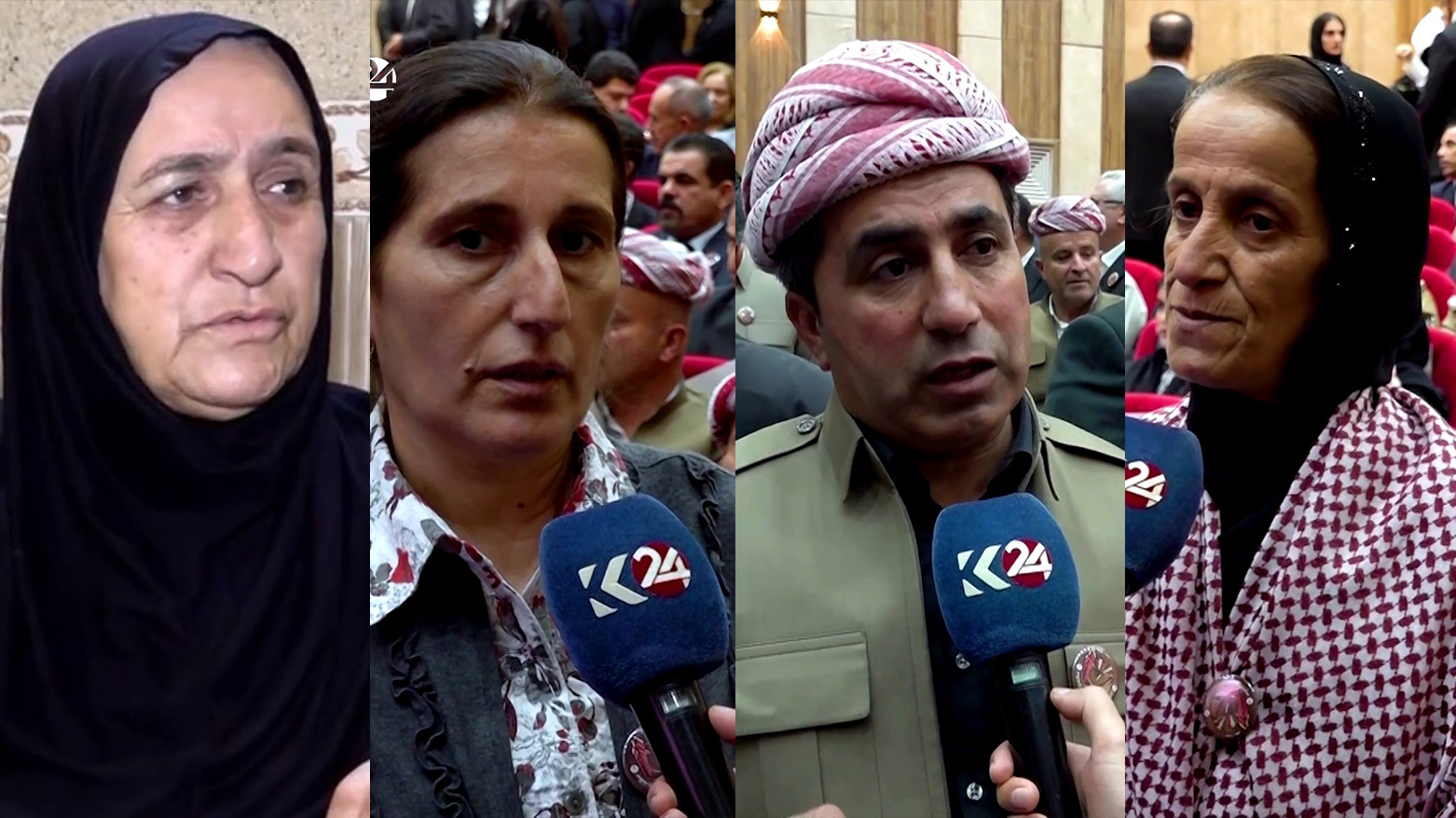
ERBIL (Kurdistan24) - Magroon still carries the photograph as if it were a family document and a witness at once. She lifts it carefully, points to the face of his father, and says simply: "There! That's him." The name was Salman. The memory is older than the room she is sitting in, older than the children and grandchildren who now know the story by heart, and older than the years that have passed since the Barzani Anfal campaign took her father and two brothers away.
"Salman," Magroon repeats, as though naming the dead might momentarily restore what history took. In her telling, the loss is not confined to one household. "In addition to my two brothers, my father and several other relatives were taken," she says.
The grief is still visible when she speaks of that day, but so is gratitude. She remembers the people of Erbil, Baharka, and Qushtapa with unmistakable warmth, saying their response to displaced Barzanis was like "the care of a mother and father."
What they offered, she says, can never be repaid. "No matter how much I say about the people of Erbil, it won't be enough," she says. "They would hide the Barzani men in their own homes."
For many families, the Anfal is remembered not only through absence, but through the way neighbors chose to act when fear spread across the region.
Salah, who remembers the years of sheltering Barzani families in Baharka, says his own household became a refuge.
"We gave them sanctuary in our house," he recalls. "They stayed with us for about 15 days until the situation calmed down." His family hid 15 people, he says, and helped them rebuild a sense of safety in the middle of uncertainty.
What he describes is practical solidarity: food, clothing, bedding, even the small items that mattered in a life turned upside down.
"If they needed clothes, we would go to their abandoned homes, retrieve their belongings, and bring them back," Salah says. "They brought everything, household necessities, blankets, mattresses, cradles for the babies, stoves, food rations… whatever they needed, it was provided."
Four decades later, he says, the relationship between hosts and survivors remains close. They visit each other often. The memory of shelter has become part of the shared social fabric of the Erbil plain and the surrounding communities.
That same thread of memory runs through the testimony of another family, one shaped by a different identity yet marked by the same historical wound.
Speaking from Barzan, a daughter of an Anfal victim who grew up as a Christian in the village of Bedial recalls the night her father was taken.
She remembers the knock at the door, the confusion, and the moment the family learned that the Barzanis were being "Anfal-ed." Her father dressed before leaving and tied the Barzani jamadani, a white and red checkered turban as part of traditional Kurdish attire, on his head.
She still hears her own voice from childhood: "Father, give me a Dirham!" she says she shouted as soldiers moved him away.
The response of a regime officer at the detention point remains with her just as clearly. He told her father, "You are a Christian; why don't you just throw off that jamadani and go home?" Her father refused.
"I will not throw off my jamadani, not for a single drop of blood," he replied. For his daughter, that refusal became a moral inheritance. "It is our symbol," she says of the jamadani. "We will hold it until we die."
Her sister speaks with the same certainty, but from the perspective of what must be carried forward.
The red jamadani, she says, belongs not only to the men who wore it but to the generations that followed. Her sons and grandsons, she says, must never abandon what it represents.
"This is our symbol," she says. "We will never set it down, and we will never allow it to be belittled." For her, the cloth is not a relic. It is a visible sign of continuity, dignity, and loyalty to a history that was meant to be erased.
That continuity is also present in the words of a son of an Anfal victim who says more than half of his extended family vanished.
"Fifty-seven or fifty-eight members of my family were 'Anfal-ed,'" he says. "My father is among those lost." His demand is direct: he wants reparations. "To this day, absolutely nothing has been done for the families of the Anfal victims in terms of reparations or compensation," he says.
The weight of those testimonies becomes clearer against the wider history attached to July 31.
An earlier Kurdistan24's reporting describes the Barzani Anfal as the opening phase of the broader Kurdish genocide, when mass arrests began in 1983 and more than 8,000 Barzanis were forcibly disappeared and killed.
Years later, mass graves were found in Iraq's Busayyah Desert, and remains have been repatriated in stages to the Kurdistan Region.
The Iraqi High Tribunal recognized the crimes as genocide in 2011, but formal recognition by Iraq's parliament and a comprehensive compensation framework for many families remain unresolved.
That unfinished legal and political chapter gives renewed force to the anniversary messages issued each year by Kurdish leaders.
President Masoud Barzani has thanked the people of the Erbil plain, Harir, and Soran for sheltering the displaced, and praised the endurance of Barzani women who carried the family lines forward through loss.
Prime Minister Masrour Barzani has urged Baghdad to meet its obligations toward the victims' families.
Kurdistan Region President Nechirvan Barzani has described the genocide as an open wound in the nation's conscience.
The Ministry of Martyrs and Anfal Affairs has continued to call for reparations, while also pressing ahead with efforts to locate graves, identify remains, and return the dead home with dignity.
Seen through the families themselves, those institutional statements are not abstract.
They speak to practical questions of burial, compensation, and memory, but also to something less easily measured: how a community survives a campaign designed to destroy it.
That is the deeper current running through the stories of families and survivors of Barzani Anfal Campaign who are still counting the missing among their kin. Their words do not simply preserve the past. They insist that remembrance is a responsibility, and that the story of the Barzani Anfal is still being lived by the generations who came after it.
That is also why the film Roots of Sacrifice, Kurdistan24's recent documentary, resonates beyond the screen. By linking Anfal survivors with today's Peshmerga families, it reflects the same lesson these relatives have been telling in their own voices: that sacrifice in Kurdistan is not a closed chapter, but a living inheritance. It is carried in photographs, in jamadani cloth, in homes that opened their doors, and in the names that families still speak aloud.
More than four decades on, the emotional landscape of the Barzani Anfal remains shaped by absence, but also by refusal, refusal to forget, refusal to surrender dignity, and refusal to allow the dead to become only a statistic.
|
Summary Families of the Barzani Anfal victims recount fatherhood, shelter, faith, and loss more than four decades later, showing how memory, dignity, and solidarity continue to shape Kurdish life and the call for justice, recognition, and reparations. |