At Ezidi Genocide Ceremony, Prime Minister Barzani Urges Baghdad to Normalize Sinjar
Prime Minister Masrour Barzani says rebuilding Sinjar, implementing the Sinjar Agreement, rescuing remaining abductees, and preventing the return of terrorism are essential to honoring the victims of the Ezidi genocide.
ERBIL (Kurdistan24) - Prime Minister Masrour Barzani on Monday used the 12th anniversary of the Ezidi (Yazidi or Yezidi) genocide to reaffirm the Kurdistan Regional Government's commitment to securing justice for survivors, rebuilding Sinjar, and ensuring that those still displaced can one day return home in safety and dignity.
Speaking during the official commemoration of the 2014 ISIS assault on Sinjar, Prime Minister Barzani said remembrance alone is not sufficient. He argued that the legacy of the genocide demands continued efforts to locate those who remain missing, strengthen cooperation with Baghdad, hold ISIS perpetrators accountable, and restore stability to a district whose recovery remains incomplete more than a decade after its liberation.
"Today, we commemorate the 12th anniversary" of the tragedy that befell the Ezidi community, Prime Minister Barzani said, describing the ISIS campaign as one of the gravest crimes committed against civilians and a tragedy that resonated far beyond Iraq's borders.
Although ISIS was militarily defeated years ago, the prime minister noted that many of the consequences of the genocide continue to shape the lives of survivors. Thousands of Ezidis remain displaced, many families are still searching for relatives abducted during the assault, and rebuilding efforts continue to face legal, administrative, and security obstacles.
Reflecting on the events of 2014, Prime Minister Barzani recalled that President Masoud Barzani pledged immediately after the attack that Sinjar would be liberated from ISIS control. He said that commitment was fulfilled through the sacrifices of hundreds of Peshmerga fighters who lost their lives during the campaign to recapture the district.
Prime Minister Barzani described witnessing the liberation effort firsthand, saying the operation represented both a military victory against ISIS and a defense of the dignity of the Ezidi community. While the recapture of Sinjar ended the group's occupation, he stressed that it did not erase the suffering inflicted on thousands of families.
"Many Ezidis were taken captive, while others were brutally massacred," he said.
The prime minister said the Kurdistan Regional Government has continued working to locate abducted Ezidis since the genocide began. According to figures he announced during the ceremony, more than 3,500 Ezidi women have been rescued from captivity, while more than 2,700 people remain missing. He appealed for continued international cooperation to help determine the fate of those who have yet to be found.
Alongside remembrance, Prime Minister Barzani highlighted the KRG's support for survivors, pointing to specialized rehabilitation services for rescued Ezidi women and educational opportunities provided through university scholarships. While acknowledging that no assistance can fully compensate for the crimes committed, he said the government remains committed to helping survivors rebuild their lives.
Much of Prime Minister Barzani's address also focused on Sinjar's future. He urged stronger coordination between Erbil and Baghdad to normalize conditions in the district, restore local administration, improve security, and accelerate reconstruction so displaced families can return to their communities.
He renewed the Kurdistan Regional Government's call for the implementation of the Sinjar Agreement, describing it as an essential framework for restoring stability, improving livelihoods, and enabling residents to return to their homes with confidence.
Prime Minister Barzani also reiterated support for continued cooperation with Iraqi authorities in recovering victims from mass graves while expressing hope that those responsible for ISIS atrocities will ultimately face justice. He said previous efforts undertaken with the United Nations to establish a specialized court for ISIS crimes had not achieved their intended outcome but emphasized that accountability remains an important objective.
The prime minister thanked the International Coalition for its role in defeating ISIS, as well as governments, humanitarian organizations, and the people of the Kurdistan Region for assisting displaced Ezidis during the crisis. He noted that many families continue to live away from their homes, underscoring the need for sustained support until conditions allow their safe return.
Closing his address, Prime Minister Barzani broadened his message beyond the Ezidi community, warning that terrorism threatens all societies regardless of religion or ethnicity.
"Terrorism knows no religion and no nation; terrorism is an assault on humanity itself," he said, calling for continued international cooperation to prevent extremist groups from regaining ground and emphasizing that justice, equality, and respect for all communities remain essential foundations for lasting peace.
As the Kurdistan Region marked twelve years since the genocide, Prime Minister Barzani urged that the anniversary serve not only as a remembrance of those who were killed, abducted, and displaced, but also as a renewed commitment to rebuilding Sinjar, supporting survivors, securing justice, and ensuring that such crimes are never repeated.
Today, we honored the memory of the victims of the Ezidi Genocide and reaffirmed that their suffering will never be forgotten. Twelve years after the Genocide, the resilience of our Ezidi sisters and brothers remains a source of strength and pride for all of Kurdistan.
— Masrour Barzani (@masrourbarzani) August 3, 2026
We… pic.twitter.com/PE0mNgGcnH
Full Transcript of the Address by Prime Minister Masrour Barzani:
In the name of God, the Most Gracious, the Most Merciful.
Distinguished and esteemed guests,
You are all most welcome.I thank you for your significant presence here today. I extend my gratitude to Prince Hazim Tahsin Beg, His Holiness the Baba Sheikh, His Beatitude the Patriarch, the representative of Prime Minister Ali Zaidi, Dr. Fuad Hussein, the honorable consuls, and all the esteemed guests joined with us on this occasion.
Today, we commemorate the 12th anniversary of the genocide against our Ezidi brothers and sisters—the most heinous of crimes, perpetrated by ISIS terrorists. It was an atrocity that shocked the conscience of all humanity, not only in Kurdistan but far beyond our borders and across the entire world.
On the very day this crime was committed, President Masoud Barzani vowed that we would avenge this atrocity and that we would liberate Sinjar from the hands of these terrorists and oppressors.
One hundred days after that vow, I accompanied the President as we reached the summit of Mount Sinjar. We succeeded in liberating the mountain, the town of Sinjar, and the entire surrounding region from those criminals. Hundreds of Peshmerga shed their blood and made the ultimate sacrifice. I was a witness to the heroism of those Peshmerga who gave their lives to protect the honor and dignity of our Ezidi brothers and sisters and to ensure that justice was served against the enemy and the terrorists.
It was a moment of immense pride when we arrived in Sinjar alongside the President and the region was largely liberated, yet this crime can never be forgotten. Thousands of our Ezidi brothers and sisters fell victim to this genocide; many were captured and enslaved, and many were brutally massacred.
From that day until now, this cabinet has remained in a continuous effort to locate the victims. To date, more than 3,500 of our Ezidi sisters have been located and rescued from the hands of those criminals, yet more than 2,700 individuals remain missing. We hope that anyone willing to assist us will join our efforts so that together we can find and rescue them.
It is fitting here to thank the International Coalition for the support they provided us in defeating ISIS, and for helping us serve our displaced Ezidi brothers and sisters who were forced to flee their homes for the Kurdistan Region, many of whom subsequently sought refuge in European countries. Every nation that opened its doors to these brothers and sisters deserves our thanks. While no place can ever replace one's own home and soil, I must express my gratitude to all the states and non-governmental organizations that assisted us—and specifically, I thank the people of the Kurdistan Region, who opened their hearts and homes to these brothers and sisters.
Tragically, more than 20,000 displaced Ezidi families still live in camps. Even though they are displaced within their own country, life is undeniably more difficult when one is uprooted from their home and land. It is our profound hope that one day they will be able to return with dignity to their homes in Sinjar and to all the villages and areas from which they were forced to flee.
We also thank the Iraqi federal authorities for their cooperation in uncovering mass graves and for working with the Kurdistan Regional Government to transport the remains of the victims to their rightful resting places. However, we still have pressing demands. We call upon the federal government to cooperate fully to normalize the situation in Sinjar, to ensure that the people of Sinjar can return to their homes with dignity, and to restore security and administrative governance to the people of Sinjar themselves.
This is our firm request to the federal government. The KRG will persist in its efforts to ensure that Sinjar and its surrounding areas are rebuilt. At the time, we made extensive efforts alongside the United Nations—and specifically with UNITAD—to establish a specialized court for ISIS crimes to prosecute those who committed these atrocities against our Ezidi brothers and sisters. Regrettably, the previous federal government was not cooperative. We hope that such a court will one day be established so that every perpetrator of these crimes faces the punishment they deserve.
We call upon the international community to cooperate as much as possible to alleviate the suffering of the victims of terrorism, particularly our Ezidi brothers and sisters. We have done everything within our power and will continue to do so, especially for the survivors. For those sisters who have been located and rescued, the KRG has dedicated a specialized treatment center to help alleviate their trauma. While this can never fully compensate for the immense harm and injustice they have suffered, we remain ready and committed to doing everything we can.
For those survivors who wished to continue their university education, we have provided full scholarships. Many of them have already graduated and have now established their careers.
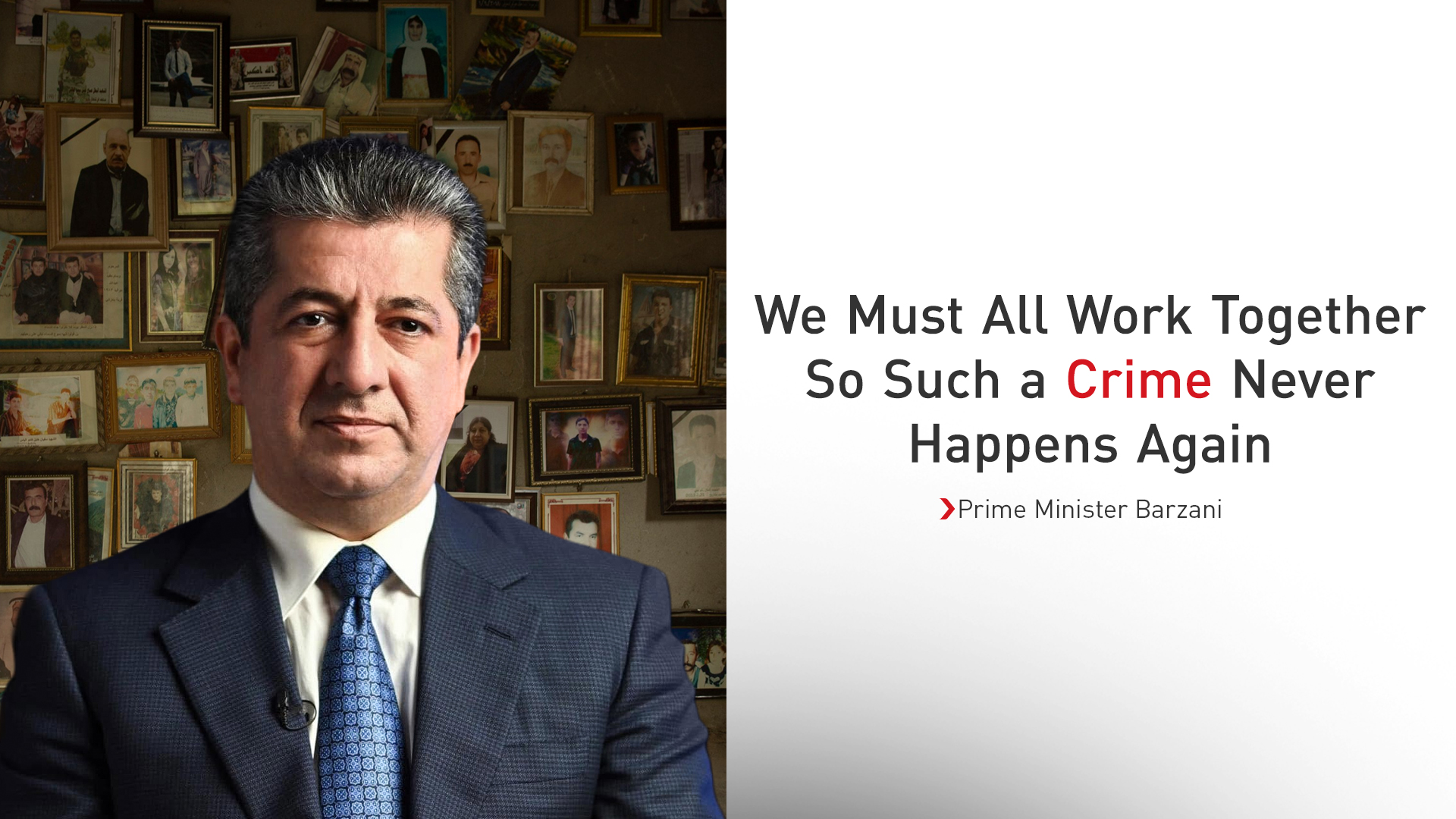
I reiterate: we must all work together to ensure that such a crime never happens again—not against our Ezidi brothers and sisters, not against our Christian brothers and sisters, and not against our Muslim brothers and sisters. Terrorism knows no religion and no nation; terrorism is an assault on humanity itself. Therefore, the cooperation and support of everyone is required to ensure that terrorism never resurfaces in Iraq. One of the primary ways to prevent the rise of terrorism is the establishment of justice, equality, and respect for the rights of every religion and every ethnicity.
As the Regional Government, we will continue—with the help of all our friends and specifically through coordination at the federal government level—to ensure that violence never returns to this land. Our people are exhausted; we need peace, we need progress, and we need our children to be certain that a brighter future awaits them. We must not allow the fear of killing, arrest, and kidnapping to persist in our country. I call on all our friends to join hands with us to end this threat and these crimes once and for all.
Once again, I call on the federal government to assist in the implementation of the Sinjar Agreement, so that all our people can return to their cities and villages with pride, have their livelihoods secured, and receive the reparations they are entitled to—particularly in light of the profound and unjust crimes committed against them.
I thank all of you for being here today. Let the commemoration of this genocide not merely be a one-day ceremony; rather, let it be a solemn vow for us to struggle and strive together until we end these tragedies and restore a life of dignity for our Ezidi brothers and sisters, and for all the people of Kurdistan and Iraq.
Thank you all once again. May you always be tall, successful, and proud. May our Kurdistan remain ever-prosperous.
This report was updated on Monday, Aug. 3, 2026, at 11:07am.