Türkiye's Peace Process Bill Moves Forward After DEM Party Signs 12-Article Proposal
The 12-article bill, designed as part of the "Terror-Free Türkiye" initiative and the peace process, is expected to be submitted to parliament after receiving the backing of multiple political parties
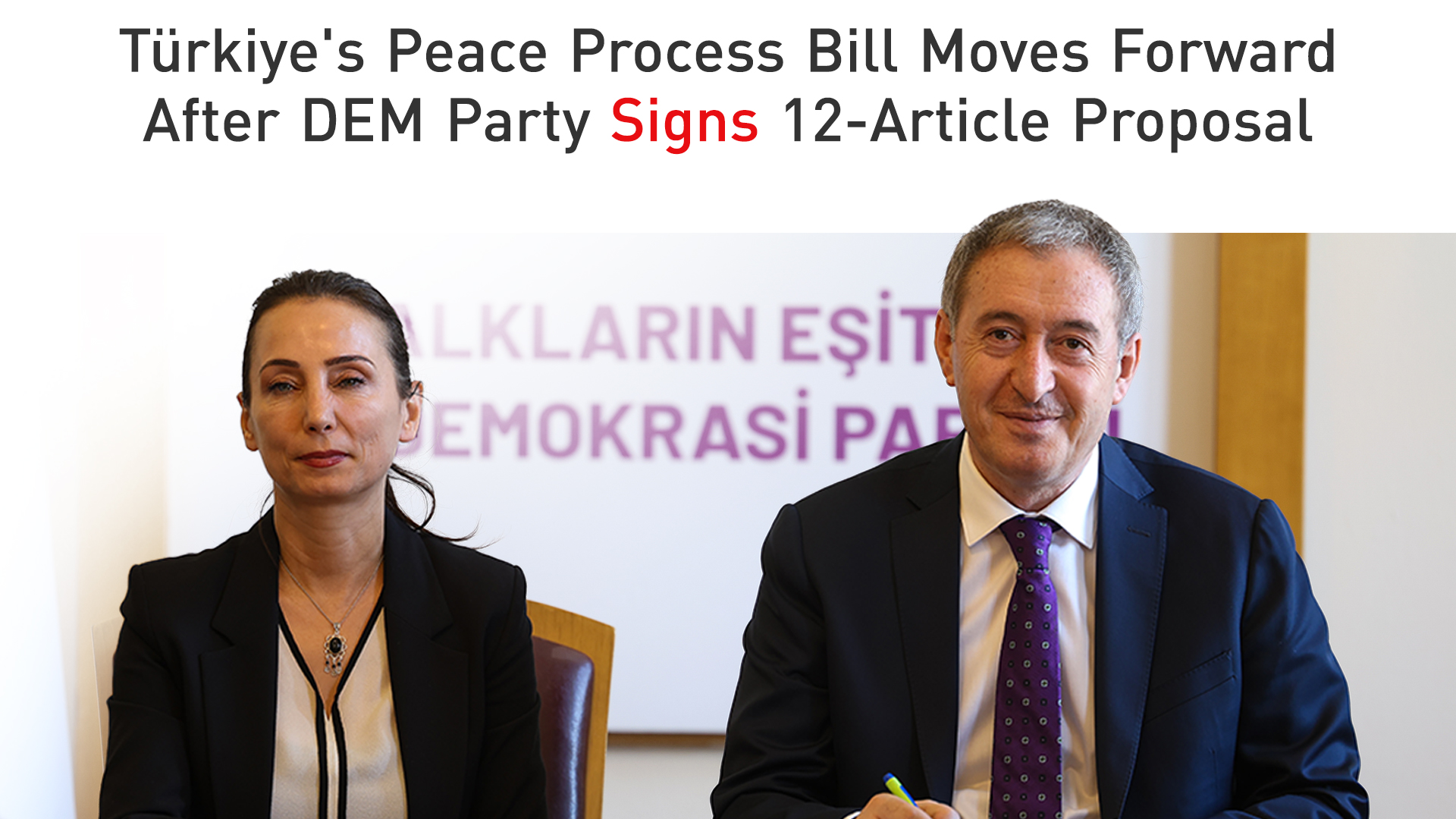
ERBIL (Kurdistan24) - Türkiye's Peoples' Equality and Democracy Party (DEM Party) announced on Wednesday that it has signed a 12-article framework bill prepared as part of the country's ongoing peace process, paving the way for its submission to the Turkish Grand National Assembly (TBMM).
The party said the proposal was signed by Co-Chairs Tülay Hatimoğulları and Tuncer Bakırhan, together with the party's deputy parliamentary group leaders, parliamentary leadership, chief administrative officer, party spokesperson, Women's Assembly spokesperson, members of the Imrali delegation, members of the Parliamentary Justice Commission, and members of the National Solidarity, Brotherhood and Democracy Commission.
In a statement on Wednesday, the DEM Party said: "Our delegation, consisting of our Co-Chairs Tülay Hatimoğulları and Tuncer Bakırhan, our deputy parliamentary group leaders, our parliamentary leadership, our chief administrative officer, our party spokesperson, our Women's Assembly spokesperson, our Imrali delegation members, our Parliamentary Justice Commission members, and our National Solidarity, Brotherhood and Democracy Commission members, today signed the Bill on Strengthening National Solidarity and Social Integration in Parliament."
With DEM Party's endorsement, the proposal is set to be submitted to parliament bearing the signatures of the Justice and Development Party (AK Party), the Nationalist Movement Party (MHP), and DEM Party.
The report also said four lawmakers from HÜDA PAR signed the proposal. Those signatories are HÜDA PAR Chairman and Istanbul MP Zekeriya Yapıcıoğlu, Gaziantep MP Şahzade Demir, Batman MP Serkan Ramanlı, and Mersin MP Faruk Dinç.
The Republican People's Party (CHP) also announced that it would sign the proposal later on Wednesday.
AK Party finalizes preparations
Earlier on Wednesday, AK Party parliamentary group leader Abdullah Güler and Deputy Chairman Efkan Ala chaired a closed-door meeting to brief lawmakers on the proposed legislation, which was prepared within the framework of the "Terror-Free Türkiye" initiative.
The meeting lasted approximately one and a half hours and focused on the proposed "Law on Strengthening National Solidarity and Social Integration," which is scheduled to be submitted to the Speaker of Parliament.
Asked whether the proposal would be submitted during the day, Güler replied that it would.
The internal signature process within the AK Party parliamentary group concluded after all lawmakers were instructed to sign the proposal before the deadline, which expired at 5:00 p.m. on Tuesday.
Following Wednesday's briefing, the bill received its final revisions ahead of its expected submission to parliament.
According to the parliamentary rules of procedure, deliberations on the proposal may begin in the Parliamentary Justice Commission 48 hours after it is formally submitted, although that waiting period can be waived if a decision is taken. After committee review, the legislation will be referred to the General Assembly, where it is expected to be considered this week.
Wednesday also marks the first legislative step following the National Solidarity, Brotherhood and Democracy Commission's inaugural meeting.
The 12-article proposal, titled the Law on Strengthening National Solidarity and Social Integration, outlines the legal framework for measures associated with the peace process.
According to the draft, the legislation covers offenses related to establishing or leading the PKK/KCK, membership in the organization, knowingly assisting it, conducting its propaganda, offenses committed within the organization's activities, and crimes under Law No. 6415 on the Prevention of the Financing of Terrorism committed on behalf of the organization.
The proposal excludes intentional homicide committed within the framework of organizational activities, as well as crimes committed before June 1, 2005, that carry life imprisonment or aggravated life imprisonment.
Eligibility under the law would be determined by the judicial authorities currently handling investigations or prosecutions. Applications to benefit from the law could be submitted either to the relevant Chief Public Prosecutor's Office or to institutions designated by the oversight board.
For offenses carrying a maximum prison sentence of 15 years or less, investigations and prosecutions would be postponed for five years. Cases involving sentences exceeding 15 years, life imprisonment, or aggravated life imprisonment would be deferred for 10 years.
Appeals against postponement decisions could be filed within two weeks. Detention or judicial control measures related to offenses subject to postponement would be lifted where legal conditions are met.
Cases currently under appellate review would be returned to the trial court to issue postponement decisions. If no new offense is committed during the postponement period, authorities would issue either a decision not to prosecute or dismiss the case.
The proposal also provides for postponing the execution of prison sentences. Sentences totaling 15 years or less would be suspended for five years, while longer sentences, including life imprisonment and aggravated life imprisonment, would be suspended for 10 years by decision of the enforcement judge, subject to appeal. If no new offense is committed during the postponement period, the sentence would be deemed served.
Statutes of limitations would not run during postponement periods.
The draft further states that postponement decisions would be reviewed periodically by the oversight board. Where deemed appropriate, the board could request the criminal peace judgeship, trial court, or enforcement judge to remove all legal disabilities arising from investigations, prosecutions, or convictions. Such requests could be made after two years in cases involving five-year postponements and after three years in cases involving 10-year postponements.
The proposal establishes an oversight board chaired by the Vice President and comprising the ministers of Justice, Foreign Affairs, Interior, and National Defense, along with the Presidential Secretary-General, the head of the National Intelligence Organization (MIT), and the Secretary-General of the National Security Council.
The Presidential Secretariat would coordinate implementation, while a 17-member Parliamentary Monitoring Commission would oversee activities carried out under the law.
The draft also envisages a joint directive prepared by the ministries of National Defense and Interior, in consultation with security institutions, governing the registration procedures for surrender and disarmament.
Individuals wishing to benefit from the legislation would be required to submit written applications within six months of the publication of the relevant National Security Council decision in the Official Gazette.