PM Barzani: Kurdistan Region Will Not Be Part of Regional War
Speaking in an interview with Al Jazeera, Barzani said the Kurdistan Region’s position had been clear from the beginning: it does not want to be part of any war in the region.
ERBIL (Kurdistan24) – Kurdistan Region Prime Minister Masrour Barzani said Sunday that the Kurdistan Region will not be drawn into the ongoing regional conflict, stressing that Erbil favors peaceful solutions and respects Iraq’s sovereignty and territorial integrity.
Speaking in an interview with Al Jazeera, Barzani said the Kurdistan Region’s position had been clear from the beginning: it does not want to be part of any war in the region.
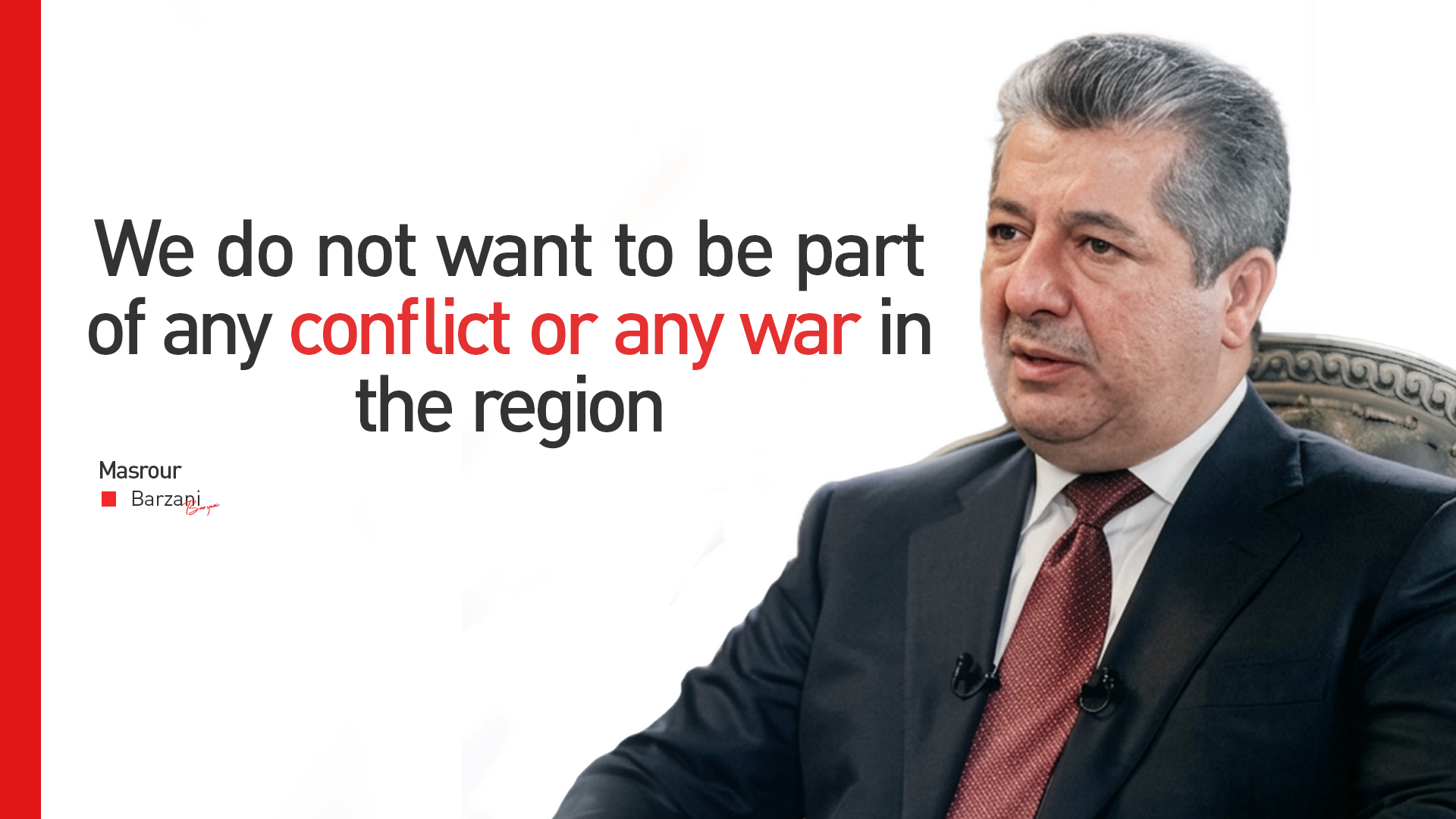
“We do not want to be part of any conflict or any war in the region,” Barzani said, adding that the region had not started the war and was focused on protecting itself.
He said the Kurdistan Region prefers peaceful settlements that respect the interests of all sides and called for Iraq’s sovereignty and the integrity of the Kurdistan Region to be respected.
Barzani also rejected claims that the Kurdistan Region had faced pressure from any side to join the conflict, saying Erbil’s national interests remained its priority.
“We respect our relations with our friends, but we do not want to be part of a new war,” he said.
The prime minister said the conflict had had a devastating impact on the region’s economy and created significant uncertainty. He expressed hope that the war would end soon.
More than 1,000 attacks
Barzani said the Kurdistan Region had been targeted more than 1,000 times by missiles and drones launched directly from Iran or from inside Iraq by militias.
He described the attacks as unjustifiable, saying they had caused casualties and severely damaged infrastructure across the region.
“Kurdistan is not a part of this war,” Barzani said, adding that his government had taken every possible measure to ensure the region did not pose a threat to neighboring countries or regional powers.
He also rejected claims that Harir Air Base was hosting U.S. forces, saying the base had been empty for years and that the coalition had originally used it during the campaign against ISIS.
Barzani said U.S. forces that had been present in Erbil were there as part of a mission to fight terrorism and protect Iraq, including the Kurdistan Region.
Calls for dialogue on Kurdish issues
Addressing Kurdish issues in the region, Barzani said disputes involving Kurds in any country should be resolved through dialogue rather than conflict.
“The best way is dialogue,” he said, arguing that Kurdish people should be able to secure their rights through peaceful agreements with their respective governments.
He reiterated that the Kurdistan Region had not participated in the war and would not become part of it. He also stressed that foreign policy is determined by Iraq’s federal government and that the Kurdistan Region follows Baghdad’s foreign policy.
Baghdad-Erbil relations
Barzani said Iraq’s relations with Iran should be based on mutual respect, trust and national interests, while stressing that Baghdad must remain independent in making decisions concerning its people and national interests.
He also voiced support for Baghdad’s efforts to bring armed groups under state authority, saying no groups outside Iraq’s formal security forces should be allowed to threaten the country or its neighbors.
Barzani said the preferred approach remained peaceful disarmament or integration of such groups into Iraq’s security forces rather than confronting them militarily.
Economic impact of war
The prime minister said the closure of the Strait of Hormuz had directly affected Iraq’s economy because of the country’s heavy dependence on oil exports.
He said economic activity in the Kurdistan Region had also slowed due to missile and drone attacks, while trade with other countries had declined by more than 70 percent.
“If this war continues, I believe that the situation will only get worse” for Kurdistan, Iraq and the wider region, Barzani said.
Barzani said the Kurdistan Region was ready to help Baghdad offset some of its oil-export losses but could not fully compensate for the volume of oil Iraq normally exports from the south.
He said the Kurdistan Region could potentially produce between 300,000 and 400,000 barrels per day with additional investment, while exports from Kirkuk could add to that volume. However, he stressed that these amounts would remain insufficient to replace Iraq’s southern exports.
Federalism remains key to Baghdad-Erbil ties
Barzani said the lack of a federal hydrocarbon law remained one of the key unresolved issues between Baghdad and Erbil.
He argued that Iraq’s Constitution already establishes the rights of the federal government and the Kurdistan Region, but many constitutional provisions have not been translated into legislation.
According to Barzani, greater respect for federalism and implementation of the Constitution would significantly reduce disputes between Baghdad and Erbil.
He also highlighted the need to resolve outstanding issues including Article 140, oil and gas legislation, taxation and the division of powers between the federal government, the Kurdistan Region and the provinces.
Kurdistan Region's economic diversification
Barzani said the Kurdistan Regional Government had pursued economic reforms, anti-corruption measures and diversification efforts to reduce dependence on oil.
He pointed to investment in agriculture, industry, tourism, education and healthcare, as well as digitalization of government services.
He also called for similar economic diversification across Iraq, urging greater support for the private sector and banking sector rather than continued dependence on government employment.
Relations with Türkiye and Syria
Barzani described relations between the Kurdistan Region and Türkiye as very good, citing strong economic ties, trade and mutual understanding.
He said around 800 villages in the Kurdistan Region remained destroyed as a result of past conflict along the border, but welcomed Türkiye’s recent peace initiative and said Erbil supported efforts toward a peaceful settlement.
On Syria, Barzani said developments over the past two years had been positive and constructive despite remaining challenges.
He said the Kurdistan Region had supported dialogue between Damascus and Syria’s Kurds and welcomed the development of relations between Erbil and Damascus.
Barzani also said Syrian President Ahmed al-Sharaa had ordered that citizenship be granted to Kurds in Syria, although he was unsure whether the process had been completed.
He stressed that trust would be essential to resolving outstanding issues in Syria and said the participation of Kurds in the Syrian parliament and cabinet represented a new phase.
'Very hopeful' about Kurdistan Region's youth
Barzani said Kurdistan Region'’s younger generation has higher expectations because it has grown up with greater access to the outside world and information.
He described the younger generation as “very vibrant,” smart and well educated, adding that he was “very hopeful and very optimistic” about its future.
Barzani also stressed the importance of Kurdish political parties putting national interests ahead of partisan interests, saying political differences were natural but a common national interest should remain the priority.