KRG Interior Minister: Kurdistan Region Not Part of Regional Conflicts, Seeks Clarification from Iran Over Attacks
Ahmed also said an agreement had been reached between the KRG, the Iraqi government and oil and gas-producing companies on the deployment of defensive systems to protect oil fields.
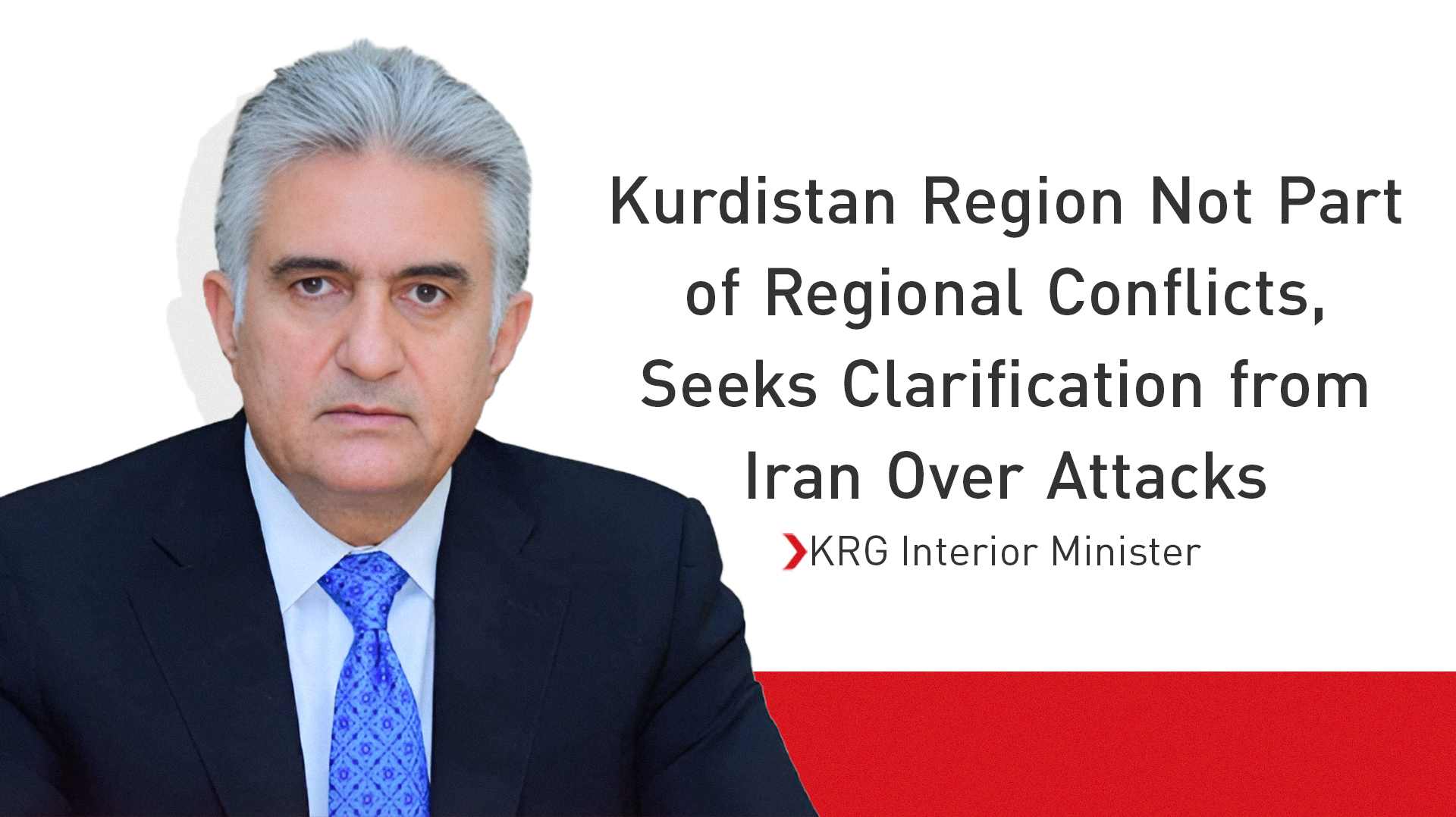
ERBIL (Kurdistan24) – Kurdistan Region Interior Minister Rebar Ahmed said on Thursday that the Kurdistan Region is not a party to regional wars and conflicts and has requested clarification from Iran over recent attacks targeting the region.
Speaking at a press conference, Ahmed said the Kurdistan Region has repeatedly come under drone attacks, while Peshmerga positions have also been targeted, resulting in casualties.
He said civilians had also been attacked, most recently when drones targeted the private office of Kurdistan Region Prime Minister Masrour Barzani and the home of the head of the Kurdistan Region’s Security and Intelligence Agency (Parastin).
Ahmed said the Parastin official's family and children were inside the residence when it was attacked, describing the incident as contrary to "all moral, religious, and humanitarian values."
"We have requested clarification from Iran and asked it to provide us with a convincing response," Ahmed said.
He added that the Kurdistan Regional Government (KRG) was coordinating with the Iraqi government over the attacks.
"Iraqi Prime Minister Ali al-Zaidi and security and intelligence officials contacted us from the first day, expressing their sympathy and support for the Kurdistan Region," Ahmed said, adding that coordination was also underway to jointly discuss the issue with Iran.
He said the attacks were also discussed during Iranian Parliament Speaker Mohammad Baqer Qalibaf's visit to Baghdad on Wednesday, adding that the Kurdistan Region was awaiting an official explanation from Tehran.
Coalition forces
Addressing the withdrawal of US-led Coalition forces from Iraq and the Kurdistan Region, Ahmed said their presence had been based on a request from the Iraqi government to combat terrorism and ISIS.
He said the current security situation requires a reorganization of the relationship between Iraq and Coalition forces, while stressing that the Kurdistan Region does not want a security vacuum to emerge.
"Security and stability are a priority for both the Iraqi and Kurdistan Region governments," Ahmed said, calling for an understanding between Baghdad and Coalition forces to ensure that their presence or withdrawal does not have negative consequences.
Ahmed also thanked the countries and parties that had expressed support following the recent attacks, including Iran's vice president.
"However, this issue is related to them, and we need the necessary clarification from them," he said.
Regarding Patriot and counter-drone systems, Ahmed said their deployment falls within the responsibilities of Coalition forces, adding that Coalition officials are best positioned to determine where such systems are needed if changes are made.
"We hope measures will be taken to prevent any further pressure on us," he said.
"Our position has not changed. We do not consider ourselves part of the wars and conflicts in the region. The KRG has never been part of these conflicts and is not opposed to any neighboring or regional country."
Relations with Washington
On relations with the United States, Ahmed said the Kurdistan Region's relationship with Washington, like its relations with other countries, is based on mutual interests.
"Our mutual interests with these countries continue to this day," he said, adding that the Kurdistan Region would not side with an international power against a regional country, or vice versa.
"We have sought to maintain a balance and preserve our relations," he said.
Defense systems for oil fields
Ahmed also said an agreement had been reached between the KRG, the Iraqi government and oil and gas-producing companies on the deployment of defensive systems to protect oil fields.
He said the companies had expressed readiness to provide the systems and that the Iraqi government had approved the plan.
"The operation of these systems will be coordinated with the KRG," Ahmed said, adding that there were no obstacles and that the region was waiting for Baghdad to accelerate the necessary steps.
Makhmur camp
Responding to a question from Kurdistan24 correspondent Havrest Rajab about the return of Kurdish people from Northern Kurdistan (southeastern Turkey) at the Makhmur camp, Ahmed said the issue was closely linked to discussions between Turkey and the Kurdistan Workers' Party (PKK) regarding the peace process.
He said the Iraqi government was serious about resolving the Makhmur camp issue and that talks were underway between Baghdad, the KRG and Turkey.
"As the KRG, we fully support the talks between Turkey and the PKK," Ahmed said.
He expressed hope that recently taken legal steps would soon move into the implementation phase, allowing the residents of the camp to return to their homeland.