Kurdish Farmer Grows Black and Red Rice in Kurdistan Region for the First Time
Hassan Mala Musa of the Barzan area brings seeds from China and produces 100 percent natural varieties with documented health benefits for diabetics and cancer patients, selling at 6,000 dinars per kilogram
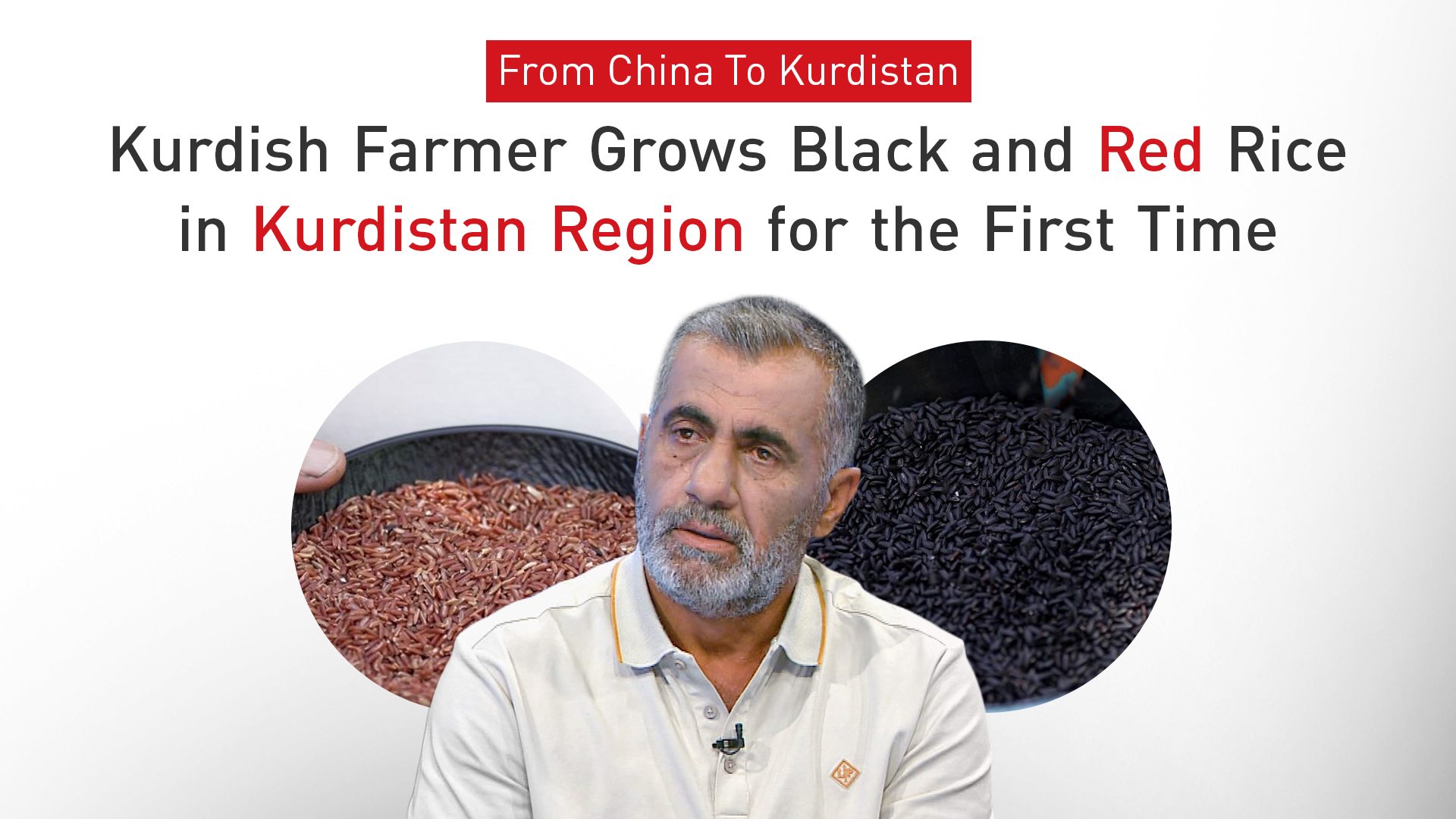
ERBIL (Kurdistan 24) - A Kurdish farmer from the Barzan area has successfully cultivated black and red rice in the Kurdistan Region for the first time, opening a new chapter in the Region's rapidly expanding agricultural sector after three years of careful experimentation that began with seeds imported directly from China.
Hassan Mala Musa, a farmer from the Barzan area, spoke during his participation in Kurdistan 24's economic news tour on Sunday, sharing the story of three years of work that produced a harvest now drawing attention from across the Kurdistan Region.
Hassan told Kurdistan 24 that the idea came to him from China, and that he imported the seeds of both varieties directly from there. Three years ago, as an initial experiment, he brought 150 kilograms of black rice seeds and 150 kilograms of red rice seeds, uncertain whether Kurdistan's soil would be suitable for these varieties. The experiment succeeded and produced a good yield, validating his decision to continue and expand.
The rice is cultivated in the Barzan area, whose climate and soil Hassan described as very well suited to the crop. The growing cycle requires five months, planted in the fifth month of the year and harvested in the tenth, and the water requirements are equivalent to those of conventional rice varieties. The rice is planted across an area now producing nearly one to two tons of output.
The most significant characteristic of both varieties, Hassan emphasized, is that they are 100 percent natural. No artificial fertilizers or chemical compounds were used at any stage of planting or growing, and the color is entirely natural, requiring no additives during preparation or cooking.
On the health benefits, Hassan explained that this rice is not merely a food but functions as a natural medicine. Based on research and medical guidance, he said, the black and red rice is highly beneficial for people with diabetes, high blood pressure, and cancer. Those with diabetes who cannot eat white rice can consume these black and red varieties without difficulty, making the crop particularly valuable for a growing population of patients managing chronic conditions.
On cost and pricing, Hassan disclosed that purchasing the seeds from China was expensive, reaching approximately $40 per kilogram at the point of acquisition. However, the produced rice is currently sold in the market at 6,000 Iraqi dinars per kilogram. Hassan sells his produce through social media platforms and expressed his readiness to provide guidance and seeds to any farmer wishing to cultivate these varieties in their own areas.
Hassan also announced that a third variety is in the pipeline. A naturally green rice variety exists in China, and he intends to import its seeds and test it in Kurdistan in the future.
The cultivation of black and red rice in the Kurdistan Region represents a significant step in the agricultural sector, as these varieties are generally produced in East Asian countries such as China and Thailand. The development comes as the Kurdistan Region's rice cultivation has expanded considerably in recent years, with more than 20,000 dunams of land planted with rice this year and production expected to reach 25,000 tons, as rice has become an increasingly attractive crop for Kurdish farmers due to its favorable market price.
Rice holds a central place in the daily diet of Kurdistan Region households. Many families consider a day incomplete without it, and the prospect of locally grown Kurdish rice carries a cultural resonance that goes well beyond its nutritional or commercial value.