Kurdistan Region President: Constitution Key to Resolving Erbil-Baghdad Disputes
“We had a good meeting with the PUK last week. We will hold another meeting this week or at the beginning of next week, hoping to reach a solution,” he said.
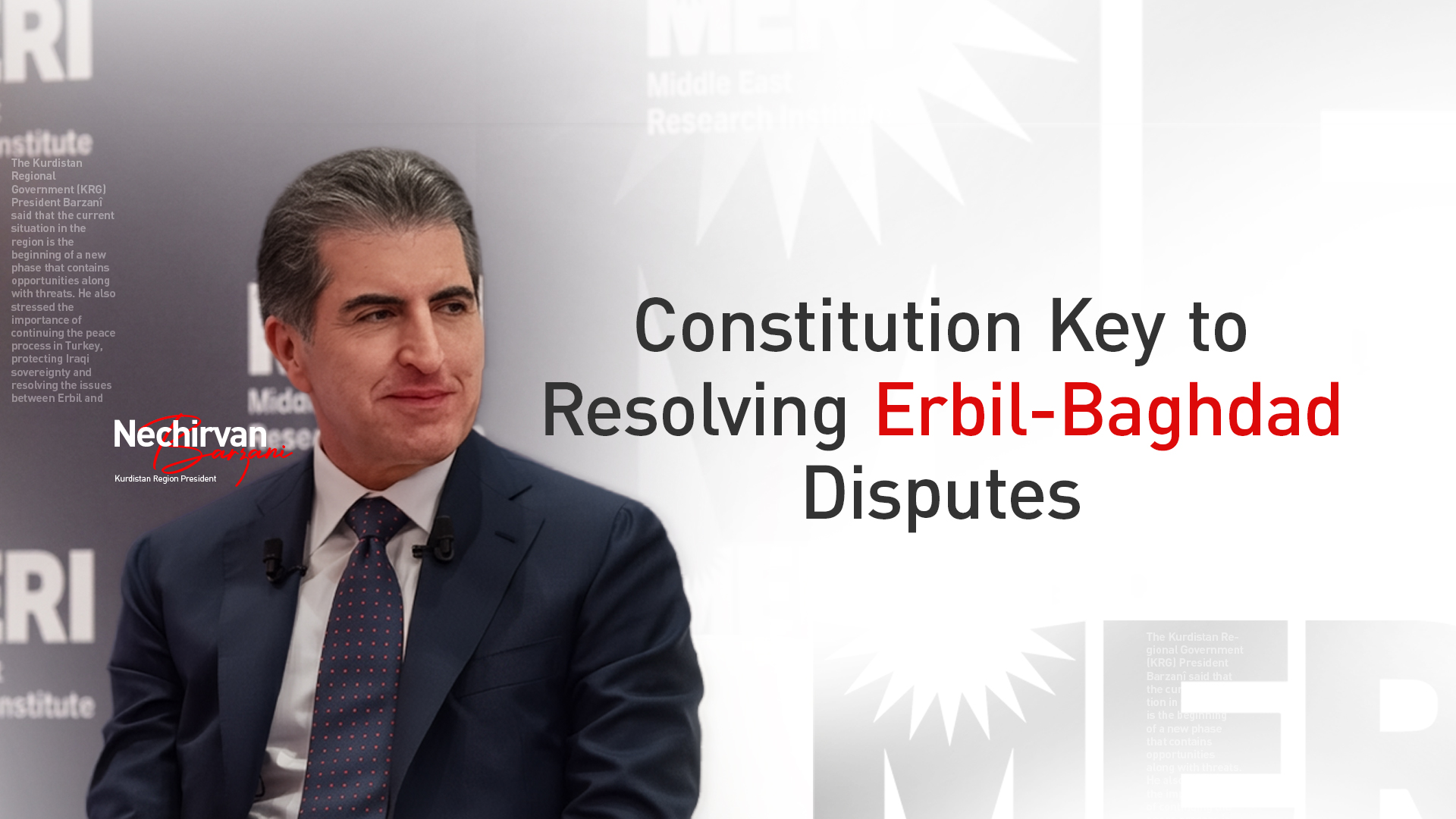
ERBIL (Kurdistan24) — Kurdistan Region President Nechirvan Barzani on Monday described the current situation in the Middle East as the beginning of a new era presenting both challenges and opportunities, stressing the need to advance Turkey’s peace process, safeguard Iraq’s sovereignty, and resolve outstanding disputes between Erbil and Baghdad through the constitution.
Speaking at a special panel during the Middle East Research Institute (MERI) Forum in Erbil, Barzani addressed regional conflicts, the Kurdish question in Turkey, Syria, and Iran, the future of international coalition forces in Iraq, and efforts to form the Kurdistan Region’s next government.
Turkey’s peace process needs patience
Barzani described the peace process in Turkey as a serious initiative, saying his meetings with Turkish officials, including President Recep Tayyip Erdoğan, had convinced him that both the Turkish government and Abdullah Öcalan, the imprisoned leader of the Kurdistan Workers’ Party (PKK), were committed to the process.
Although progress has been slow, Barzani said this was understandable given the conflict’s four-decade history.
“Even if the process has not yet achieved significant results, it has at least halted military confrontation between the two sides,” he said, adding that the steps taken so far were moving in the right direction.
He emphasized that the Kurdistan Region’s role was to support the process and fulfill its responsibilities, urging patience as efforts continued.
“Anyone who can resolve the Kurdish issue in Turkey deserves to win the Nobel Peace Prize,” Barzani said.
He also stressed that the Kurdish question must be addressed according to the specific circumstances of each country, arguing that progress in resolving it elsewhere would open a new chapter for the Kurdistan Region and enable Turkey to play a greater role in the region.
Kurdish rights in Syria require constitutional guarantees
Turning to Syria, Barzani praised Kurdish leaders for making what he described as realistic decisions in response to developments in the country. He cautioned against assuming that the Kurdistan Region’s political model could be replicated in Syria, citing differences in geography and social structure.
Barzani said his meeting with Syrian President Ahmed al-Sharaa had left him convinced that the Syrian leader was not opposed to the Kurds.
He also pointed to progress in discussions on integrating forces, Kurdish-language education, and recognition of Kurdish identity.
However, he stressed that lasting progress would depend on enshrining the rights of Kurds and other communities in a permanent constitution within a unified Syria.
“It is very important for the Kurds to have a unified position to secure their rights,” he said.
Barzani added that the reception given to the Kurdistan Region’s delegation in Damascus indicated a willingness on the Syrian president’s part to address outstanding issues. Nevertheless, he cautioned that rebuilding Syria would take considerable time, given the scale of the country’s challenges.
Kurdistan Region will not become part of Iran war
Addressing the war involving Iran and the situation of Kurdish political forces in Eastern Kurdistan (Western Iran), Barzani criticized what he described as irresponsible statements and social media content that had placed the Kurdistan Region in a dangerous position.
“Our policy has been clear since the beginning of the war. We will not become part of the conflict, and the Kurdistan Region must not become a source of threat to Iran,” he said, describing such a scenario as unconstitutional and wrong.
Barzani said the Region had also informed Iran that it would not allow its territory to be used in that way.
He described the conflict and Iraq’s strategic circumstances as a significant test for the Kurdistan Region, saying Kurdish political forces had worked together despite their differences to preserve stability and protect the Region’s interests.
Regarding the Kurdish question in Iran, Barzani said opportunities would eventually emerge for Kurds in Eastern Kurdistan, although the situation had not yet reached the same stage as the peace process in Turkey.
He stressed that the issue could not be resolved through denial or imposition, urging Kurdish political forces to assess the circumstances realistically.
Barzani also confirmed that reports of the Kurdistan Region’s mediation efforts between Iran and the United States were partly accurate.
“We played that role, and our efforts were positively received in both Washington and Tehran,” he said.
Iraq must protect sovereignty beyond coalition withdrawal
On the future of international coalition forces in Iraq, Barzani recalled that the coalition had arrived at Baghdad’s request to fight the Islamic State (ISIS), with the United States leading the effort.
After a decade, he said, circumstances had changed, making it understandable that Iraq might no longer require a coalition of the same size.
However, he argued that safeguarding Iraq’s sovereignty required more than withdrawing foreign forces.
Iraq must strengthen its international relations, protect its airspace, and exercise control over weapons held by armed groups, Barzani said, adding that attacks on neighboring countries must not originate from Iraq or the Kurdistan Region.
He also highlighted the contributions of Iraqi security forces and the Peshmerga in defeating ISIS on the ground, reaffirming the Peshmerga’s readiness to make sacrifices to protect the country.
Barzani said Iraq needed both an effective defense system and strong diplomacy and dialogue to address future threats.
Constitution key to resolving Erbil-Baghdad disputes
Barzani identified the failure to implement Iraq’s constitution as the fundamental cause of longstanding disputes between the Kurdistan Regional Government (KRG) and the federal government in Baghdad.
He said Iraq’s federal system was not being implemented in practice and that the Kurdistan Region continued to be governed through outdated laws, an approach he said successive Iraqi prime ministers had maintained.
“The key to resolving these issues is the constitution, because its implementation would ensure that everyone feels they are equal citizens,” he said.
Barzani identified the distribution of wealth and natural resources, oil and gas legislation, fair revenue allocation, and the Federal Supreme Court as among the key issues requiring resolution.
Addressing these matters, he said, would make it easier to settle other outstanding disputes between Erbil and Baghdad.
KDP-PUK talks offer hope for new KRG cabinet
Barzani acknowledged that the prolonged delay in forming the Kurdistan Region’s next government had created a negative record, but expressed hope that renewed discussions between the Kurdistan Democratic Party (KDP) and the Patriotic Union of Kurdistan (PUK) would lead to progress.
“We had a good meeting with the PUK last week. We will hold another meeting this week or at the beginning of next week, hoping to reach a solution,” he said.
He added that the two main Kurdish parties had moved closer in their positions on strategic issues, describing the convergence as an encouraging sign for the political process.
The formation of a new cabinet remains a key challenge for the Kurdistan Region as political parties continue negotiations over the next administration and the priorities it will pursue.