Adel Bakawan on Kurdistan’s Political Deadlock, Iraq’s Militias and U.S. Presence
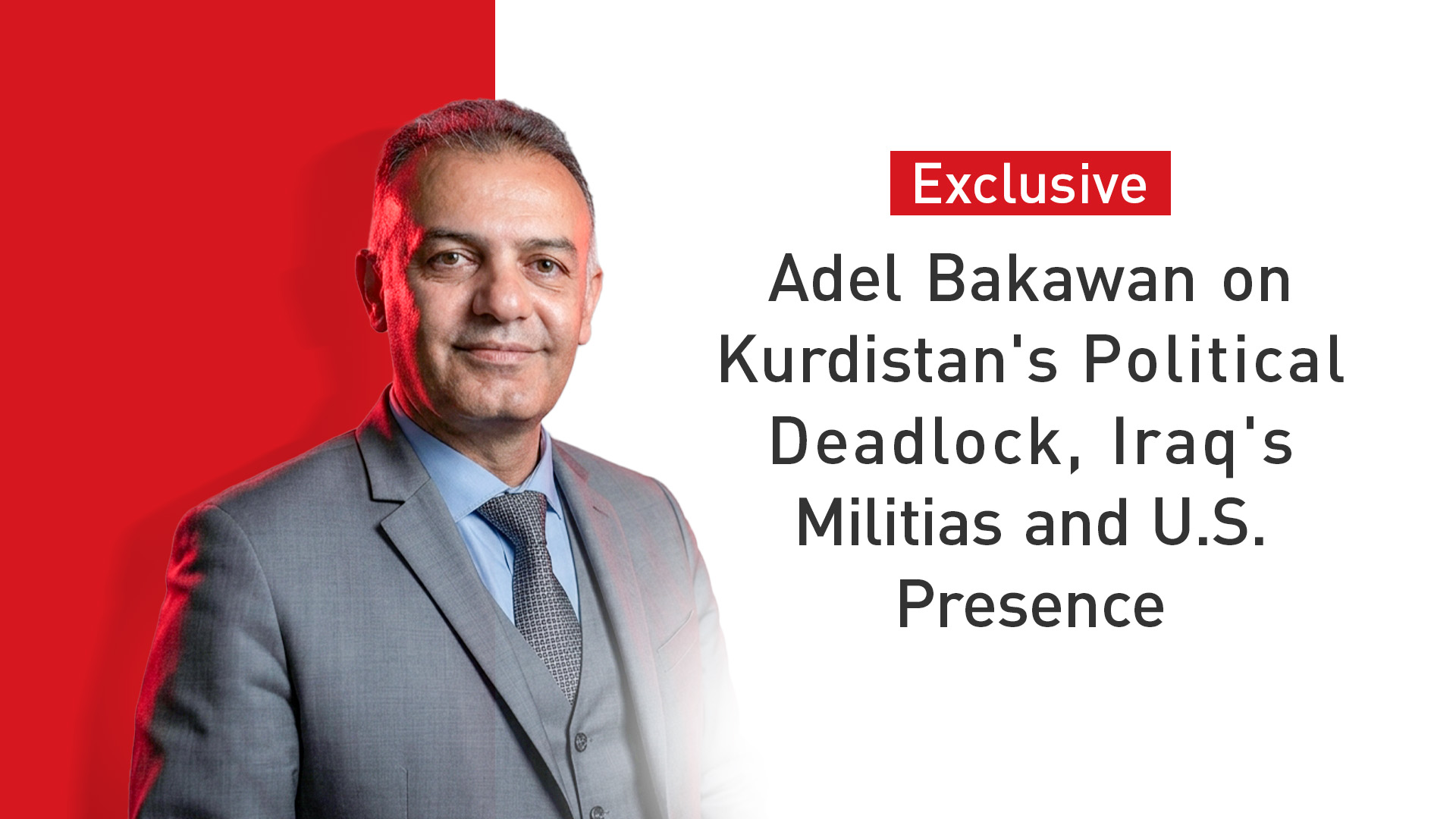
ERBIL (Kurdistan24) - In a bold and candid interview, Dr. Adel Bakawan, sociologist and director of the French Institute for Research on the Middle East, analyzes the complex political landscape. Why have the Kurdish parties failed to reactivate Parliament despite their good social relations? Can Zaidi disarm Iraq’s factions, or were they the ones who brought him to power? What would a far-right victory in France mean for the Kurdistan Region? And what is the difference between the “institutional America” of the Biden era and the “impulsive America” of the Trump era?
Full interview:
Kurdistan24's Kovan Ezzat: Good evening. I have an important interview today. We will discuss the situation in the Kurdistan Region, relations between the Patriotic Union of Kurdistan and the Kurdistan Democratic Party, the formation of a new government cabinet and the reactivation of Parliament.
We will also discuss Iraq more broadly: Is there a scenario for a U.S. withdrawal? Will the armed groups lay down their weapons? Will there be a confrontation between the government and the militias, or where is Iraq heading? We will also discuss the U.S.-Iranian conflict and the stage it has reached.
We will address the French elections as well. As you know, the Kurdistan Region has good relations with France, and we will examine what may happen to those relations, particularly since Macron will not return to the presidency. More broadly, we will discuss the global situation.
My guest is Dr. Adel Bakawan, director of the French Institute for Research on the Middle East. I will discuss all these issues with him. Welcome, Doctor.
Dr. Adel Bakawan: Thank you, Kak Kovan.
Kovan Ezzat: Doctor, what is the reason for your visit to Kurdistan?
Dr. Adel Bakawan: To see you.
Kovan Ezzat: Thank you. Just me?
Dr. Adel Bakawan: You and several other people.
Kovan Ezzat: Several other people. Thank you. Doctor, you met with President Barzani. Let us begin by discussing the situation in the Kurdistan Region.
Dr. Adel Bakawan: Yes.
Kovan Ezzat: You met President Barzani, and I am sure you are meeting other figures as well. What did you discuss? Tell us what you are able to say, and I would like you to speak candidly. There are things you are free to disclose and others that perhaps should not be disclosed, but what can you tell us?
Dr. Adel Bakawan: Certainly. We discussed a number of strategic issues concerning the Kurdistan Region. We did not discuss “micro” issues but “macro” issues—the major questions. Micro issues are the everyday problems occupying people domestically. Macro issues are the grand narratives related to the Kurdistan Region’s existential and strategic questions.
Kovan Ezzat: Very well. Let us discuss the Kurdistan Region’s internal situation. What specifically did you discuss regarding the reactivation of Parliament, the formation of the new government, relations between the KDP and PUK, and the Region’s overall situation?
Dr. Adel Bakawan: Look, Kak Kovan, President Barzani’s office has an official spokesperson who speaks on his behalf. As I told you, my meeting with him concerned the Kurdistan Region’s strategic issues. It would therefore be difficult for me to say, “President Barzani thinks this,” or, “He said that.”
As you know, I direct a research institute concerned with the Middle East. Everything I say consists of analysis based on information. Such analysis does not damage relations between states or the Kurdistan Region’s regional and national relationships. Yet a single statement that I might relay from President Barzani could upset the entire balance.
Kovan Ezzat: Give me one analysis.
Dr. Adel Bakawan: Do you remember that I met President Barzani approximately nine months ago? I relayed only one sentence: that the Kurdistan Region was ready to support Western Kurdistan—Rojava in Syria—and would not leave it alone.
Kovan Ezzat: Yes, that happened.
Dr. Adel Bakawan: And that is precisely what happened. What the Kurdistan Region did for Rojava was not done by France, the United States or anyone else. But did you notice the uproar caused merely by relaying that sentence?
Parliament’s Continued Suspension Is No Longer a Crisis for Society or the Opposition. Why Don’t Half a Million Voters Take to the Streets to Pressure Those in Power?
Kovan Ezzat: Very well. You want those discussions to remain private and do not wish to speak about them. But regarding the formation of the new cabinet, the reactivation of Parliament and relations between the PUK and KDP—you speak with both sides and with everyone. Are relations between them good?
Dr. Adel Bakawan: Those are two entirely different questions: Are their relations good? And will Parliament be reactivated and the tenth cabinet formed? They are separate matters.
Kovan Ezzat: Does a good relationship not lead to those outcomes?
Dr. Adel Bakawan: No. My relationship with you could be excellent, yet I could still refuse to appear on your program.
Kovan Ezzat: So relations are good, but they are not moving toward reactivating Parliament?
Dr. Adel Bakawan: You and I could have dinner together, meaning that our relationship is excellent, but we might not agree to present a program together. The KDP and PUK have known one another for more than half a century. Their leaders, political bureaus and cadres interact with one another every day.
One side is not Afghan and the other Pakistani; they are not Chinese and American. They are the children of the same homeland and the same nation.
Kovan Ezzat: Yet these children of the same homeland have spent almost two years without reactivating Parliament or forming a government.
Dr. Adel Bakawan: Yes, that is the first part of your question. They are bound together by social, tribal and cultural relations, as well as by language and land. They sit together in cafés, go to the cinema and swim together. Everything brings them together.
Kovan Ezzat: But Parliament does not bring them together.
Dr. Adel Bakawan: Yes, they have not agreed to reactivate Parliament. As long as they do not agree, reactivating it will be extremely difficult.
Kovan Ezzat: I remember an analysis in which you said that if they did not form a government before the Iraqi parliamentary elections, it would be extremely difficult for them to reach an agreement afterward. What do you say now?
Dr. Adel Bakawan: My hypothesis is that the objective conditions—as I understand them, although I may be wrong, and I sincerely hope that I am—indicate that it will be extremely difficult to reactivate Parliament and form a government before the next elections.
Kovan Ezzat: The next Kurdistan Region elections?
Dr. Adel Bakawan: Yes.
Kovan Ezzat: Whether they are held early or on schedule in two or three years?
Dr. Adel Bakawan: Whenever they are held. I do not believe early elections are possible, because to hold early elections, you must first reach an agreement. How can you agree to early elections when you have not agreed to reactivate Parliament?
Allow me, Kak Kovan, to tell you something. This is a very painful admission, but it is important that we see ourselves as we truly are.
Kovan Ezzat: See ourselves as we truly are?
Dr. Adel Bakawan: Sometimes Kurds believe that we represent the pinnacle of civilization simply because we are Kurdish.
Kovan Ezzat: That is true, and with foreigners they become three or four million.
Dr. Adel Bakawan: Whether you like it or not, since the last century, others have managed to establish something called “traditions of statehood” and governance. We have nothing of the kind. Because we have never possessed a modern state or traditions of statehood throughout our history, we are unable to respect election results.
Why do we hold elections? So that we can go to Parliament, correct? Yet we hold elections and then do not go to Parliament.
Kovan Ezzat: They do not go to Parliament, so why hold elections?
Dr. Adel Bakawan: The purpose of going to Parliament is to form a government. We go there but do not form one. Do you know where the catastrophe lies? Look at Iraq. Iraq is a great catastrophe in the history of states. Yet despite all the disasters of post-Saddam Hussein Iraq, they hold elections, go to Parliament, activate it and form a government.
We in the Kurdistan Region watch them and criticize them day and night—and rightly so—yet they still do these things. Why? Because despite its catastrophes, Iraq possesses traditions of what is called “state administration.”
I once wrote: “I would be the shoelace of the Peshmerga who becomes the first border guard of a Kurdish state.” I do not praise Qatar because I love it. My job is to describe reality as it is. Unfortunately, in this part of the world, we lack traditions of state-building. We hold elections but do not go to Parliament.
The greater catastrophe, Kak Kovan, is that even this situation creates no problem within Kurdish society. Set aside the KDP and PUK—they are the parties in power. Society criticizes them day and night. But why does this society not take to the streets and exert immense pressure on them, saying: “Parliament is sacred to us. How can you hold elections and then refuse to enter it?”
Kovan Ezzat: Set society aside.
Dr. Adel Bakawan: I will tell you the truth. Do you not have an opposition? The opposition’s primary task is to scrutinize the mistakes of those in power. If the government’s greatest mistake is paralyzing Parliament, and these opposition parties received the votes of more than 500,000 people, why do they not mobilize that half-million and bring them into the streets to compel those in power to reactivate Parliament?
Do you know why? Because Parliament’s suspension does not constitute a problem or crisis for anyone in Kurdish society—not those in power, not the opposition and not the social movements.
Kovan Ezzat: Where will this situation lead us?
Dr. Adel Bakawan: Imagine elections were held in France and Parliament was not activated. What would happen? All hell would break loose, from the Élysée Palace to the smallest institution. Citizens would not accept it. Institutions, trade unions and independent voices would not accept it.
We are dealing with the Kurdistan Region with complete irresponsibility.
Kovan Ezzat: And where will that lead us?
Dr. Adel Bakawan: When you behave irresponsibly at a time when you must act responsibly, the price may ultimately be very high. There is no such thing as a “sudden explosion” or the “end of the Kurdistan Region” overnight. Political history is not an office whose door you can close with a single decision.
Instead, you enter a historical process. You either strengthen yourself—by reactivating Parliament, unifying the Peshmerga, building a strong economy and creating a unified diplomacy—or you weaken yourself.
Kovan Ezzat: Those are fine words, but none of that is happening on the ground.
Dr. Adel Bakawan: Exactly. Because you are not doing those things, one part after another falls from the “machine”—the engine—day after day, until you reach a point at which the engine can no longer function.
The context is extremely complex, and everyone bears responsibility, from the political parties to the media, the opposition and society.
Kovan Ezzat: It is said that the Kurdistan Region’s defense system no longer exists.
Dr. Adel Bakawan: It still exists at this very moment as we speak. But that is not the issue. The question being raised in the Kurdish media about an “American withdrawal from the Kurdistan Region” reflects a narrow perspective.
The United States does not build its Middle East policy around the Kurdistan Region. The Region is merely a “screw”—a small component—in the much larger American machine. America’s decision is connected to Saudi Arabia, Qatar, Iran, Türkiye, Egypt and Iraq. U.S. policy in the Middle East has not yet been determined.
Everything depends on the direction of the conflict with Iran. The way the balance of power with Iran is managed will determine whether the United States withdraws its defense systems on Sept. 30 from Kuwait, Qatar, Jordan, Saudi Arabia, the United Arab Emirates and the Kurdistan Region—because we are part of that system.
Kovan Ezzat: Under Trump, are both possibilities on the table? Had the previous administration remained in office, would you have had an answer?
Dr. Adel Bakawan: America under Biden was the “America of institutions” and senior diplomats. Under Trump, even his closest advisers say whatever Trump wants to hear.
One French channel presented a statistic: Have you ever seen a president post 39 times in a single day? Trump has made the world disbelieve the words of the American president. The U.S. presidency has lost its credibility.
Trump may wake up and say, “We have taken control of the Strait of Hormuz,” while Iran is still there. European leaders laugh when Trump speaks because they expect him to change his position two hours later.
Former Secretary of State Antony Blinken recently posted: “One of the things we lost in our war with Iran is that the word of the American presidency has lost credibility around the world.”
Armed Factions Hold 183 Seats in Parliament and Formed the Government. How Can Zaidi Disarm Them?
Kovan Ezzat: Will Iraq’s armed groups lay down their weapons?
Dr. Adel Bakawan: No, they will not lay down their weapons. Nor will we see a military confrontation between them and the army.
Kovan Ezzat: Then what is the purpose of all these discussions and statements?
Dr. Adel Bakawan: We have been following the Iraqi issue for 15 years. Have you ever seen an Iraqi prime minister who did not begin with this issue—bringing all weapons under state control?
Is Zaidi serious? Yes, he is serious. Is Zaidi serious about eliminating corruption? Yes. But Zaidi is like Sudani, Sudani is like Kadhimi, Kadhimi is like Abdul-Mahdi, Abdul-Mahdi is like Abadi.
Kak Kovan, if I were the director of your channel and the person who appointed you, would you be able to dismiss me from my job?
Iraq’s militias hold 183 seats in Parliament. They are the ones who brought the prime minister to power, so how can he disarm them?
Kovan Ezzat: Then what is happening? Is it a settling of scores or merely a show?
Dr. Adel Bakawan: It is not a settling of scores. There is extremely intense American pressure to disarm the factions, as well as pressure from Europe and the Gulf states.
Zaidi cannot say “no” to America, and he cannot say “no” to the factions. Diplomacy is not conducted through the word “no.” He is operating within the “realm of the possible.”
He has said clearly that there will be no armed confrontation between the army and the factions. That means dialogue will continue, and it may continue for another year, two years or four years.
On the U.S. Presence: “America Will Not Withdraw Because of Iraq or Kurdistan. Its Decision Is Entirely Tied to the Nature of the Conflict With Iran.”
Kovan Ezzat: So he is preserving the status quo. Is Iraq’s situation unlike that of any other country?
Dr. Adel Bakawan: Iraq’s situation resembles Lebanon’s. Is there any force in the world capable of disarming Hezbollah? Yet the Lebanese state still comes forward and says, “We have begun the disarmament process.”
The United States and Europe are theoretically capable of disarming the militias and Hezbollah, but on one condition: They must deploy military forces on the ground. At present, neither the United States nor Europe is prepared to send a single soldier to Iraq or Lebanon.
Kovan Ezzat: France has elections, and Macron will not return to the presidency because his term has constitutionally ended. What will be the future of relations between the Kurdistan Region and France?
Dr. Adel Bakawan: There are currently three political currents in France: the far right, represented by Marine Le Pen; the center, represented by those close to Macron; and the left.
If the far right—Marine Le Pen—wins, the Kurdistan Region and its relations with France will collapse entirely.
If the left wins, specifically former President François Hollande, who has a strong chance, that would represent an excellent opportunity for the Kurdistan Region.
If Macron’s political current remains in power, that would also be good. The problem is that the other candidates—outside these currents—have no history or previous relationship with the Kurdish issue, meaning that we would have to begin with them from scratch.
Kovan Ezzat: Many thanks to Dr. Adel Bakawan, director of the French Institute for Research on the Middle East, for this interview.