EUAM Iraq Says Mission Will Stay at Least Two More Years in Kurdistan
EUAM Iraq chief Ralf Schroeder says the mission will remain at least two more years, continuing strategic and technical support for Kurdistan police reform.
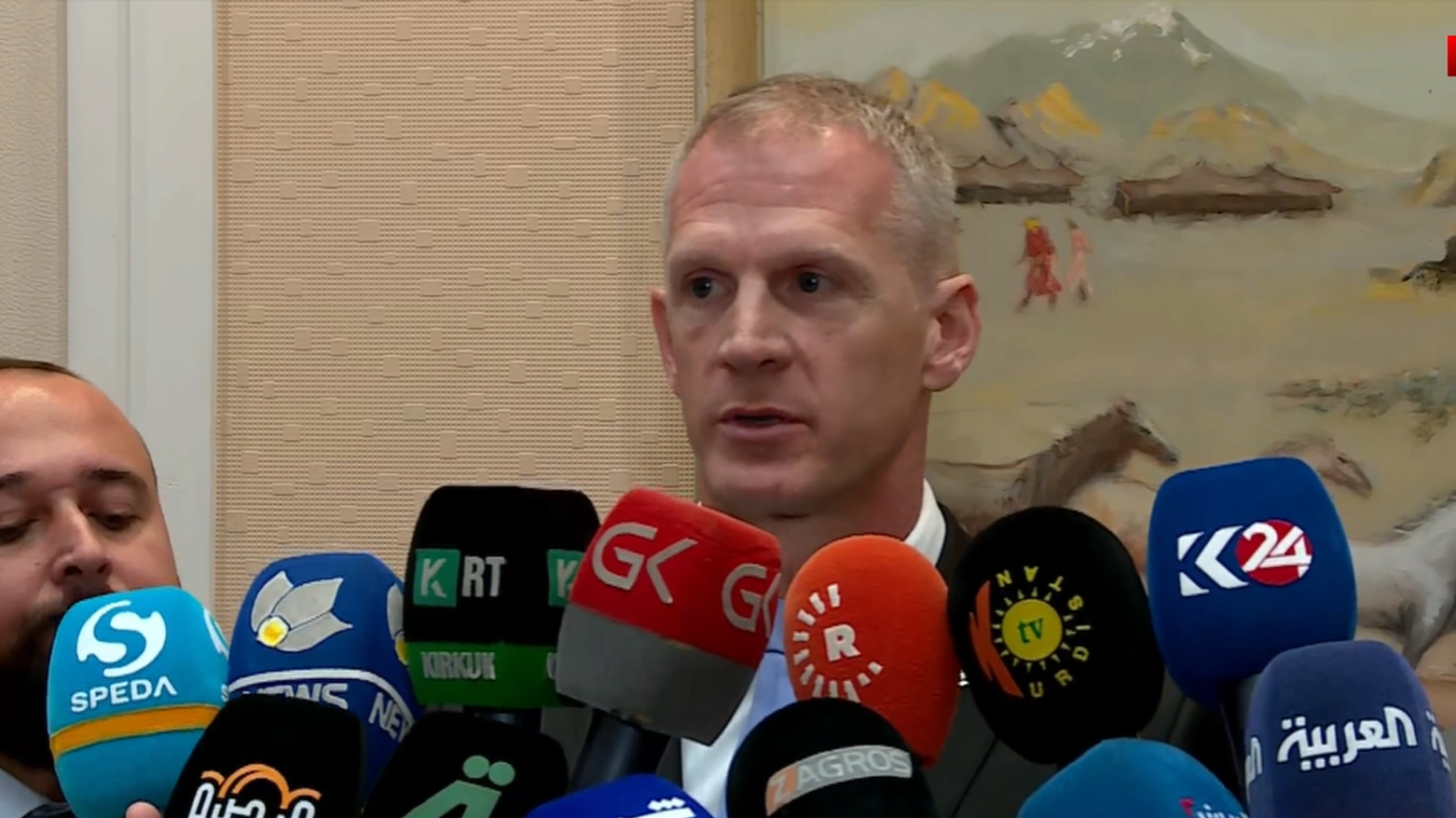
ERBIL (Kurdistan24) - The European Union Advisory Mission in Iraq will continue operating independently of the international coalition's withdrawal and is preparing to begin a new mandate on Nov. 1 that will keep it in the country for at least another two years, mission chief Ralf Schroeder said Sunday.
Speaking to journalists following a strategic leadership and police-reform workshop in the Kurdistan Region, Schroeder said EUAM Iraq's work was separate from the coalition and would continue under the European Union's Common Security and Defence Policy framework.
"Yes, absolutely. We are not connected to the coalition at all," Schroeder said when asked whether the mission would remain after coalition forces leave Iraq.
"We will have a new mandate starting on the 1st of November this year. So we will at least stay here for two more years from this point on. But we're very sure that we will stay even longer after this," he added.
His remarks provide clarity over the future of European advisory support at a time when the Kurdistan Regional Government is advancing a new phase of police reform focused on professionalism, public trust, digitalization and institutional modernization.
Reform program owned by Kurdistan police
Schroeder stressed that the police-reform program was not imposed or selected by the European Union.
Instead, he said, it was initiated and owned by the Kurdistan Region's Ministry of Interior and police institutions, which requested EUAM assistance for their internal reform agenda.
"The Kurdish police have not been chosen," he said. "It's a program run by the Ministry of Interior, it's owned by the Kurdish police, and they asked us for support of their internal reform program."
The objective, he said, is to strengthen what EUAM describes as service-oriented policing — an approach designed to bring police institutions closer to the communities they serve.
That includes making police more accessible to the public, improving accountability and strengthening professionalism.
"The program is about increasing the so-called service-oriented policing element in police," Schroeder said, adding that the goal is "to bring the police and the community closer together, to be available for the population, to be accountable towards the population, and to move towards a more modern and professional police force."
Strategic advice and technical expertise
Schroeder said EUAM's support is primarily advisory rather than logistical.
At the strategic level, the mission assists with drafting strategies, modernization planning and change management.
It also shares European policing experience with counterparts in the Kurdistan Region.
On the technical side, EUAM works on specific security challenges, including organized crime, while providing expertise in management and professional development.
"We're delivering strategic and technical advice," Schroeder said.
He explained that the mission supports the design of strategies and the broader reform process while connecting local institutions with European expertise and experience.
EUAM does not generally provide equipment or conventional logistical assistance, he added.
Its practical support instead includes training programs, workshops and expert exchanges.
Among those initiatives was a train-the-trainer program that prepared the first 35 master trainers in service-oriented policing.
The mission has also brought European police specialists into direct discussions with Kurdish counterparts, including officers from the Netherlands.
Wider cooperation with civilian security institutions
Schroeder also clarified that EUAM's mandate is not confined strictly to the police.
The mission works with civilian security institutions but does not directly advise military forces.
"In our mandate, our support and cooperation is extending to all, as we call them, civil security entities," he said.
"In this example of Kurdistan, we're having close connection to the police but also to Asayish."
That distinction means the mission does not directly provide support to the Peshmerga, which is a military force, while maintaining cooperation with internal security agencies that fall within its civilian-security mandate.
KRG places public trust at heart of reform
Schroeder's comments came during the same workshop at which KRG Interior Minister Reber Ahmed outlined the government's police-modernization strategy.
Ahmed said police reform is a central component of the Ninth KRG Cabinet's wider reform agenda under Prime Minister Masrour Barzani.
The objective is to develop a modern and professional police institution capable of responding to changes in society and emerging security challenges.
Ahmed emphasized that reform should not be judged only by organizational restructuring or new regulations.
Instead, he said, its success should be measured by whether citizens receive better services, laws are enforced more effectively and police officers demonstrate greater professionalism.
Public trust is therefore being treated as one of the reform program's central objectives.
Digitalization, leadership and women's participation
The Interior Ministry is also seeking changes in police education and institutional management.
Ahmed said police colleges should develop new curricula and evolve from traditional training institutions into centers capable of producing future leaders and decision-makers.
Digitalization is another key component.
The minister said technology should be viewed not simply as a new set of tools but as a different way of managing police work, with the potential to improve crime prevention, strengthen transparency in investigations and provide more advanced services to citizens.
Ahmed also called for greater opportunities for women to join the police and take up leadership positions, arguing that security institutions should reflect the diversity of the communities they serve.
He thanked EUAM for its assistance but, like Schroeder, stressed that successful reform must ultimately be driven from within Kurdistan's own institutions.
That shared emphasis on local ownership is central to the current program.
EUAM can provide strategic advice, technical knowledge and European policing experience, but decisions over how the Kurdistan Region's police institutions evolve remain with the Ministry of Interior and police leadership.
With the mission's new mandate due to begin on Nov. 1, that partnership is now set to continue well beyond the current phase of international coalition operations in Iraq.