KRG to Open 32 New School Buildings for New Academic Year
KRG Education Minister Alan Hama Saeed says 32 new school buildings are ready, nearly 20 million textbooks have been printed and teachers will begin new training on Sept. 1.
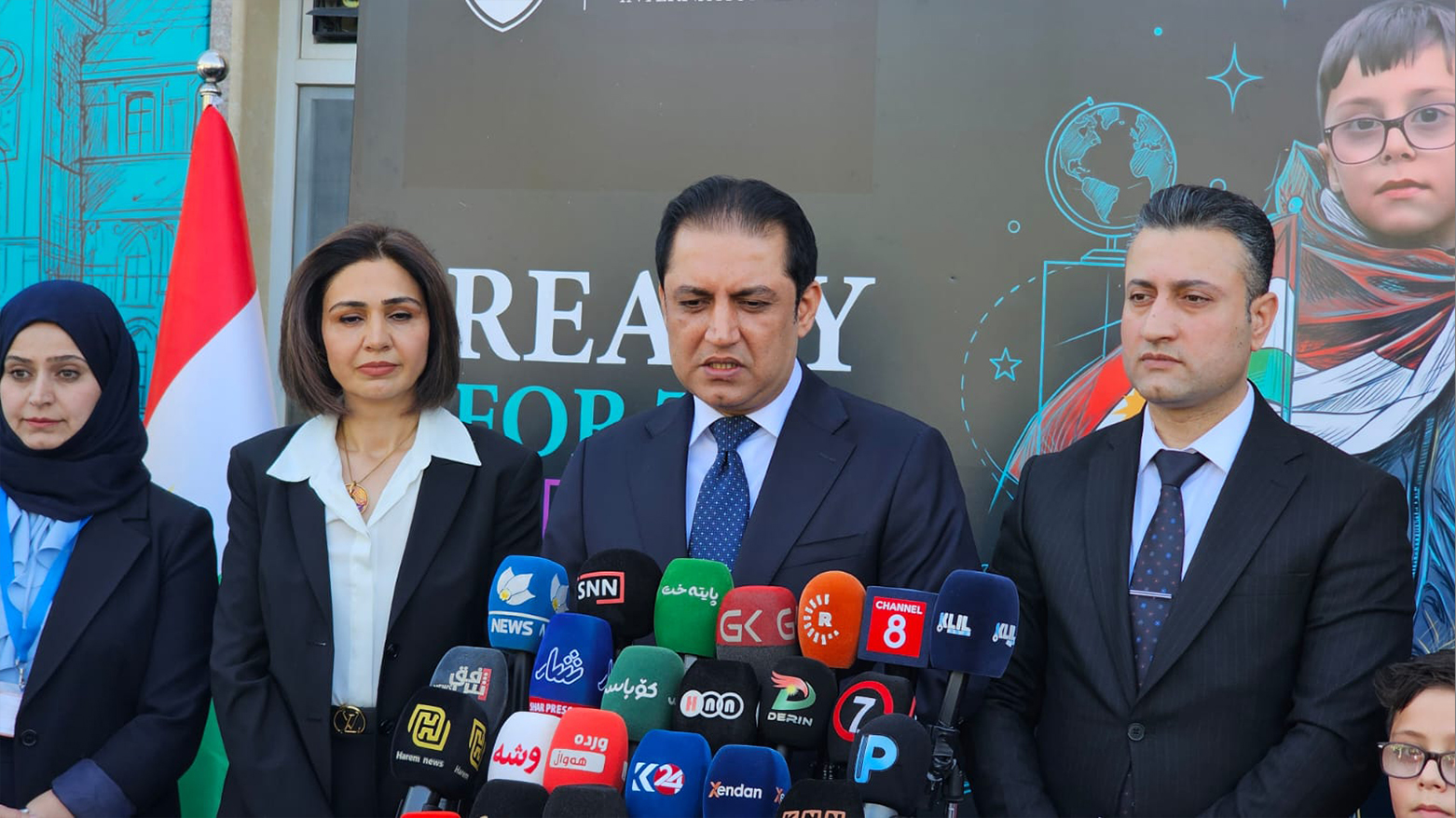
ERBIL (Kurdistan24) - The Kurdistan Regional Government has prepared 32 new school buildings for the coming academic year, printed nearly 20 million textbooks and launched a broad teacher-training program covering technology, artificial intelligence and student engagement, Education Minister Alan Hama Saeed said Monday.
Speaking at a press conference on Aug. 31, Hama Saeed said preparations for the new school year had begun in June, with the ministry prioritizing textbooks, school supplies, infrastructure and professional development for teachers.
He said nearly 20 million textbooks had been printed and that 90% had already reached warehouses in cities and towns across the Kurdistan Region.
"If conditions allow, 99% will reach the Kurdistan Region within the next few days," the minister said.
The Education Ministry has also distributed 264 containers of supplies to education departments in towns, while work is continuing to repair thousands of school desks in coordination with organizations.
32 new school buildings prepared
Hama Saeed said 32 new school buildings had been readied for use during the new academic year and distributed among the Kurdistan Region's provinces and independent administrations.
The ministry has also sought fuel and other essential supplies needed to operate the new facilities.
"We have sent official correspondence to the Council of Ministers and the Ministry of Natural Resources requesting kerosene supplies," he said.
Approval has also been obtained for the provision of other materials required by the new school buildings, he added.
The opening of additional facilities is intended to ease pressure on an education system that has faced growing demand from an expanding student population and, in some areas, overcrowding and multiple-shift schooling.
Teachers return Sept. 1
The minister announced that teachers would return to work on Tuesday, Sept. 1, when a 19-day professional-development program is scheduled to begin.
Each teacher will participate in five to six days of training during that period.
The program will cover technology, artificial intelligence, environmental strategy and methods for interacting with students.
The inclusion of artificial intelligence and technology training reflects the ministry's effort to adapt teaching methods to rapid changes in education and digital tools.
To make participation easier, the ministry has also introduced a measure allowing teachers who live outside major cities to attend training at the school closest to their residence before classes formally begin.
Hama Saeed said the decision was intended to reduce commuting burdens and make the training program more accessible.
Vocational education among reform priorities
The minister also highlighted vocational education as an important part of the KRG's wider education reform agenda.
He said the ministry intends to increase the number of vocational institutes and secondary schools while also introducing what he described as the English system within educational institutions.
The broader reform effort is aimed at diversifying educational pathways and better preparing students for employment and future economic needs.
Vocational education has increasingly been presented by the KRG as an alternative to an education system heavily concentrated on academic university pathways.
The ministry's plans seek to give more students opportunities to acquire technical and practical skills before entering the labor market.
Kirkuk schools enter year under pressure
The preparations announced by the KRG come as Kurdish-language education in Kirkuk, a Kurdistani terrirtory outside Kurdistan Region's administrative control, enters the new academic year facing significant infrastructure and resource shortages.
Kamaran Ali, director of Kurdish education in Kirkuk, told Kurdistan24 that the KRG and its Education Ministry remain the principal official sources of assistance for Kurdish-language schools in the province.
Ali said more than 100 schools require renovation and another 40 need additional classrooms.
He said requests for assistance had repeatedly been submitted to Kirkuk's local government without producing results.
According to Ali, no new Kurdish-language school has been constructed in Kirkuk since Oct. 16, while 30 existing schools are now operating three shifts each day.
He described equipment and supplies in some of those schools as heavily worn and no longer usable.
A small number of organizations, particularly the Barzani Charity Foundation, have helped renovate schools, he said.
Enrollment continues to increase
Despite the shortages, Kurdish-language education in Kirkuk continues to attract new students.
Ali said 1,200 students had transferred from Arabic-language schools to Kurdish-language education this year and that enrollment was continuing.
Nearly 100,000 students and 8,200 teachers are expected to begin the new academic year across 558 Kurdish-language schools in Kirkuk.
Ali also said the KRG Education Ministry had already supplied more than one million textbooks for those schools.
Across the Kurdistani territories outside the Kurdistan Region's administration, official figures cited by Kurdistan24 show 141,322 Kurdish students receiving Kurdish-language education in 738 schools under the supervision of 15,943 teachers and staff.
New academic year tests infrastructure and reform
The Education Ministry's preparations illustrate the scale of the logistical effort required before schools reopen.
The immediate focus is on ensuring textbooks, furniture, fuel and school buildings are ready, while the ministry is simultaneously attempting to introduce longer-term reforms involving vocational education, teacher development and technology.
The 32 new school buildings and nearly 20 million printed textbooks represent the most visible elements of those preparations.
But the situation in Kirkuk also underscores uneven conditions across Kurdish-language education, particularly in areas outside the KRG's administrative control.
As teachers return on Sept. 1 and training begins, the ministry's challenge will be to translate preparations made over the summer into a smooth start to the academic year while continuing to address shortages, overcrowding and infrastructure needs across the wider education system.