Mecca Defense Alliance Born in Istanbul: Secretariat in Riyadh, First Secretary-General Pakistani, Open to New Members
Turkish Foreign Minister Fidan announces the alliance's formal name, permanent institutional structure, and openness to expansion as Egypt, Bangladesh, and Syria signal interest in joining what analysts call the Muslim world's answer to NATO
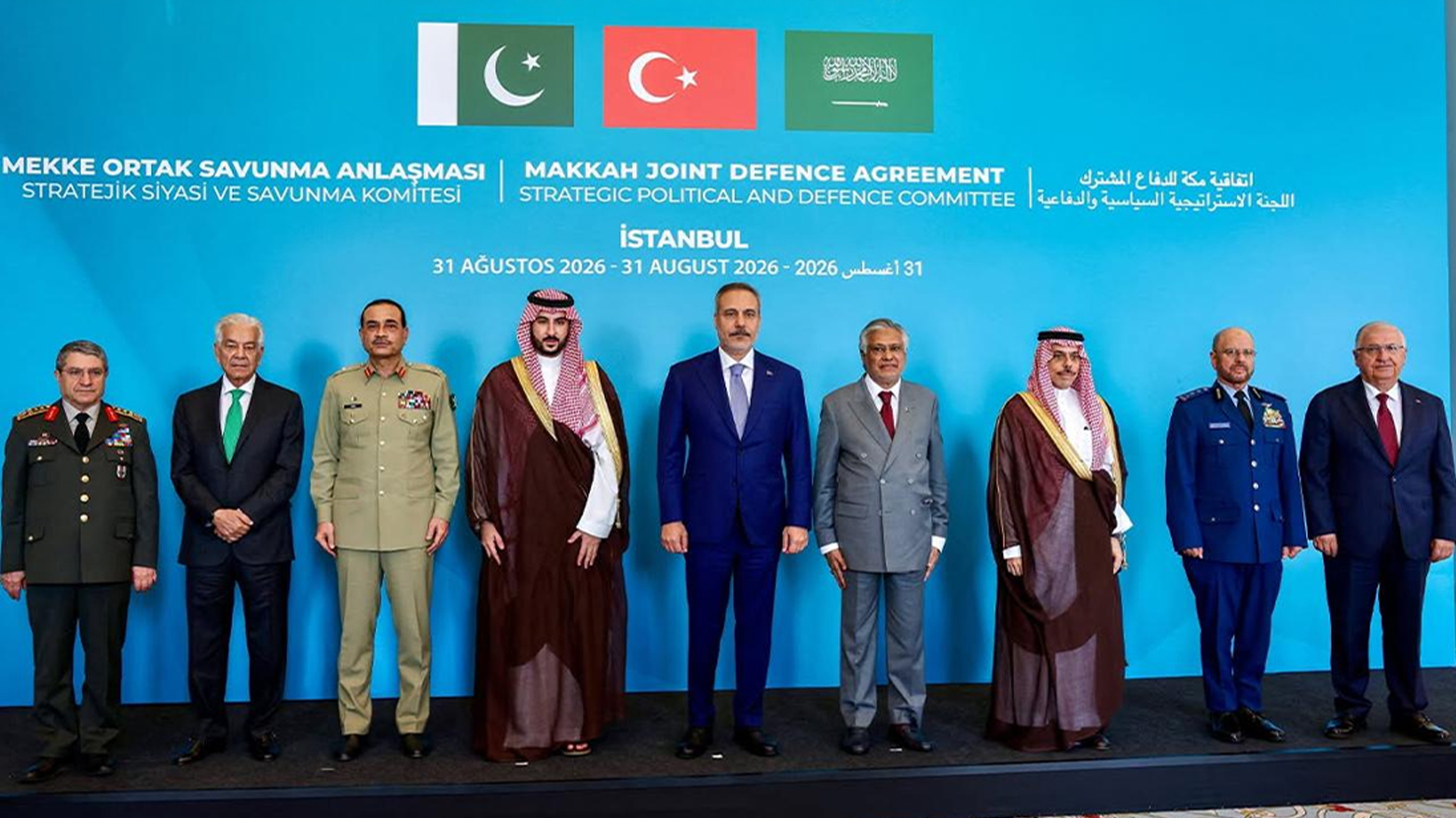
ERBIL (Kurdistan 24) - The three founding members of the Mecca Joint Defence Agreement emerged from their inaugural Istanbul meeting on Monday having formally named their alliance the Mecca Defense Alliance, established a permanent secretariat in Riyadh with a Pakistani first secretary-general, and launched the Strategic Political and Defense Committee as the alliance's governing body, in a set of outcomes that transformed a political declaration signed three weeks earlier into a functioning multilateral defense institution.
Turkish Foreign Minister Hakan Fidan announced the outcomes at a news conference following the talks. "There is a secretariat that has been established in Riyadh, and the first secretary-general will be appointed amongst our Pakistani brothers," Fidan said, confirming that Pakistan will hold the alliance's inaugural top administrative post while Saudi Arabia hosts its permanent home.
Fidan described the alliance's founding principles as rooted in international law. "The agreement is a product of the principle of regional ownership. As we have always stated, attempts to impose solutions on our region from outside do not provide remedies to our problems. It has become an urgent necessity for the countries of the region to act together for security, stability, prosperity, and lasting peace, and to give an institutional character to the steps they take in this direction. With this agreement, the process of establishing a new security and cooperation architecture in our region has thus begun," he said. Fidan also clarified that the alliance does not contradict Türkiye's membership of NATO.
What the Istanbul Meeting Decided
The Istanbul session formally established the Strategic Political and Defense Committee as the alliance's primary governing mechanism, bringing together foreign ministers, defense ministers, and military chiefs-of-staff from all three member states in a structure modeled closely on NATO's own committee architecture. Turkish Foreign Minister Fidan said the pact would function similarly to NATO, with a ministers' committee, political and military committees, and a permanent secretariat to oversee the implementation of decisions.
The secretariat's establishment in Riyadh with a Pakistani secretary-general reflects a deliberate division of institutional roles among the three founding members: Saudi Arabia provides the geographic and financial anchor, Pakistan fills the top administrative position, and Türkiye hosted the inaugural meeting and provided the diplomatic framing through Foreign Minister Fidan's leadership of the post-meeting press conference.
Fidan said the alliance was based on "international principles, such as respecting the sovereignty of other states, territorial integrity and not intervening in internal affairs" and it remained "open for the partnership and participation of any other country" in the region.
Who Is Coming Next
The alliance's openness to expansion is already producing concrete expressions of interest. Turkish President Recep Tayyip Erdogan said in an August interview with Al Jazeera that Egypt could potentially join the pact. Bangladesh has also stated it is actively considering joining the agreement. Pakistan has separately announced that six or seven Muslim-majority countries have expressed interest in joining, as confirmed by Cryptobriefing on Monday. Syrian Foreign Minister Asaad al-Shaibani said on August 20, 2026, during his visit to Pakistan, that Syria was considering whether to join or cooperate with the Mecca Agreement.
The potential addition of Egypt would be the most strategically significant expansion, adding the Arab world's most populous country and largest standing army to an alliance that already includes NATO's second-largest military, the world's only nuclear-armed Muslim state, and the world's largest oil exporter.
What Changes and What Is Affected
The Istanbul outcomes have immediate and far-reaching implications across multiple domains. On defense industry cooperation, the three member states bring fundamentally different but complementary equipment profiles that the alliance's new institutional structure is designed to integrate. Saudi Arabia operates primarily American and European equipment, Turkey has been developing indigenous systems at a rapid clip, and Pakistan fields a mix of Chinese, American, and domestically produced platforms. The alliance's defense industry cooperation mandate is designed to begin bridging those differences through joint procurement, technology transfer, and interoperability standards.
On regional geopolitics, Jerusalem now views the emerging Turkey-Saudi-Pakistan alliance as a potential threat, with high hopes that Saudi Arabia might join the Abraham Accords, as Egypt, Saudi Arabia, Turkey, Syria, and other countries grow closer together. The alliance's emergence alongside warming Ankara-Cairo relations and Israel's hostile posture toward Syria's new government is reshaping the Eastern Mediterranean security landscape in ways that affect Israeli strategic calculations directly.
On Iran, the alliance carries a clear deterrent message without naming Tehran as an adversary. The Mecca accord, like its bilateral precursor, the Pakistan-Saudi Strategic Mutual Defence Agreement, does not explicitly identify an adversary, maintaining strategic ambiguity that allows the three signatories to frame it as an instrument of regional stability rather than a targeted counter-Iran coalition. Nevertheless, the alliance's founding context, the US-Iran war and Iran's missile and drone attacks on Gulf infrastructure, makes its deterrent function unmistakable to all regional actors.