Germany Sees ‘Significant Potential’ to Expand Partnership With Kurdistan: Consul General
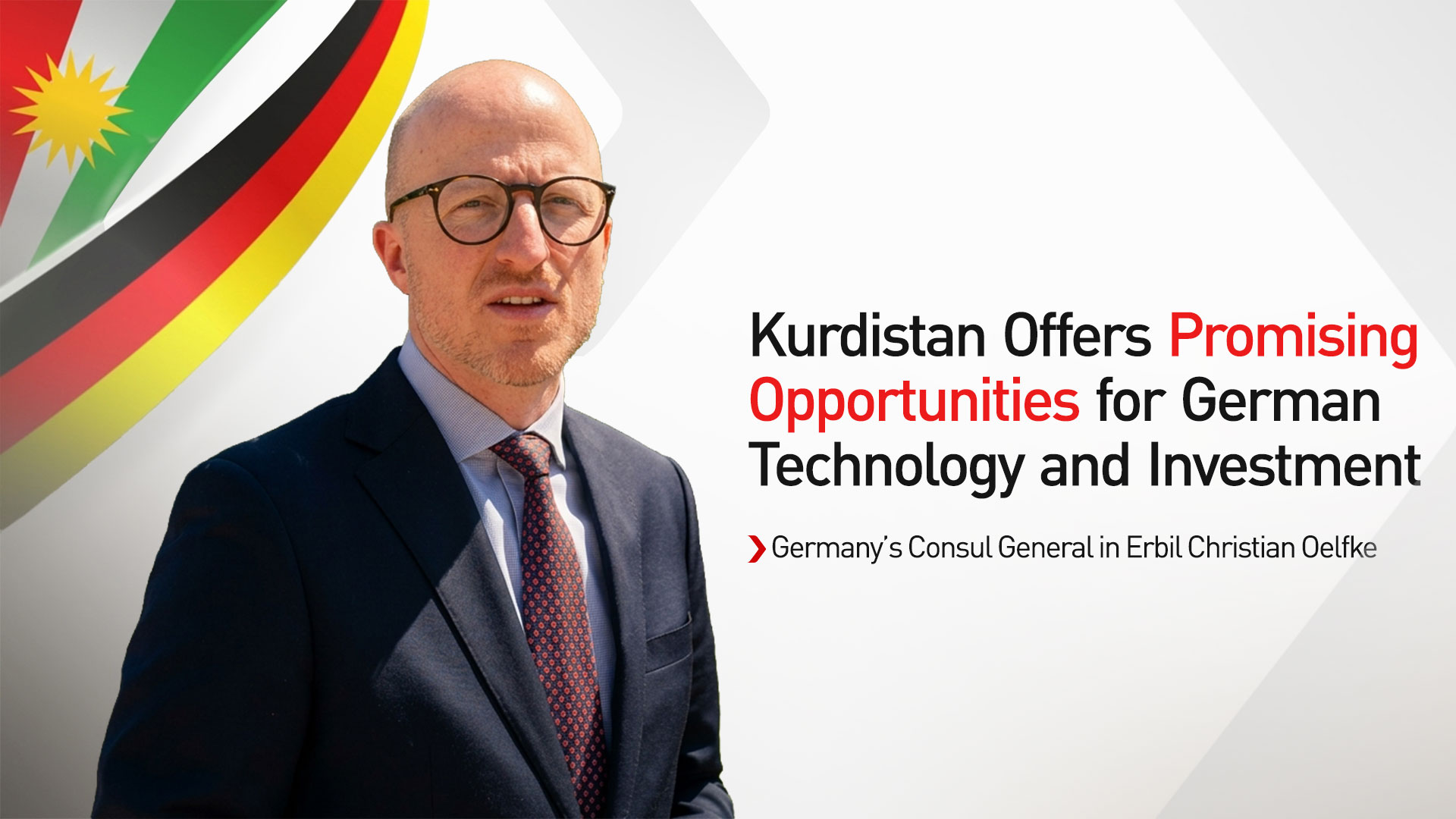
ERBIL (Kurdistan24) — Germany sees “significant potential” to expand its longstanding partnership with the Kurdistan Region into broader economic and societal cooperation, Germany’s Consul General in Erbil Christian Oelfke told Kurdistan24 English in an exclusive interview on Thursday.
Oelfke said relations between Germany and the Kurdistan Region are broad and rooted in “long-term mutual trust,” highlighting Germany’s role as a reliable partner in humanitarian assistance, stabilization, development cooperation, and security.
“These have created the foundation for a strong partnership,” Oelfke said, adding that strengthening exchanges between institutions, businesses, and civil society would be key to broadening bilateral ties over the long term.
The German diplomat said Berlin is “clearly committed” to a stable, secure, and prosperous Kurdistan Region within Iraq, stressing that stability extends beyond security and depends on economic opportunities, good governance, functioning institutions, and prospects for younger generations.
“Together with our partners, we will continue our efforts to contribute to stabilization through various means,” he said.
Oelfke identified three priorities for his tenure as Germany’s consul general in Erbil: strengthening political relations and dialogue, expanding economic ties between Germany and the Kurdistan Region, and supporting cooperation in stability and development.
German Investment Potential
The consul general said the Kurdistan Region offers promising opportunities for German technology in several sectors, including energy, infrastructure, water management, agriculture, and mechanical engineering.
However, he stressed that attracting greater German investment would require transparent regulatory frameworks, legal certainty, strong investment protection, effective institutions, and a well-qualified workforce.
“Above all, peace and security remain critical factors,” Oelfke said, noting the Kurdistan Region’s efforts to contribute to peace in the wider region.
“We can only hope that the wider Middle East will eventually find some peace and stability,” he added.
Oelfke also pointed to Germany’s experience in developing a diversified, small and medium-sized enterprise-driven economy as an area from which the Kurdistan Region could benefit.
He identified agriculture and food processing as particularly promising sectors capable of creating jobs, developing local value chains, and gradually reducing the Region’s dependence on raw material exports.
“Kurdistan has significant agricultural potential,” Oelfke said, adding that German companies could contribute modern, resource-efficient agricultural technologies, machinery, and processing solutions.
Such technologies, he explained, could increase productivity while reducing resource consumption and help the Kurdistan Region transition from primarily exporting raw agricultural products toward greater processing and packaging.
Learning More About Kurdistan
Oelfke said understanding the Kurdistan Region remains an important priority as he settles into his diplomatic role in Erbil.
“I still have many things to learn about the Kurdistan Region,” he said, explaining that he wants to identify areas where Germany and the Region can connect for mutual benefit.
That, he said, requires a deeper understanding of how the local economy functions, how people conduct business, and what the Region’s genuine needs are, particularly at a time when Germany must also focus its assistance on areas where it can make the greatest difference.
Oelfke described his experience of learning about Kurdistan as a process that can come through a wide range of sources, from books and experts to personal encounters and even art.
On the broader regional picture, he said the Kurdistan Region is operating within a complex and rapidly changing environment.
“The Kurdistan Region is moving in a flexible parallelogram of forces, in a difficult, complex, and in a way critical setting,” Oelfke said.
He added that the speed of developments makes the future difficult to predict, citing the old saying that predictions are particularly difficult when they concern future events.
‘Good Vibes’ in Erbil
Oelfke also spoke warmly about his early impressions of Erbil, describing the city as having “a lot of good vibes.”
He said the city’s long history of settlement did not surprise him, pointing to the Erbil Citadel as a powerful reminder of Kurdistan’s rich historical heritage.
“I like the pace of the city; people are relaxed and friendly in a very discrete way,” he said.
Beyond Erbil, Oelfke said he had already visited Duhok and was impressed by the breadth and depth of cooperation between the Duhok Governorate and Germany.
He said he was also looking forward to visiting Sulaimani, noting that several colleagues at the German Consulate are originally from the city and speak enthusiastically about their hometown.
As someone who enjoys outdoor activities, Oelfke said he was particularly eager to explore the Kurdistan Region’s mountains during his time in the Region.
Football as a Bridge
The German consul general also discussed football, saying he had not yet had the opportunity to attend a live match in Kurdistan but had read about Kurdish clubs, including Duhok and Zakho.
He said the atmosphere surrounding Zakho’s matches appeared particularly appealing and expressed hope that he would attend a game.
Oelfke described football as a force that “unites people around the world,” arguing that supporters can find common ground through their shared passion for the sport even when their national or club teams compete against each other.
He recalled traveling to different parts of the world where he did not speak the local language but found an immediate connection when people mentioned legendary German footballers such as Franz Beckenbauer, Rudi Völler, Lothar Matthäus, or Bastian Schweinsteiger.
“Football is a simple game and at the same time very complex,” Oelfke said, describing its unpredictability as part of its appeal.
Turning to Germany’s national team, he said the country still possesses considerable individual talent but needs to rebuild a team capable of performing consistently at major international tournaments.
Oelfke said Germany had historically excelled at creating teams that were “greater than the sum of their parts,” citing the national sides that reached or won the World Cup and European Championship during previous generations.
“For some reason, we have lost this edge,” he said, arguing that Germany needs to reshuffle its roster and replace players who do not fit into what he described as a winning team.
For Oelfke, however, football is ultimately another example of the broader connections that can bring people and societies together—an idea that also reflects his vision for strengthening ties between Germany and the Kurdistan Region beyond their established cooperation in security and stabilization.
Full Text: Kurdistan24 English Interview with Germany’s Consul General in Erbil, Christian Oelfke
Kurdistan24 English: You have just arrived in Erbil, and you described the Kurdistan Region as a place with a rich history, cultural heritage, and friendly people. What has been your first impression of Erbil and the Kurdistan Region, and what are you most looking forward to discovering during your time here?
Christian Oelfke: Erbil has a lot of „good vibes“. It does not surprise me that people have been settling in this place for several thousand years. The Citadel serves as a powerful reminder of Kurdistan‘s long and rich history. I like the pace of the city; people are relaxed and friendly in a very discrete way. Beyond the city limits, I paid my first visit to Dohuk. Bilateral relations between the Governorate of Dohuk and Germany are very well-established, and I was very impressed by the wide spectrum and at the same time, depth of the cooperation. I am also looking forward to travelling to Sulaimani: I have a number of colleagues at the Consulate who are from "Suly," and every time they start talking about their hometown, their eyes start glowing. So, there must be something about that city! And finally, as I enjoy being outdoors, I am also longing to explore the mountains! I hope I will be able to fit all this into my time here!
Kurdistan24 English: You mentioned that you enjoy discussing politics and economic affairs over a good cup of coffee. After arriving in Erbil, what are some of the issues or developments in the Kurdistan Region that you are particularly interested in understanding better?
Christian Oelfke: Gaining a good understanding of the consular district is essential and I have a feeling that I still have many things to learn about the Kurdistan Region. In the first place, I want to find out where Germany and the Kurdistan Region can best connect for mutual benefit. This requires taking a close look at i.e. how the economy functions and how people do business here. It will also require understanding true needs for assistance in times where we ourselves need to concentrate our aid on areas where we can really make a difference. To get a sense of these matters is a great learning experience. I tend to find the key to understanding in many different sources; this can be by reading a book or listening to experts, but also by anecdotal encounters or by stumbling across a piece of art.
On a broader scale, I would like to find the right angle, the right perspective for the analysis of current events: The Kurdistan Region is moving in a flexible parallelogram of forces, in a difficult, complex, and in a way critical setting. I have been trying to discern patterns in the course of developments in history, but everything evolves so quickly and seems quite hard to foresee. The old saying: " all predictions are difficult, especially those that concern the future of events" seems to hold true for Kurdistan!
Kurdistan24 English: You also spoke enthusiastically about sports, especially football. Germany has a deep football culture, while football is enormously popular in the Kurdistan Region as well. Have you had a chance to experience the local football culture here, and what do you think football can contribute to bringing people and cultures closer together?
Christian Oelfke: Unfortunately, I have not had a chance to watch any live games yet. I read a few articles about Kurdish clubs, for example Duhok and their success at the Gulf Cup Champions League. Also, Zacho seems to have a fantastic atmosphere and it would be great to attend one of their matches. I strongly believe that football unites people around the world. Even though our national teams or club teams may be adversaries on the pitch, we are united by our passion for the game. I have travelled to many places around the world and even where I did not speak the language of the locals I met - if somebody just dropped the name of say Franz Beckenbauer or Rudi Völler, Lothar Matthäus or Bastian Schweinsteiger, you feel you have something in common, in that you share admiration for a particular player and instantly there is something by which you feel connected.
Kurdistan24 English: You joked about helping Germany’s national team return to its glory days. As someone who follows football closely, what do you think Germany needs to do to regain its position among the world’s leading football nations?
Christian Oelfke: That´s a tough one, and I am afraid there is no easy answer, no silver bullet. Football is a simple game and at the same time very complex. Sometimes success and defeat escape any rational explanation. That´s the magic of the game. One absolutely critical issue is that we need to field a true team again. Germany still has a lot of individual talent but we have witnessed that the same group of key players has consistently underperformed at the recent major international tournaments. In the ideal world your team, the whole, is greater than the sum of the parts. Germany in the past has been quite good at creating teams that were greater than the sum of their parts and that somehow outperformed other teams with much more individual talent. Good examples were the teams at the World Cup tournaments in 1954 and 1974 (GER won the World Cup), 1986 and 2002 (GER came in 2nd), and 1996 (GER won the European Championship). For some reason, we have lost this edge, and I believe we will need to reshuffle our roster and replace a number of players who just do not seem to fit as an element of a winning team.
Kurdistan24 English: Moving from football to diplomacy, Germany has been an important partner of the Kurdistan Region for many years, particularly in humanitarian assistance, development, and security cooperation. How would you assess the current state of German-Kurdistan relations, and where do you see the greatest potential for expanding that partnership?
Christian Oelfke: Relations between Germany and Kurdistan are broad and based on long-term mutual trust. Germany has proven to be a reliable partner, particularly in humanitarian aid, stabilization, development cooperation, and security. This has created the foundation for a strong partnership. I see significant potential in expanding our partnership toward economic and societal cooperation. Strengthening exchanges between institutions, businesses, and civil society will be key to broadening these ties long-term.
Kurdistan24 English: Economic cooperation is another area you highlighted. What opportunities do you see for German companies in the Kurdistan Region, and what steps could the Kurdistan Regional Government take to make the region more attractive to German investors?
Christian Oelfke: Kurdistan offers promising opportunities for German technology to address regional priorities, specifically in energy, infrastructure, water management, agriculture, and mechanical engineering. Yet, to attract more German investment, transparent frameworks, legal certainty, strong investment protection, effective institutions, and a well-qualified workforce are essential. And, above all, peace and security remain critical factors. I am aware that the KRI has always tried to contribute to peace in the region. In this regard, we can only hope that the wider Middle East will eventually find some peace and stability.
Kurdistan24 English: The Kurdistan Region is seeking to diversify its economy beyond oil and strengthen sectors such as agriculture, tourism, industry, and renewable energy. From Germany’s experience, which areas do you believe offer the greatest potential for practical economic cooperation between Germany and the Kurdistan Region?
Christian Oelfke: Given Germany’s experience in fostering a diversified, SME-driven economy, I see potential in sectors that can create jobs, build local value chains, and gradually reduce the region’s dependence on raw material exports. Agriculture and food processing are prime examples. Kurdistan has significant agricultural potential. German companies could contribute with resource-efficient modern agricultural technologies, machinery, and processing solutions. Such technologies not only increase productivity and reduce resource consumption, but also help move the region from exporting primarily raw agricultural products towards processing and packaging.
Kurdistan24 English: Finally, looking beyond bilateral relations, Iraq and the Kurdistan Region are navigating a complex regional environment involving security challenges, relations with neighboring countries, and broader geopolitical tensions. What role does Germany hope to play in supporting stability in Iraq and the Kurdistan Region, and what are your priorities as Germany’s new Consul General in Erbil?
Christian Oelfke: Germany is clearly committed to a stable, secure, and prosperous Kurdistan within Iraq. Stability is not just a security issue; it depends on economic prospects, good governance, functioning institutions, and opportunities for the younger generation. Together with our partners, we will continue our efforts to contribute to stabilization through various means.
As Consul General in Erbil, my priorities are threefold: first, to further strengthen political relations and dialogue; second, to expand economic ties between Germany and the region; and third, to support cooperation in stability and development.