Indonesia Suspends Operations at Six Airports After Anak Krakatau Eruption
Indonesia suspended operations at six airports, including Jakarta's main international hub, after Anak Krakatau erupted and volcanic ash spread across western Indonesia.
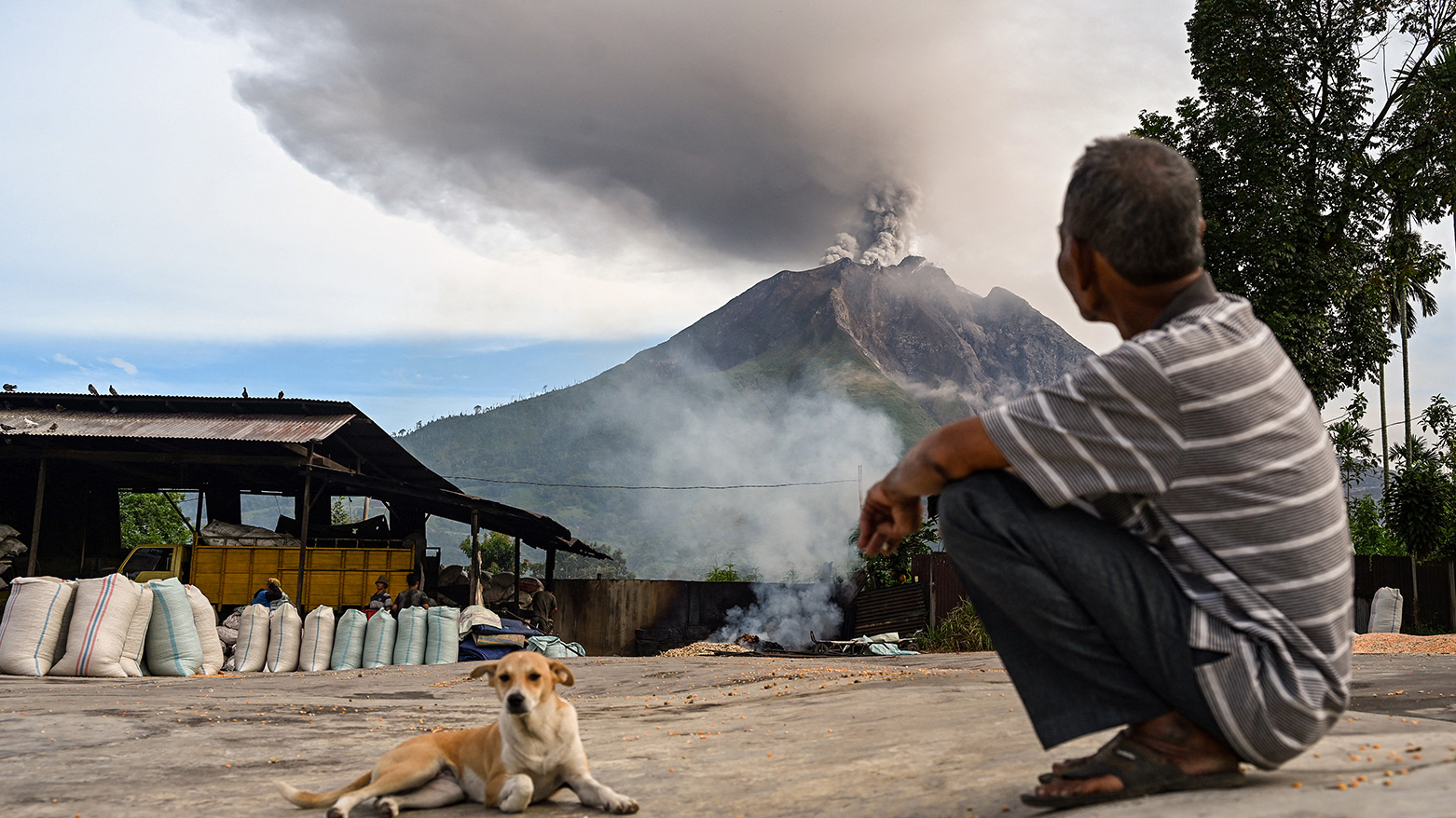
ERBIL (Kurdistan24) - Indonesian authorities suspended operations at six airports on Sunday, including Jakarta's main international hub, after Mount Anak Krakatau erupted and volcanic ash spread across parts of western Indonesia.
Indonesia's Transport Minister Dudy Purwagandhi said Husein Sastranegara Airport in Bandung was the latest airport to be closed after authorities detected signs that volcanic material was affecting operations, according to Agence France-Presse.
Soekarno-Hatta International Airport, the country's largest airport and the main gateway serving Jakarta, had already suspended flights earlier.
The closures followed a renewed eruption of Anak Krakatau, the volcanic island in the Sunda Strait between Java and Sumatra.
Associated Press reporters Tatan Syuflana and Niniek Karmini reported that the volcano erupted for about 30 seconds at 3:53 a.m. Sunday after showing increased activity since Friday. Closed-circuit footage showed lava flares from the crater.

No casualties were reported and no evacuation order was issued.
AirNav Indonesia closed airspace around Soekarno-Hatta and Halim Perdanakusuma airports in Jakarta as well as four additional airports, including Radin Inten II Airport in Lampung, because of volcanic ash, AP reported.
By mid-afternoon Sunday, the closures had affected 516 flight movements.
At Soekarno-Hatta alone, 202 flights were affected, involving approximately 22,800 passengers, according to AP. The airport was ordered to remain closed until at least 5:30 p.m.
Indonesia's Directorate General of Civil Aviation said authorities were coordinating with airlines, airport operators, air-navigation services and the country's meteorological agency to assess when operations could safely resume.

"Safety remains our top priority in every operational decision," Civil Aviation Director General Lukman F. Laisa said in a statement cited by AP.
He warned that the disruption could continue even after airports reopen because aircraft rotations, fleet availability and terminal capacity may be affected.
The eruption also disrupted services at Bali's I Gusti Ngurah Rai International Airport and at Medan, AP reported.
Satellite observations identified two major ash clouds. One rose to around 20,000 feet and drifted over Jakarta, Banten, West Java and nearby waters. A second plume reached roughly 50,000 feet and spread across parts of Banten, Lampung and Bengkulu, the southern Sunda Strait and portions of the Indian Ocean west of Sumatra.
Indonesia's disaster authorities have separately urged residents in coastal areas of Banten and Lampung not to panic over fears that the eruption could trigger a tsunami.

Indonesia's state news agency ANTARA reported that the National Disaster Management Agency, known as BNPB, was closely monitoring the situation because Anak Krakatau's volcanic activity has previously been associated with destructive tsunamis.
Public concern has centered on memories of the Dec. 22, 2018 disaster, when volcanic activity triggered a tsunami that killed more than 400 people in Java and Sumatra.
Berton S.P. Panjaitan, acting head of BNPB's disaster information center, said an evaluation by the Center for Volcanology and Geological Hazard Mitigation found that the volcano's growth since 2018 remained relatively limited and did not currently indicate a risk of a massive collapse capable of generating a similar tsunami.
"Therefore, we hope residents in Banten and Lampung will not panic," he said, according to ANTARA.

Authorities nevertheless maintained Anak Krakatau at Level III, or Alert, and told residents, fishermen and tourists to stay outside a three-kilometer radius from the active crater.
Lana Saria, head of Indonesia's Geological Agency, said activity at the volcano had intensified since July and that Sunday's eruption was the strongest during the current period of unrest.
She said repeated eruptions indicated a continued supply of magma and volcanic gases beneath Anak Krakatau, while stressing that authorities could not predict whether a larger eruption would follow.
Anak Krakatau, meaning "child of Krakatau", emerged from the remains of the volcanic system associated with Krakatau's catastrophic 1883 eruption.
Sunday's eruption has so far caused its greatest disruption in aviation, with thousands of passengers affected and major air routes temporarily suspended while authorities assess the movement of ash.
