Prime Minister Barzani Launches Kurdistan Biodiversity Project, Calls On All Citizens To Protect And Document Kurdistan's Nature
In a speech Prime Minister Masrour Barzani calls on Kurdish citizens worldwide to contribute sightings and data, asks researchers to document species on all Kurdish lands beyond the Region's administrative borders, and reaffirms full KRG support for the initiative as a scientific and national duty.
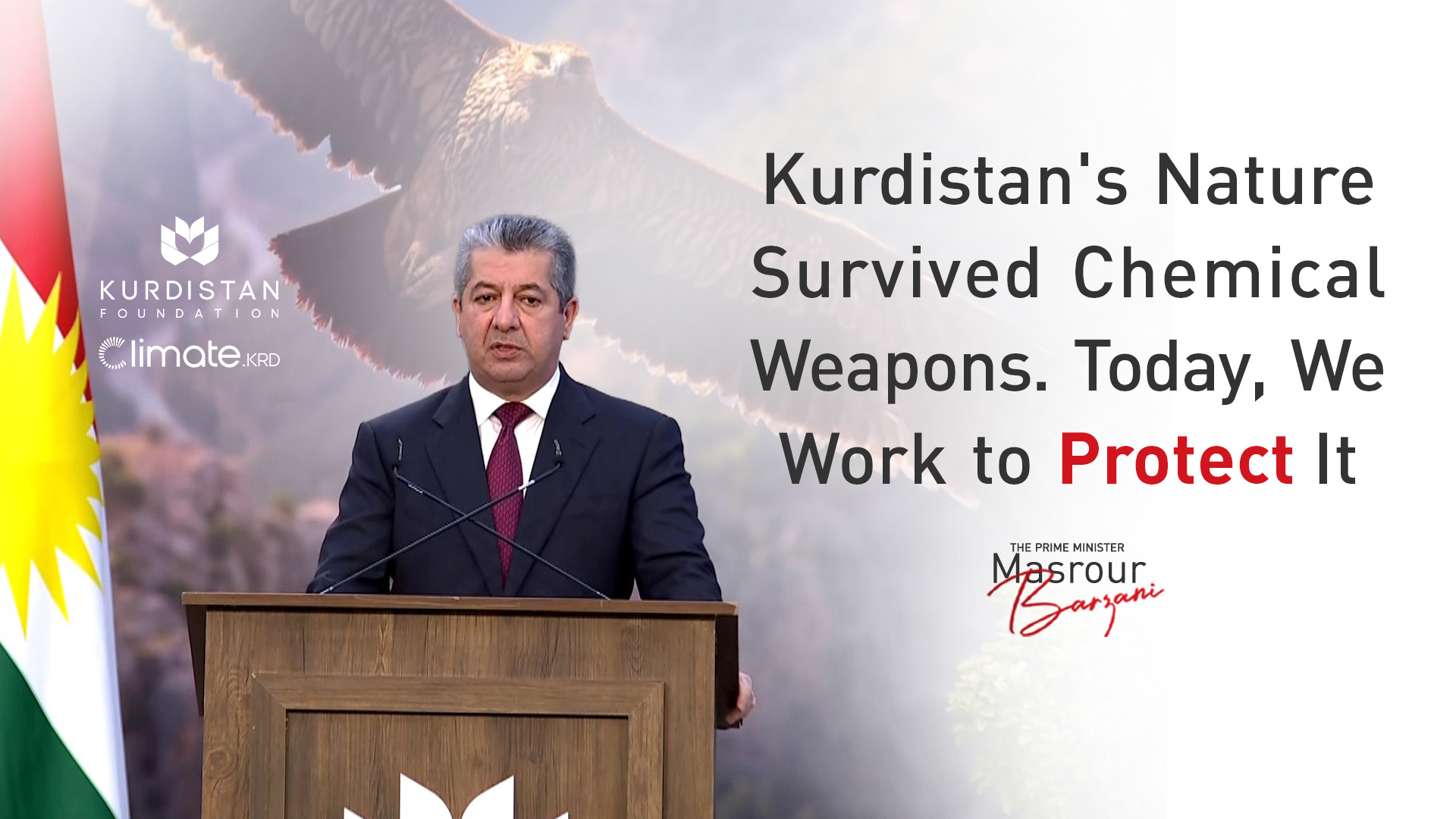
ERBIL (Kurdistan 24) - Kurdistan Region Prime Minister Masrour Barzani launched the Kurdistan Biodiversity Project on Tuesday in an official ceremony in Erbil, delivering a speech in which he described the project as a critically important and unique national initiative, reaffirmed full KRG support, and called on every citizen of Kurdistan to participate in documenting and protecting the Region's natural heritage from a threat he placed in the context of both historical destruction and the current climate crisis.
Today we are launching a very important, unique, and special project which is the Kurdistan Biodiversity Project, and another important initiative of the Kurdistan Foundation to record and introduce the animals, plants, and important areas of the Kurdistan Region, identify plant and animal species, and subsequently research, study, and protect them,
Barzani said.
Prime Minister Masrour Barzani announces the Kurdistan Biodiversity Project, calling it a "very important, distinctive, and special project" to document, study and protect the Region's natural environment. The initiative has already recorded 2,252 plant and animal species across 19 biodiversity hotspots. "This initiative is a very important step toward introducing the world more broadly to the diverse components of Kurdistan's rich and colorful natural environment," Prime Minister Barzani said. Read more: https://t.co/9gJ3eYKUg3
— Kurdistan 24 English (@K24English) October 20, 2026
Historical Destruction and Natural Wealth
The Prime Minister situated the project within a history of deliberate environmental destruction. "God has given Kurdistan beautiful, heartwarming, and rich nature. But unfortunately, due to the wars, attacks, and aggressions of Kurdistan's enemies over the past hundred years, this beautiful nature of Kurdistan has faced great destruction, devastation, and damage," he said. He specifically referenced the era of the previous Iraqi regime, saying thousands of Kurdistan's villages were burned and destroyed, mountains, springs, summer resorts, and tourism areas were bombed, animals and wildlife and forests were eliminated, and prohibited chemical weapons were used against Kurdistan's beautiful nature.
He noted that following the glorious March 1991 uprising, a large portion of Kurdistan's villages were rebuilt and services were extended as far as the KRG's capacity allowed, but that more services, protection, and development are still needed.
Environment Is Everyone's Responsibility
Barzani drew a direct line between the biodiversity project and the broader duty of environmental protection. "Protecting nature and environmentalism is not only the government's responsibility. Every individual citizen of Kurdistan must work to protect the environment because it is everyone's common property," he said. He defined environmentalism broadly, saying it is not only keeping the environment clean but also protecting trees, water, forests, and animals, and expressed hope that all citizens embrace a culture of environmental protection and treat nature like their own home.
A Call to Document All Kurdish Lands
One of the most significant moments of the speech came when Barzani explicitly extended the project's ambition beyond the Kurdistan Region's administrative borders. "Far from politics, wherever the land of Kurdistan is, I hope you give it importance and that those animals and plants that exist in any part of the land of Kurdistan are also recorded — whether in the Kurdistan Region, or outside the Kurdistan Region in neighboring countries," he said. "Wherever the land of Kurdistan is, I hope you give it importance and collect that information, that data, and this will mean that scientifically, more information and more data will be presented and the importance of that significant natural wealth will be recognized."
The Numbers
The project has so far documented 2,266 total species, comprising 858 animal species and 1,408 plant species. The data was compiled by a specialized and diverse team including eight members of the climate unit team, eight researchers, four photographers, two writers, and a project-specific adviser.
Barzani confirmed that the data will be presented through the biodiversity.krd website and a smart interactive map to serve as a shared resource for researchers, academic institutions, education, awareness, and planning, with sources and image credits clearly displayed and gaps openly identified.
The Researchers
Eight scientists and field researchers are contributing to the project: Dr. Korsh Ararat, wildlife and bird researcher from Sulaymaniyah; Dr. Sulaiman Tamr, veterinarian from Duhok; Ibrahim Ziad, assistant lecturer from Duhok; Mohammed Dler, wildlife photographer from Erbil; Rawezh Osman, wildlife photographer from Sulaymaniyah; Saber Dri, photographer and wildlife expert from Erbil; Soma L. Majeed, wildlife researcher from Sulaymaniyah; and Soran H. Ahmed, wildlife researcher from Sulaymaniyah.
Climate Change and the Future
Barzani also placed the project in the context of the current global climate crisis. "We are now living in the age of climate change, which has created a great challenge and obstacle facing our region and the world, and we must prepare ourselves in every way to face those obstacles," he said. He asked citizens of Kurdistan to contribute their knowledge, observations, suggestions, photographs, and natural documents to the initiative and to become part of documenting and protecting Kurdish wildlife.
He closed by congratulating all staff and workers on the project and expressing hope for its continued success. "May Kurdistan flourish and I hope we are all part of the project of protecting Kurdistan's colorful nature."