Far-Right AfD Leads German State Election Amid Record Turnout
Germany's far-right AfD wins Saxony-Anhalt's state election with 44.5% of the vote in exit polls, but may fall short of the majority needed to take power.
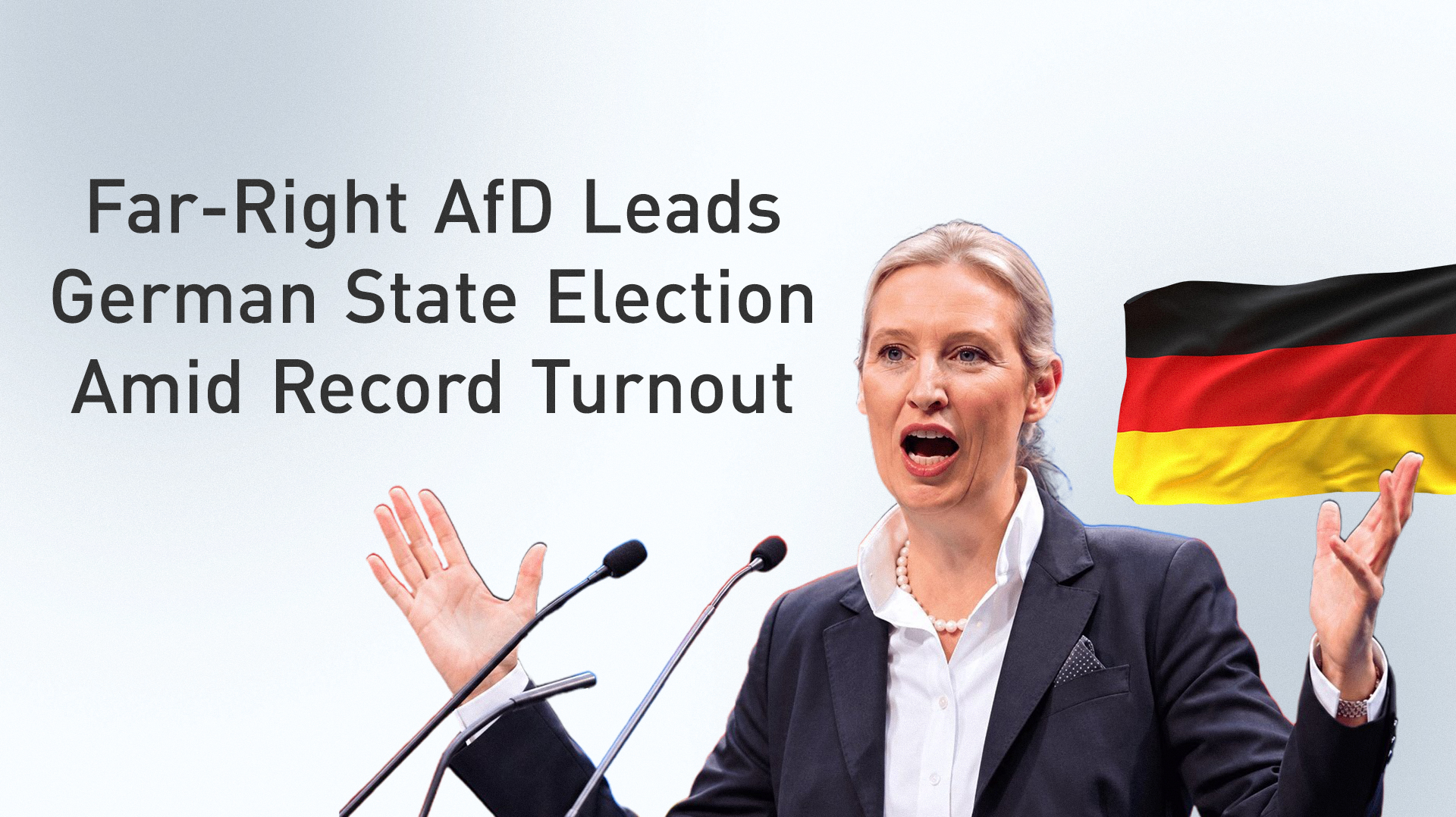
ERBIL (Kurdistan24) - Germany's far-right, anti-immigration Alternative für Deutschland (AfD) emerged as the projected winner of a closely watched state election in Saxony-Anhalt on Sunday, according to exit polls, though it remained unclear whether the party could secure the parliamentary majority it says is required to take power, a threshold that, if crossed, would make it the first far-right party to govern a German state or hold national power since World War Two.
Initial exit polls showed the AfD winning 44.5% of the vote, well ahead of Chancellor Friedrich Merz's Christian Democratic Union (CDU), which trailed on 18.5%. The far-left Die Linke placed third with 9.5%, followed by the Greens on 9% and the Social Democrats on 8%. The smaller BSW party unexpectedly cleared the 5% threshold needed to enter parliament. Voter turnout reached a record 76.5%, and vote counting was ongoing as of Sunday evening.
Although the AfD outperformed pre-election polling, which had shown it around 40 to 41%, initial results suggested it fell short of the absolute majority its lead candidate, Ulrich Siegmund, had set as his goal. Siegmund has said he would decline to become state premier without an outright majority, arguing this was the only path to enacting substantive change. Germany's mainstream parties, including the CDU, have ruled out governing alongside the AfD under a longstanding political boundary known as the "Brandmauer," or firewall. Germany's domestic intelligence agency has classified the Saxony-Anhalt branch of the AfD as "rightwing extremist."
The vote was widely viewed as a major test for Merz, whose CDU-led coalition with the Social Democrats has struggled to revive Germany's economy or slow the AfD's rise since the party entered parliament in 2017. Although irregular immigration has declined under Merz, the improvement has not been enough to satisfy many voters. Saxony-Anhalt, a state of roughly 2.1 million residents, has been governed by the CDU in coalition with smaller parties since 2002.
Should the AfD ultimately form a government, Siegmund has pledged to pursue mass deportations, ban rainbow flags in schools, halt new wind farm construction, and restore the singing of the national anthem in schools, while replacing the state's official slogan. During the campaign, he leaned on nostalgia for communist East Germany and repeatedly cited a rise in crime linked to foreigners, despite an overall decline in crime rates.
The German Economic Institute has cautioned that an AfD immigration policy would be economically damaging for the aging, worker-dependent state, while other critics have raised concerns that an AfD-led government, given the party's Kremlin-friendly positions, could compromise sensitive intelligence — an accusation the AfD rejects, saying it would instead reform the domestic intelligence service it considers biased.
In Magdeburg, the state capital, thousands rallied Saturday in a "festival of democracy," and the city's cathedral displayed a message rejecting the AfD's claim to patriotism.
With ballots still being tallied, the outcome in Saxony-Anhalt is set to reverberate well beyond the state, adding pressure on Merz's national coalition as the AfD looks toward Germany's next federal elections in 2029.