Four Iraqi Government Institutions Join Forces Against Desertification as Iraq's Green Cover Collapses to 17 Percent
Green Vision Iraq says four state institutions are actively violating environmental law and Cabinet decisions, putting food security and biodiversity at risk as desertification tightens its grip on the country.
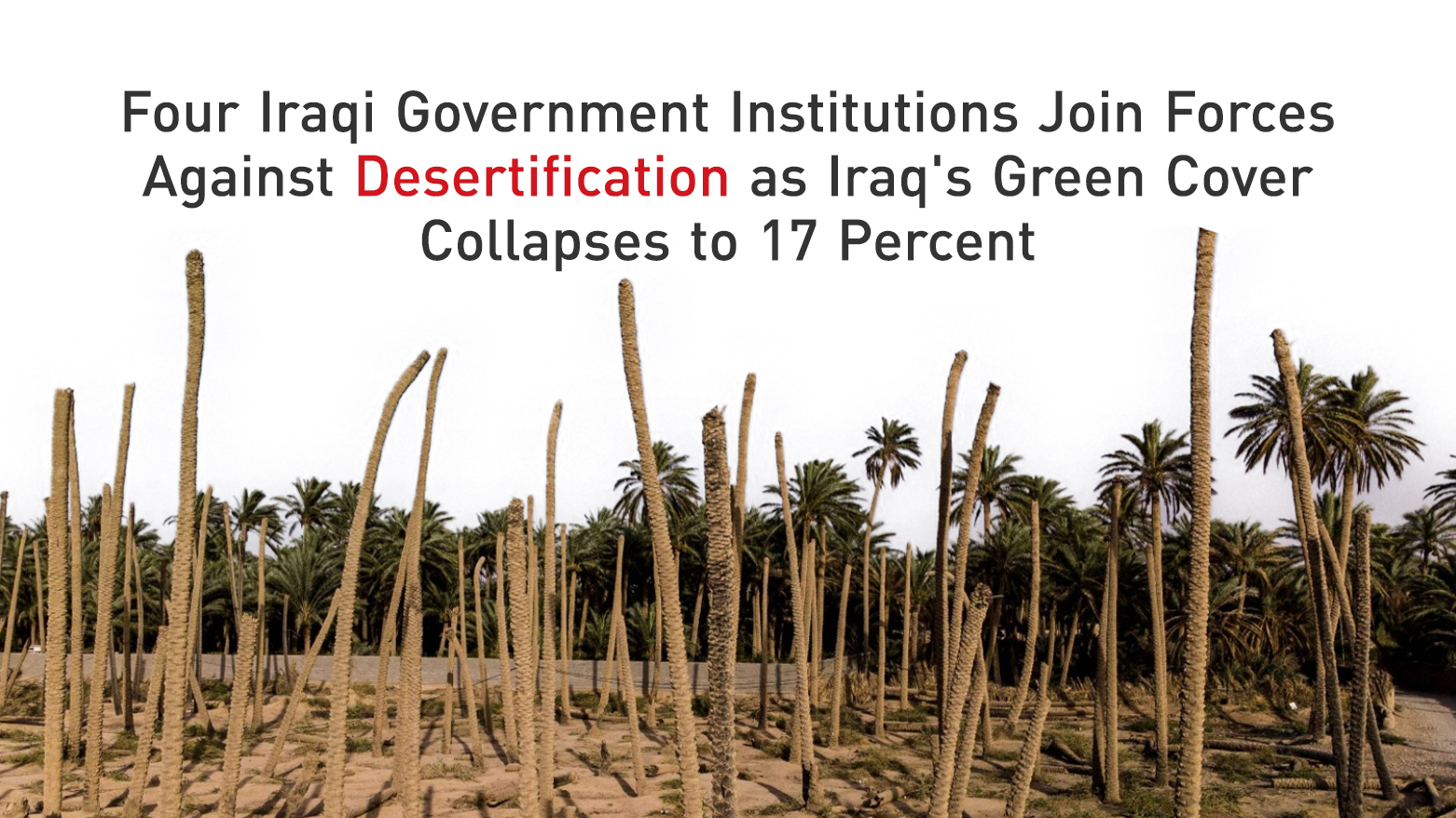
ERBIL (Kurdistan 24) - Iraq's Green Vision announced on Tuesday, September 8, 2026, that four government institutions are participating in joint efforts to combat the destruction of green spaces and prevent further desertification across the country, in a coordinated multi-agency environmental initiative addressing one of Iraq's most alarming ecological crises, as the country's green area has collapsed from 50 percent to just 17 percent due to climate change and sustained governmental neglect, as Kurdistan 24 previously confirmed.
The announcement comes as Iraq continues to rank among the countries most severely impacted by climate change globally, with vast areas in its central and southern regions succumbing to desertification, and Baghdad's greenness rate having plummeted to just 4.5 percent according to Iraqi environmental organizations, as Kurdistan 24 reported in October 2025. That figure stands in dramatic contrast to the 20 percent green cover reported in the Kurdistan Region, where the Kurdistan Regional Government has actively prioritized urban forestry and environmental initiatives, with green space coverage rising from 15 percent in 2018 to 20 percent in 2026.
Iraq's Ministry of Agriculture has estimated that the country needs to plant 15 billion trees to combat desertification, establish forests, and reduce greenhouse gases. Iraq is the second most polluted country in the world, and Baghdad was ranked 13th globally by air quality surveys, as Kurdistan 24 previously documented.
The multi-agency collaboration announced on Tuesday builds on a series of government-led environmental initiatives that have been gathering momentum throughout 2026. As the Iraqi Ministry of Environment confirmed on May 31, 2026, the development of green belts across the country serves as a core pillar of its strategic master plan to combat desertification, with the operational rollout decentralized to allow each governorate council and local authority to design and implement specific green belt infrastructure. Najla Al-Waeli, Director General of the Technical Department at the Ministry of Environment, told the Iraqi News Agency that the green belt portfolio is an essential component of the operational roadmap under the National Strategy to Combat Land Degradation and Desertification in Iraq.
The primary challenge facing the multi-agency effort is water. Iraq's rivers have hit historic lows after years of drought, cutting irrigation, shrinking crop yields, and leaving the land increasingly bare, with 78 percent of irrigation now depending on groundwater, as Shafaq News confirmed in March 2026. Omar Abdul Latif of the Iraq Green Observatory has stressed that the desertification crisis is more than a technical problem, reflecting deep structural issues in Iraq's water management, agricultural policy, and urban planning that no single government institution can resolve alone.
In the Kurdistan Region, a functioning model of green space expansion already exists and is scaling up. The Erbil Green Belt Project, a strategic circular belt two kilometers wide designed to encircle the regional capital with a 78-kilometer forested perimeter, has already planted 700,000 saplings as part of a long-term plan to reach 7 million trees by 2050, as the KRG-US office confirmed in April 2026. The project is expected to reduce carbon dioxide emissions by an estimated 140,000 to 210,000 tons annually, reduce temperatures, block dust storms, and create agricultural employment, as Kurdistan 24 confirmed in July 2026. The project entered Phase Two earlier this year, supported by large-scale irrigation systems and reservoirs designed to ensure newly planted areas can be sustained over the long term.
The KRG has also closed 85 unofficial, highly polluting refineries and phased out more than 2,500 private diesel generators through the Runaki Programme, resulting in a reduction of over one million tons of carbon dioxide emissions annually, as Kurdistan 24 confirmed in May 2026. The Kurdistan Region's approach, combining green belt expansion with energy sector reform and strict environmental enforcement, provides a template that the four-institution federal collaboration announced on Tuesday will need to match in scale and consistency if Iraq's national desertification crisis is to be meaningfully reversed.