BRICS Calls for Restraint in Iran War, Rejects Unilateral Sanctions
BRICS leaders called for restraint in the Iran war, opposed certain unilateral sanctions, defended safeguarded nuclear sites and backed Iran's WTO bid.
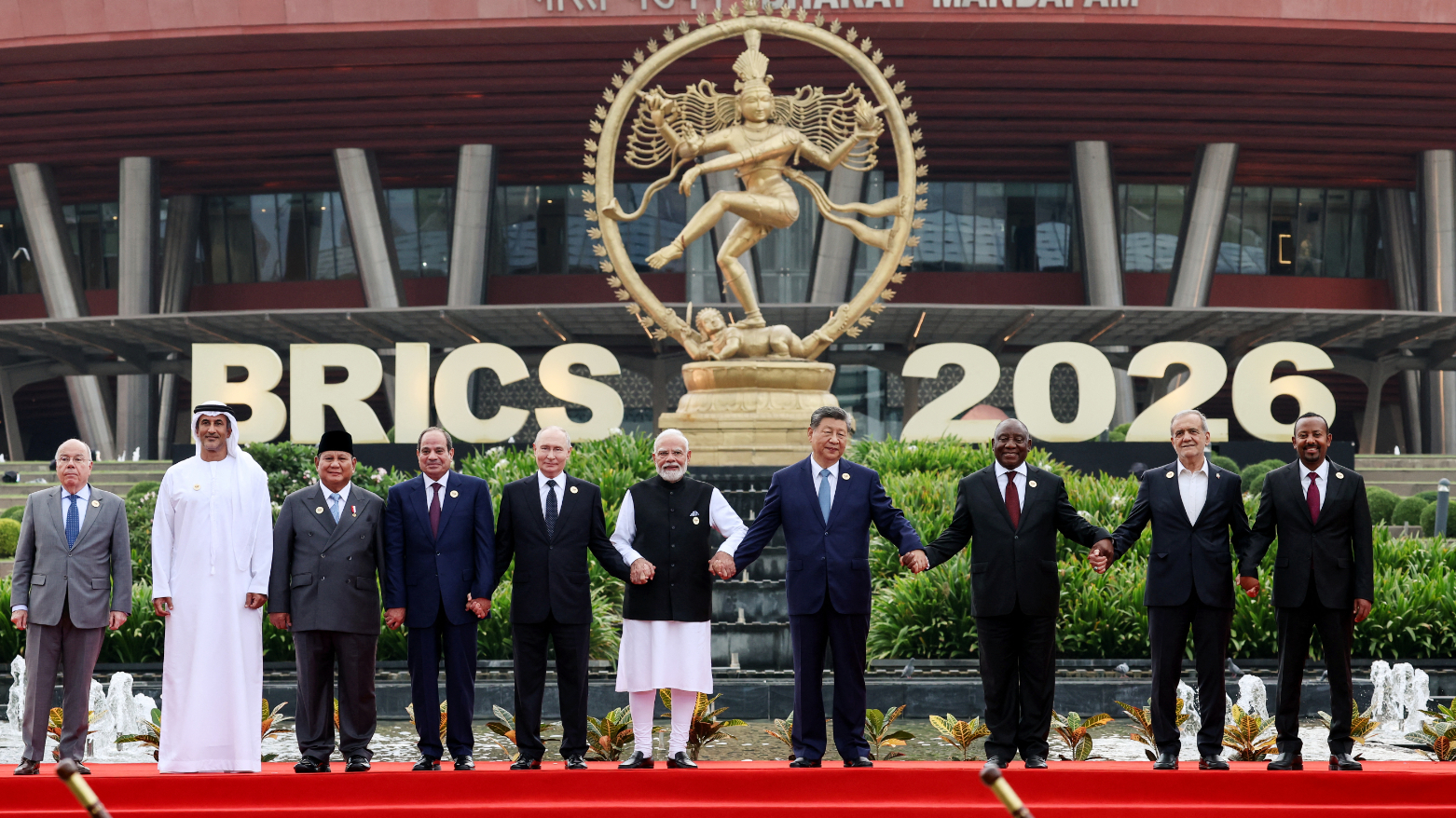
ERBIL (Kurdistan24) - BRICS leaders have called for "maximum restraint" in the escalating Middle East conflict, voiced serious concern over attacks on safeguarded peaceful nuclear facilities and renewed their opposition to unilateral economic sanctions, achieving a consensus with direct implications for Iran after months of divisions inside the expanding bloc.
The New Delhi Declaration, adopted during the Sept. 12-13 BRICS summit in India, does not assign responsibility for the Middle East war or explicitly identify the United States or Israel in its section on nuclear installations. Instead, the 11-member grouping recalled the differing national positions of its members while agreeing that further escalation should be avoided.
That carefully negotiated language is notable because BRICS foreign ministers were unable to agree on a joint statement in May amid differences involving Iran, Saudi Arabia and the United Arab Emirates over the war that began with U.S.-Israeli strikes on Iran on Feb. 28, according to reporting by Associated Press correspondents Sheikh Saaliq and Aijaz Hussain and Agence France-Presse journalists Uzmi Athar and Bhuvan Bagga.
This time, the leaders agreed that civilians and civilian infrastructure should be protected, state sovereignty and territorial integrity respected, and diplomacy intensified toward a longer-term settlement. They also linked regional stability directly to uninterrupted global trade, supply chains and energy flows.
The declaration went further on nuclear security.
BRICS expressed "serious concern" over deliberate attacks on civilian infrastructure and peaceful nuclear facilities operating under full International Atomic Energy Agency safeguards, saying nuclear safeguards, safety and security must be maintained even during armed conflict.
The document did not name the facilities or states involved. AP, however, described the provision as indirect criticism of U.S. and Israeli strikes on Iranian nuclear facilities.
The distinction is important: the declaration establishes the bloc's collective position on safeguarded nuclear installations without recording a consensus explicitly condemning Washington or Israel by name.
BRICS also reaffirmed broader concern over nuclear conflict and supported efforts to establish a Middle East zone free of nuclear weapons and other weapons of mass destruction.
For Tehran, the summit's economic language was nearly as consequential as its security provisions.
The leaders condemned unilateral coercive measures they consider contrary to international law, specifically referring to unilateral economic and secondary sanctions. They said such measures can affect development, health and food security and reiterated opposition to sanctions imposed without authorization from the UN Security Council when those measures contravene international law and the UN Charter.
The declaration again did not single out the United States or Iran in that section. But its language carries particular relevance for Tehran, which remains subject to extensive U.S. sanctions and has sought stronger BRICS mechanisms to reduce its exposure to Western financial pressure.
AP reporters Saaliq and Hussain noted that Iranian President Masoud Pezeshkian has pushed for greater use of national currencies among BRICS members as part of efforts to lessen dependence on Western-dominated financial systems.
The declaration provided movement in that direction, although it stopped well short of establishing a common BRICS currency.
Leaders acknowledged work by the BRICS Payment Task Force on making cross-border payments more efficient and studying greater interoperability between payment and messaging channels. They also cited discussions on settling trade and investments in members' local currencies, while explicitly recognizing national priorities and saying there was no single model applicable to every member.
BRICS additionally offered Iran a more direct form of economic diplomatic support by endorsing Iran's bid to join the World Trade Organization, alongside Ethiopia.
Taken together, the sanctions, payments and WTO provisions fit a broader BRICS effort to give emerging economies greater influence in international financial and trading institutions without formally positioning the bloc as an anti-Western alliance.
Indian Prime Minister Narendra Modi emphasized that point during the summit, saying, "BRICS is not against anyone."
AP correspondents Aijaz Hussain and Sheikh Saaliq reported that Modi instead portrayed the bloc as seeking a larger role for the Global South in shaping international rules. On Sunday, he urged member states to turn the agreements reached in New Delhi into measurable action rather than leave them at the level of summit declarations.
Energy security was another theme with direct relevance to the Iran conflict.
The declaration called for stable energy markets, uninterrupted flows from diverse sources and stronger protection for critical and cross-border energy infrastructure. It also acknowledged that fossil fuels will continue to play a substantial role for emerging and developing economies.
Those commitments come as the Iran war has disrupted regional shipping and heightened concerns about energy supply routes, making the consequences of the conflict far broader than the battlefield itself.
The agreement ultimately reflects both the reach and the limits of BRICS consensus.
Iran secured language aligned with several of its longstanding positions: opposition to certain unilateral sanctions, protection for safeguarded nuclear facilities, support for its WTO accession and continued work on local-currency trade. At the same time, the declaration did not explicitly condemn the United States or Israel over the Iran war, nor did it establish a mechanism for lifting sanctions or ending the conflict.
What BRICS did achieve in New Delhi was a common position where one had proved impossible only months earlier: restraint rather than wider escalation, diplomacy rather than an expanding regional war, protection of nuclear facilities and energy flows, and resistance to economic measures the bloc considers outside the UN-centered international system.