McGurk to Kurdistan24: Damascus, World Must Recognize SDF Sacrifices
Former US official says integrating the Kurdish-led forces into Syria’s state will be difficult, while expressing cautious optimism about the country’s future
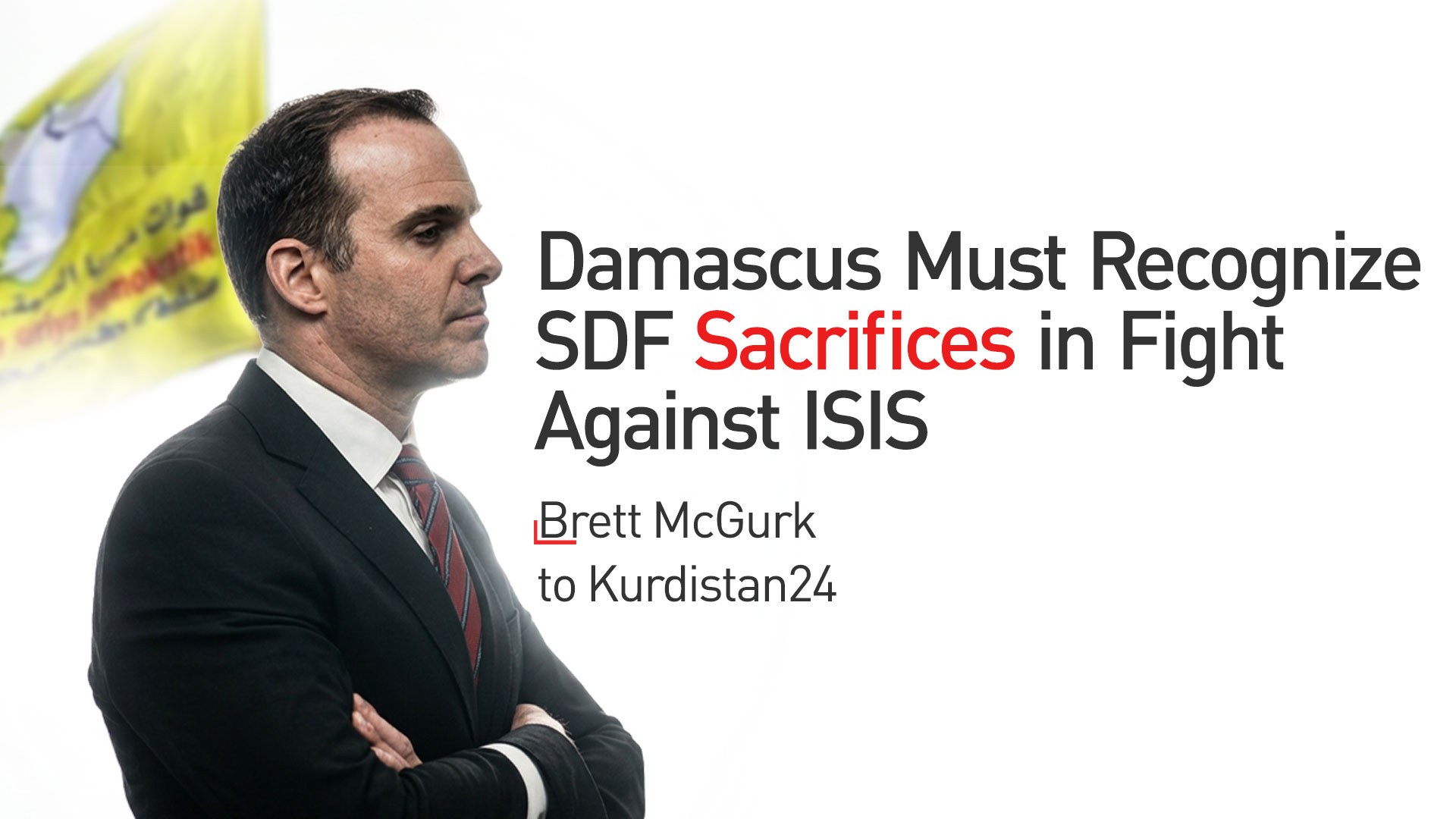
ERBIL (Kurdistan24) — Former senior US official Brett McGurk said the Syrian government and the international community must recognize the sacrifices of the Syrian Democratic Forces (SDF) in the fight against ISIS, while warning that integrating the forces into the Syrian state will be a difficult process.
Speaking to Issa Hassan, Kurdistan24's correspondent in New York, McGurk said he had long supported a unified Syria and welcomed Syrian President Ahmad al-Sharaa’s reference to Decree 13, saying its provisions should become part of the country’s constitutional framework.
McGurk moderated an Atlantic Council discussion with al-Sharaa in New York on Sept. 22, ahead of the Syrian president’s address to the 81st session of the United Nations General Assembly.
The discussion focused on Syria’s future, reconstruction, institutional reform, and its relations with the United States and the wider region.
Reflecting on Washington’s close cooperation with the SDF during the campaign against ISIS, McGurk said the eventual integration of the forces into the Syrian state had long been part of discussions about the country’s future.
“I think we always wanted to see a unified Syria,” McGurk told Kurdistan24.
“When we worked so closely with the Syrian Democratic Forces in those very difficult days of ISIS, we always talked about the future, hopefully with a new government in Damascus, you would have an integration into the state.”
However, McGurk cautioned that such a process would be challenging.
“This is a very difficult process,” he said.
McGurk said his questions during the Atlantic Council discussion were intended in part to address the challenges facing Syria as Damascus seeks to consolidate state institutions and determine the future status of the SDF.
He stressed that the SDF’s contribution to the international campaign against ISIS must be recognized both by the international community and by the Syrian government.
“It’s very important to make sure that the world recognizes what the SDF did for the world,” he said. “It’s very important for the government in Damascus to recognize those sacrifices as well.”
McGurk also welcomed al-Sharaa’s reference to Decree 13, which concerns the rights and status of Syria’s Kurdish population, saying its provisions should be reflected in the country’s constitutional order.
“I thought it was important that the president mentioned Decree 13, and this will now be part of the constitutional fabric in Syria,” McGurk said. “I thought that was a very good and very important answer.”
The former US official said Syria’s future has implications beyond its borders, with the country’s stability affecting the wider Middle East and the international community.
“We all want Syria to succeed. It’s important for the world, and it’s important for the stability of the region,” he said.
“Most importantly, it’s important for the Syrian people after almost six decades of just horrendous rule.”
McGurk ended his assessment with cautious optimism, saying he welcomed the possibility of progress while remaining aware of the substantial challenges facing Syria.
“So I’m hopeful,” he said, “but I am also very mindful of the challenges ahead.”
McGurk has extensive experience dealing directly with the Kurdistan Region and Syria from his time as the US Special Presidential Envoy for the Global Coalition to Defeat ISIS from 2015 to 2018. During that period, he was closely involved in Washington’s coordination with the Kurdistan Region and the Peshmerga in the fight against ISIS, making repeated visits to Erbil and other parts of the Region.
In Syria, he worked closely with the Syrian Democratic Forces (SDF), a key US partner in the coalition’s campaign against ISIS, including on military operations, stabilization and governance efforts in areas liberated from the group. His role placed him at the center of US policy toward Kurdish forces in both Iraq and Syria and the broader international campaign against ISIS.