Remains of Kocho Victims to Return to Families in Sinjar
The remains of 25 Ezidis killed by ISIS in 2014 will return to Sinjar on Oct. 1 as mass-grave identification and searches for the missing continue.
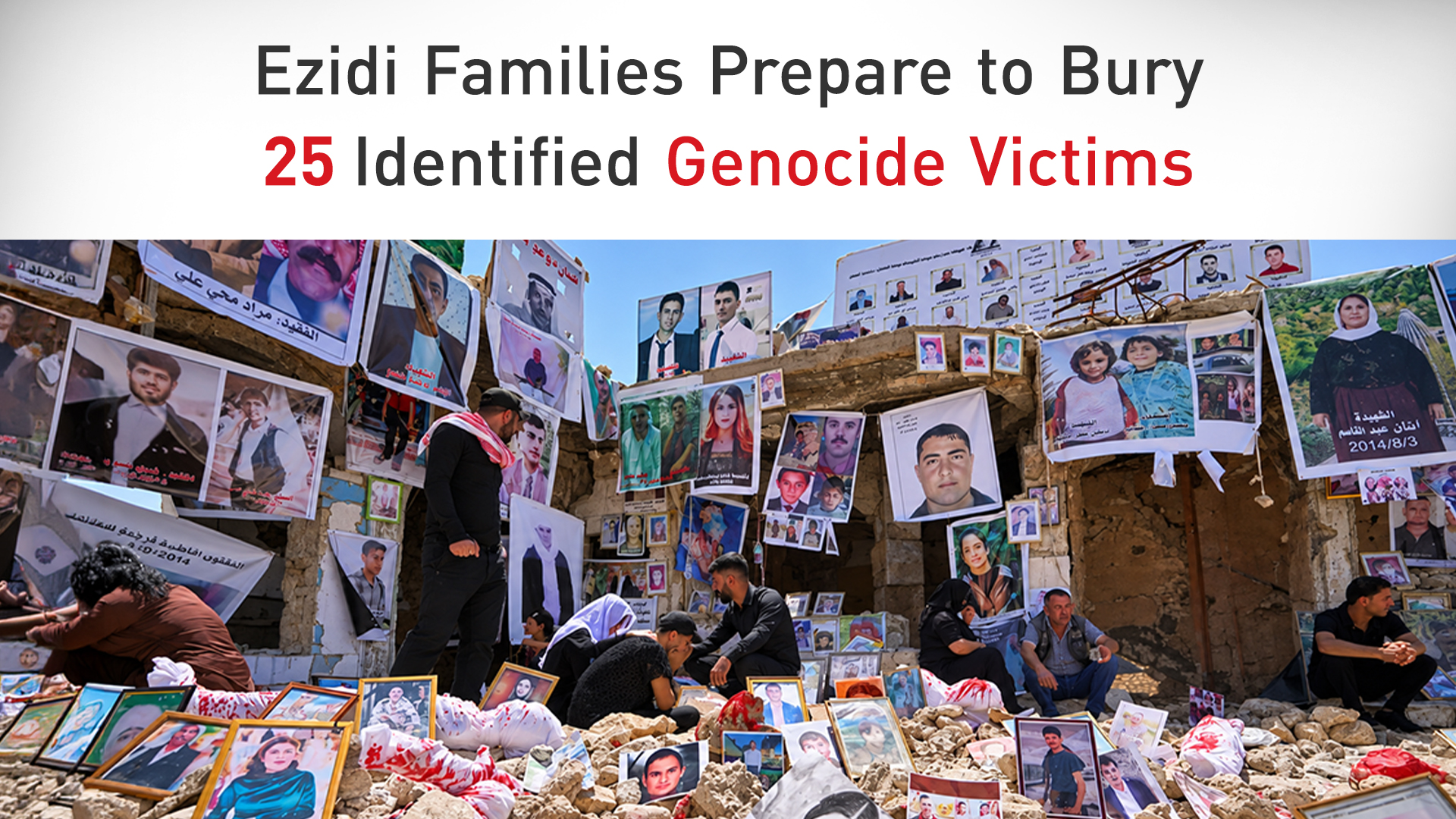
ERBIL (Kurdistan24) - The remains of 25 Ezidi victims killed by ISIS in Sinjar in 2014 will be returned to their families on Oct. 1, bringing another group of victims home more than a decade after the genocide while hundreds of other remains and missing-person cases remain unresolved.
The 25 victims, most of them from Kocho village, were between 12 and 70 years old. Their remains have been held at the Forensic Medicine Department in Baghdad for more than six years while forensic examinations and identification procedures were completed.
The remains will first be taken to the memorial monument in Sinjar, where a special ceremony will be held to receive them. About an hour later, each set of remains will be handed to the victim's family for burial in a designated cemetery.
The return represents the ninth group of identified victims and forms part of the prolonged effort to determine the fate of those killed or disappeared after ISIS overran Sinjar and surrounding villages on Aug. 3, 2014.
The assault targeted the Ezidi religious component, also known as Yezidis or Ezidis. ISIS militants executed civilians, abducted families, enslaved women and girls, imposed forced religious conversions and destroyed religious sites as the group sought to erase the community and its heritage.
Twelve years later, many families still do not know what happened to relatives who disappeared during the attack.
In an Aug. 3, 2026 announcement, the Kurdistan Regional Government said 5,000 Ezidis had been killed and 6,417 abducted during the genocide. Of those abducted, 3,595 had been rescued, while 2,526 remained missing.
More than 10 countries have formally recognized the atrocities against the Ezidis as genocide. At the August 2026 commemoration, Ezidi leader Mir Hazim Tahsin Beg called for reconstruction, compensation and effective protection for the community, while survivors continued to press for answers about those still missing.
Read More: Mir Hazim Tahsin Beg: ISIS Could Not Erase Ezidis' 4,000-Year Heritage
Identifying remains recovered from Sinjar is one part of that search.
The latest figures state that 96 mass graves have been discovered in Sinjar, in addition to dozens of individual burial sites. Seventy-eight mass graves have been exhumed, while another 18 are expected to be opened.
So far, 857 sets of remains have been recovered. The identities of 296 victims have been established, while 536 sets of remains remain at the Forensic Medicine Department in Baghdad.
An earlier KRG announcement in August recorded 93 mass and individual graves in Sinjar and surrounding areas and said 296 victims had been identified through DNA testing and their remains returned to families. The latest report separately records 96 mass graves, alongside dozens of individual burial sites.
For Ezidi families, each identification can end years of uncertainty by allowing relatives to hold a funeral and establish a grave for someone whose fate had remained unknown.
The victims whose remains will be returned are Haji Murad Basmi, Hawi Khalaf Qasim, Dakhil Omar Sido, Amer Khidr Mato, Ghazala Abbas Qasim, Washiya Bashar Jara, Hanifa Khalaf Sharo, Jian Osman Zafo, Nouri Sharaf Ibrahim, Misri Hamidan Murad, Shirin Qasim Khdeida, Nisan Khalaf Ali, Adnan Hadi Hussein Aziz, Haji Khdeida Khalaf, Barjan Khalaf Murad, Sahar Khashan Rasho, Alaa Barakat Elias, Marwan Ismail Sido, Abbas Elias Qasim, Rafi Hadi Hussein, Joko Murad Bashar, Khidr Mishko Nasser, Hawas Habibo Kato, Sirwan Barjas Suleiman and Hussein Barjas Suleiman.
Their return comes as other consequences of the genocide remain unresolved.
Read More: Over 1,200 Ezidi Women Still Missing Nearly 12 Years After ISIS Genocide, KRG Says
Survivors continue to live with the physical and psychological effects of captivity, while many displaced Ezidi families have yet to return permanently to Sinjar. The KRG said in August that livelihoods, shelter, protection and essential services remained among the principal challenges facing displaced Ezidis.
Read More: Duhok Commemorates 12 Years Since Ezidi Genocide as Calls for Justice Intensify
Damaged homes, weak services, competing armed groups and unresolved administrative arrangements have also hindered recovery.
The October 2020 Sinjar Agreement between Baghdad and Erbil was intended to reorganize security and administration, recruit local security personnel, remove unauthorized armed groups and advance reconstruction. Kurdistan24's August reporting described its implementation as limited.
Read More: Justice, Reconstruction and Return Remain Elusive for Sinjar
Those unresolved security and administrative questions remain closely connected to the return of displaced families, for whom rebuilding life in Sinjar depends on security, functioning institutions, reconstruction and basic services.
Criminal accountability remains another unfinished part of the genocide's aftermath.
On Aug. 4, Kurdistan24 reported that a proposed Law on Combating International Crimes had completed legal review but still required parliamentary approval. Iraqi official Khalaf Sinjari said the legislation would allow prosecutions for genocide, war crimes and crimes against humanity rather than relying solely on terrorism charges, while also establishing a compensation fund.
Read More: Iraq Advances Bill Targeting ISIS Genocide Crimes Amid Calls to Secure Sinjar
Ezidi survivors and community leaders have continued to demand the recovery of missing relatives, identification of the dead, compensation, reconstruction and prosecutions that recognize the full nature of the crimes committed against them.
On Oct. 1, 25 families will be able to bury relatives whose remains spent years awaiting identification and return. For hundreds of others, the mass graves, unidentified remains and missing-person files mean the search for answers continues.