Masrour Barzani Thanks Coalition On Behalf Of Kurdistan's People As Peshmerga Stands Ready For Any Threat
Prime Minister delivers a statement of historic gratitude on the day Operation Inherent Resolve formally concludes, reaffirming the Peshmerga's readiness and the Kurdistan Region's commitment to its alliances as the coalition departs Erbil Air Base after twelve years
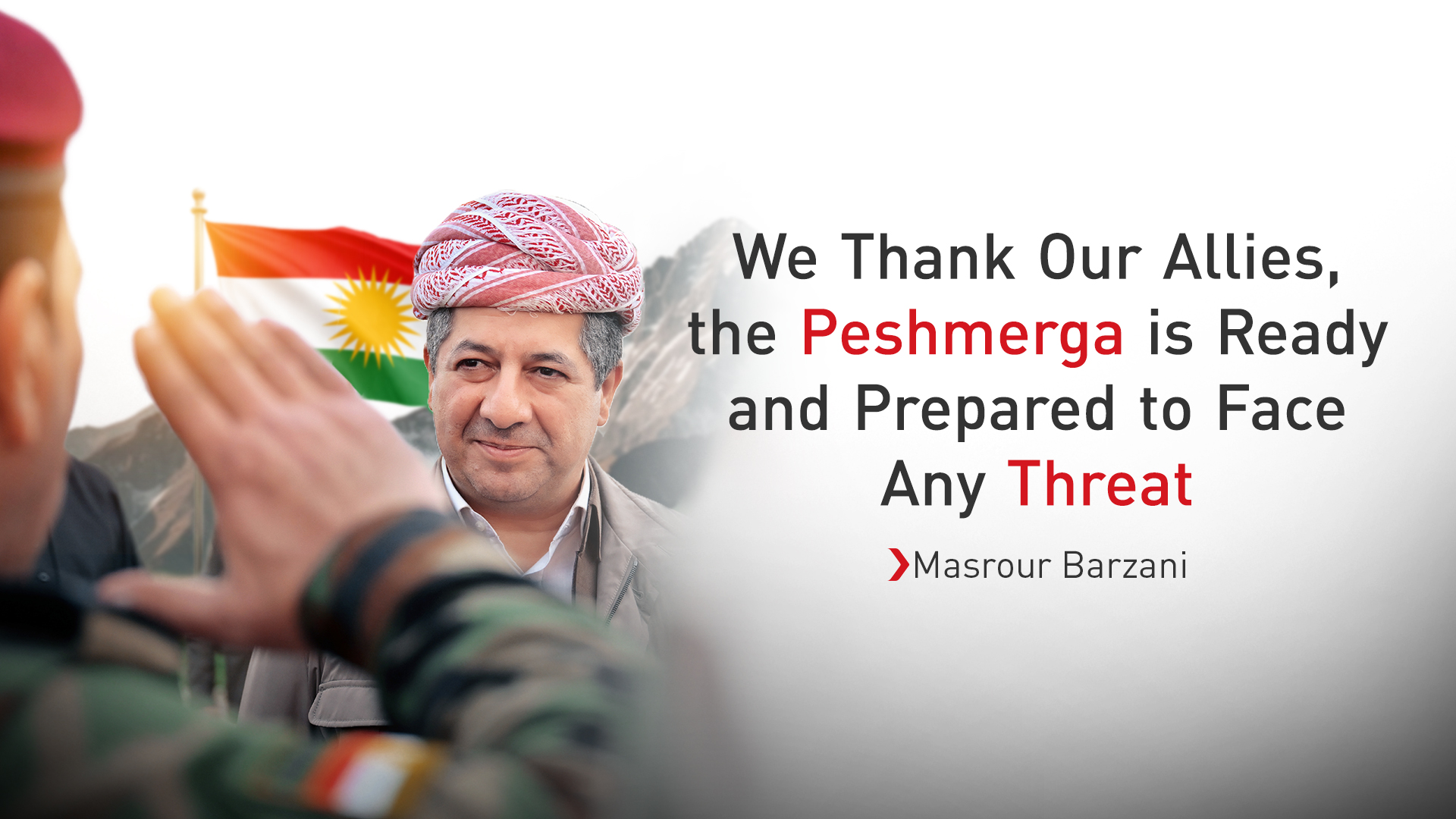
ERBIL (Kurdistan 24) - Kurdistan Region Prime Minister Masrour Barzani delivered his statement thanking the international coalition and reaffirming Peshmerga readiness on Wednesday on the sidelines of the foundation stone ceremony for three strategic Toyota Company projects in Erbil, including a spare parts center, an expanded pre-delivery inspection facility, and Erbil Motor City.
The ceremony, attended by Japan's Consul General in the Kurdistan Region, the Erbil Governor, and Toyota Iraq's CEO, provided the backdrop for one of the Prime Minister's most significant public statements of the post-coalition transition period, delivered at a moment when the Kurdistan Region was simultaneously marking the end of a twelve-year military partnership and laying the groundwork for continued economic growth and private sector investment confidence in its capital.
"On behalf of the people of Kurdistan, we thank our allies," Prime Minister Barzani said during his speech.
The statement is measured and precise. It is a public expression of gratitude at a moment when the Kurdistan Region's international security partnerships are transitioning rather than ending, and a clear signal to adversaries, to Iran above all, that the Peshmerga's combat readiness has not been diminished by the coalition's departure.
"The Peshmerga forces are solid and ready to confront any threat," Barzani added.
Twelve Years of Partnership
The coalition that Prime Minister Barzani is thanking on behalf of his people was born in the darkest moment the Kurdistan Region has faced in its modern history. In August 2014, ISIS swept out of Mosul with American-supplied weapons seized from the collapsing Iraqi Army, advancing toward Erbil and threatening to overrun the Kurdish capital. It was the Kurdistan Region's appeal for international help, and the United States' response with airstrikes beginning August 8, 2014, that halted the ISIS advance at the gates of Erbil and launched the coalition that formally concluded on Wednesday.
Over the twelve years that followed, the coalition, at its peak comprising more than 80 countries, conducted more than 35,000 airstrikes against ISIS across Iraq and Syria, deployed advisers and trainers who worked alongside Peshmerga forces in some of the conflict's most intense battles from Sinjar to Makhmour to the Nineveh Plains, and provided intelligence, logistics, medical support, and weapons that enabled the Peshmerga to hold the line and eventually push ISIS back across hundreds of kilometers of front.
The human cost on the Kurdish side was staggering. More than 1,800 Peshmerga fighters were killed in the battle against ISIS, with thousands more wounded. The Yazidi community of Sinjar suffered what the United Nations characterized as genocide, with thousands massacred and thousands more taken as slaves. The families of those fighters and those victims are among the people on whose behalf Prime Minister Barzani offered Wednesday's thanks.
The Peshmerga's Readiness Statement
Prime Minister Barzani's declaration that the Peshmerga are solid and ready to confront any threat is not ceremonial language. It is a direct operational message to multiple audiences simultaneously.
To the Kurdish people, it is reassurance. The coalition's departure creates genuine anxiety in a Region that has absorbed more than 1,000 Iranian drone and missile attacks since the war began in February 2026, including the Hadid-110 drone strikes on the Prime Minister's own office in Pirmam on August 17, 2026, and the interception of 10 attack drones over Erbil governorate airspace on September 2, 2026. Citizens who have watched US Patriot batteries removed from around Erbil need to hear that their own forces are prepared.
To Washington, it is a signal of continued reliability. The Pentagon's formal departure statement explicitly named the Peshmerga alongside Iraqi Security Forces as the forces expected to lead the continuing effort to secure Iraq and suppress ISIS remnants, a designation that carries with it an expectation of capability and resolve. Prime Minister Barzani's readiness statement answers that expectation directly.
To Tehran, it is a deterrent message. Iran has consistently targeted the Kurdistan Region throughout the conflict on the grounds that its enemies, Iranian Kurdish opposition groups and American forces, operate from Kurdish territory. The departure of American forces removes one of Iran's stated justifications for strikes. The Peshmerga readiness declaration signals that the second justification, the opposition group presence, will not translate into Kurdish vulnerability.
To the Kurdistan Region's own armed forces, whose morale and institutional confidence matter as much as their firepower, it is an affirmation from their commander. The Peshmerga's unification process, the promotion of 519 security officers in September, and the completion of 99 percent digital salary registration are not administrative details. They are building blocks of an institution that its prime minister is publicly declaring ready for whatever comes next.
The Transition Ahead
The coalition's departure does not end the Kurdistan Region's security relationships. It changes their form. The United States has committed to continued targeted training and intelligence support through a bilateral framework. The State Department has reaffirmed to Kurdistan 24 that the Kurdistan Region remains a foundational pillar of the broader US-Iraq relationship. Several European nations that contributed to the coalition, including Germany, France, and the United Kingdom, have maintained independent bilateral security cooperation with the Kurdistan Region throughout the coalition period and are expected to continue doing so.
The Peshmerga enters the post-coalition period as a more institutionally unified, digitally administered, and internationally trained force than the one that stood at the Erbil front line in August 2014. It is also entering a more dangerous regional environment, with Iranian military capability intact, Iran-aligned militias still armed and active in Iraq, and the US military footprint reduced to a diplomatic protection role.
Prime Minister Barzani's two sentences on Wednesday carry the weight of twelve years of sacrifice, partnership, and survival. The thanks are real. So is the readiness that follows them.