DEM Party Co-Chair Accuses Türkiye of Discrimination Against Amedspor
DEM Party co-chair Tuncer Bakırhan has accused Turkish football authorities of racist and discriminatory treatment of Amedspor following new disciplinary penalties against the Kurdish club.
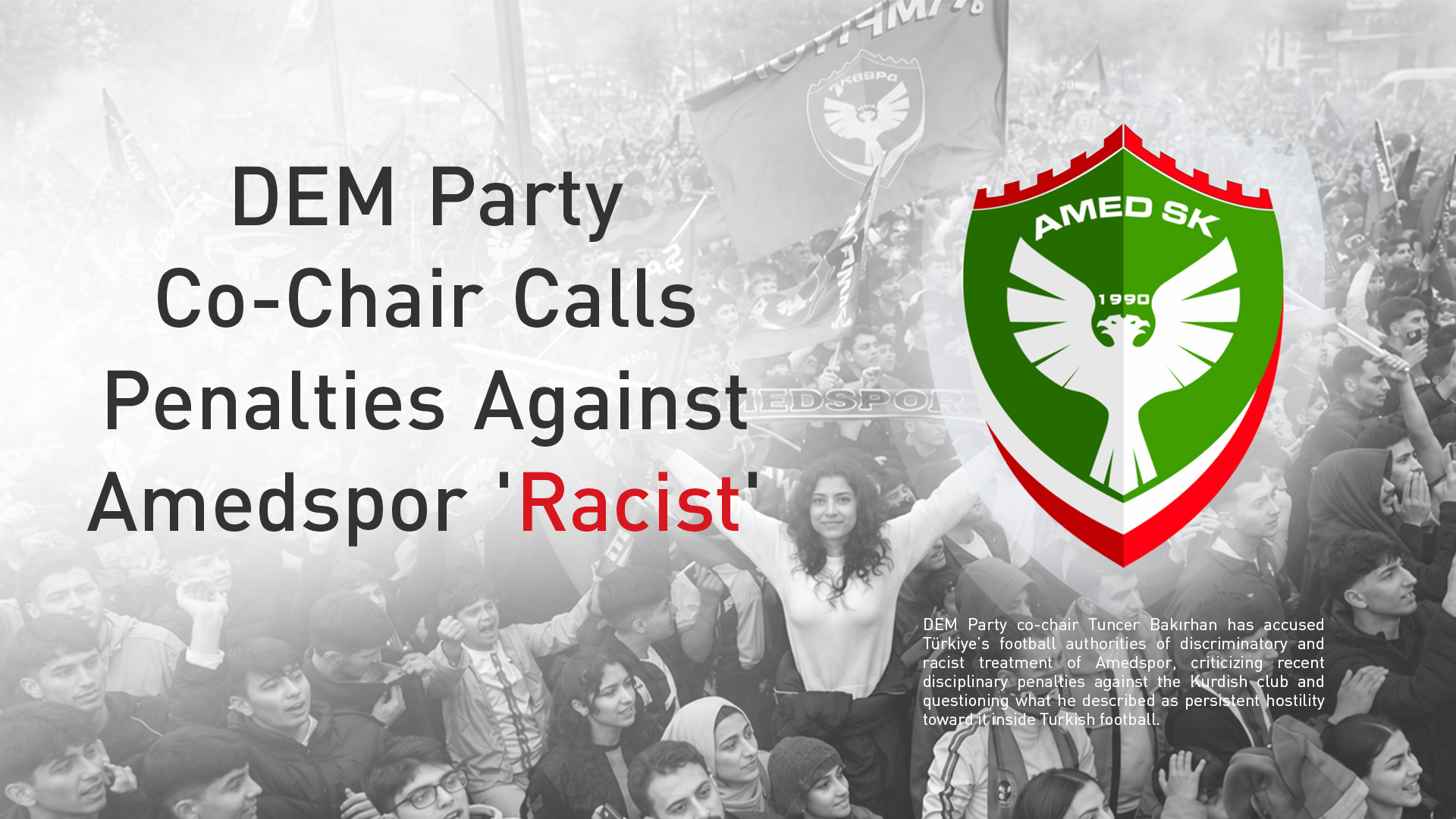
ERBIL (Kurdistan24) - DEM Party co-chair Tuncer Bakırhan has accused Türkiye’s football authorities of discriminatory and racist treatment of Amedspor, criticizing recent disciplinary penalties against the Kurdish club and questioning what he described as persistent hostility toward it inside Turkish football.
Bakırhan's remarks were reported by Kurdistan24 correspondent Ebdulselam Tutinçî following renewed controversy over sanctions imposed on Amedspor by the Turkish Football Federation's disciplinary authorities.
The DEM Party co-chair sharply criticized both the federation and the body responsible for refereeing, saying they were being administered by people he regarded as incompetent.
He linked problems in football to broader political conditions in Türkiye, arguing that genuinely "clean football" could not be achieved without democracy.
A central part of Bakırhan's criticism concerned the treatment Amedspor and its supporters encounter at matches.
He accused the Turkish Football Federation of remaining silent when the club is subjected to threats and discriminatory behavior in stadiums and questioned why a club closely associated with Kurdish identity should repeatedly face hostility.
Those statements represent Bakırhan's political assessment. The Turkish Football Federation has yet to respond to his accusations.
Bakırhan also broadened his criticism beyond Amedspor.
He alleged that Kurdish footballers who had performed successfully at European level had not been given opportunities with Türkiye's national team because of their Kurdish identity.
No specific players were identified in the Bakırhan's remarks.
His comments followed a disciplinary decision imposing more than 2.5 million Turkish lira in fines on Amedspor, according to Kurdistan24's reporting, with authorities citing political slogans displayed during matches.
The decision has prompted criticism from Kurdish politicians and officials, who have characterized the punishment as part of a wider pattern of unequal treatment toward the club.
Amedspor has previously faced disciplinary disputes involving Kurdish-language writing and slogans on players' jerseys, while its supporters have also been barred from attending some away matches.
One such case involved Rohan Sefo, an 11-year-old Kurdish singer and Amedspor supporter whose social media accounts were shut down in Türkiye after his rendition of a song celebrating the club went viral, according to his family.
Rohan, whose family comes from Qamishlo and who lives in Batman, northern Kurdistan, had already built a substantial online following through his Kurdish songs. Following Amedspor's 3–2 victory over Beşiktaş, he performed "Lêxe Amedspor" (Hit Amedspor), drawing what his family said were five million views within 24 hours.
His Instagram and Facebook accounts were subsequently closed.
The federation has historically cited disciplinary rules and security considerations in measures involving the club, while Amedspor officials, supporters and Kurdish political figures have frequently argued that the club is treated differently because of the identity it represents.
That debate extends well beyond individual fines.
Based in Diyarbakır, known in Kurdish as Amed, the club has developed into one of the most visible sporting expressions of Kurdish identity within Türkiye's football system.
Amedspor was founded in 1972 and adopted its current name in 2014. Its growing profile was strengthened by a run to the Turkish Cup quarterfinals in 2016 and subsequent progress through Türkiye's league structure.
The club's sporting rise has been accompanied by an unusually strong emotional connection with supporters.
Previous research and reporting have examined how Amedspor functions not simply as a football team but as a place where sporting loyalty and Kurdish identity meet.
Sociologist Dağhan Irak, writing in Society Register, examined Amedspor through theories of resistance and collective identity, arguing that the club's public identification with Amed made Kurdish identity visible within a national sporting institution.
Sociologist Sven Ismer, writing in Nationalities Papers, has explored more broadly how collective emotion generated through sporting rituals can deepen feelings of belonging.
For Amedspor supporters, that connection can be seen in the symbols, chants, shirts and shared match-day experiences through which football becomes tied to a sense of community.
Journalist Rabia Çetin previously documented the personal side of that attachment in reporting on Amedspor supporters. One Kurdish supporter described following the club despite having little general interest in football because Amedspor's experience resonated with her own identity.
The intensity of the relationship between the club and its supporters is also visible far away from the stadium.
Kurdistan24 recently reported that some families in Diyarbakır have even named newborn children after Amedspor players.
One family named its child Shervan Dia Saba, after Amedspor player Dia Saba. Another had previously named a baby after player Mbaye Diagne.
Such examples illustrate how the club has become woven into everyday expressions of affection and belonging for some supporters.
That popularity has developed alongside repeated controversy.
Amedspor supporters have faced restrictions on traveling to away fixtures, and the club has experienced hostile incidents at matches, including objects being thrown onto the pitch during a game in Bursa in 2023.
At the same time, Amedspor remains a professional football club competing within Türkiye's national league system, and claims that disciplinary decisions are ethnically or politically motivated remain matters of dispute rather than established findings.
Bakırhan's latest remarks nevertheless show how readily sporting decisions involving Amedspor become part of Türkiye's wider debate over Kurdish identity, equality and political rights.
His criticism focused not only on the latest financial penalty but on what he described as an accumulation of sanctions, hostile behavior and institutional silence.
For the DEM Party co-chair, football cannot be separated from the broader political environment in which the club operates.
Amedspor's supporters, meanwhile, continue to invest the team with meaning extending beyond results on the pitch.
That combination, sporting ambition, intense local loyalty and Kurdish cultural identification, helps explain why disciplinary decisions involving the club repeatedly generate political controversy.