Nujaba Leader's US Flag Video Tests Baghdad's State Authority
Akram al-Kaabi's video trampling the U.S. flag after Iraq's Prime Minister Ali al-Zaidi ordered punishment for a similar act poses an early test of Baghdad's post-Coalition authority.
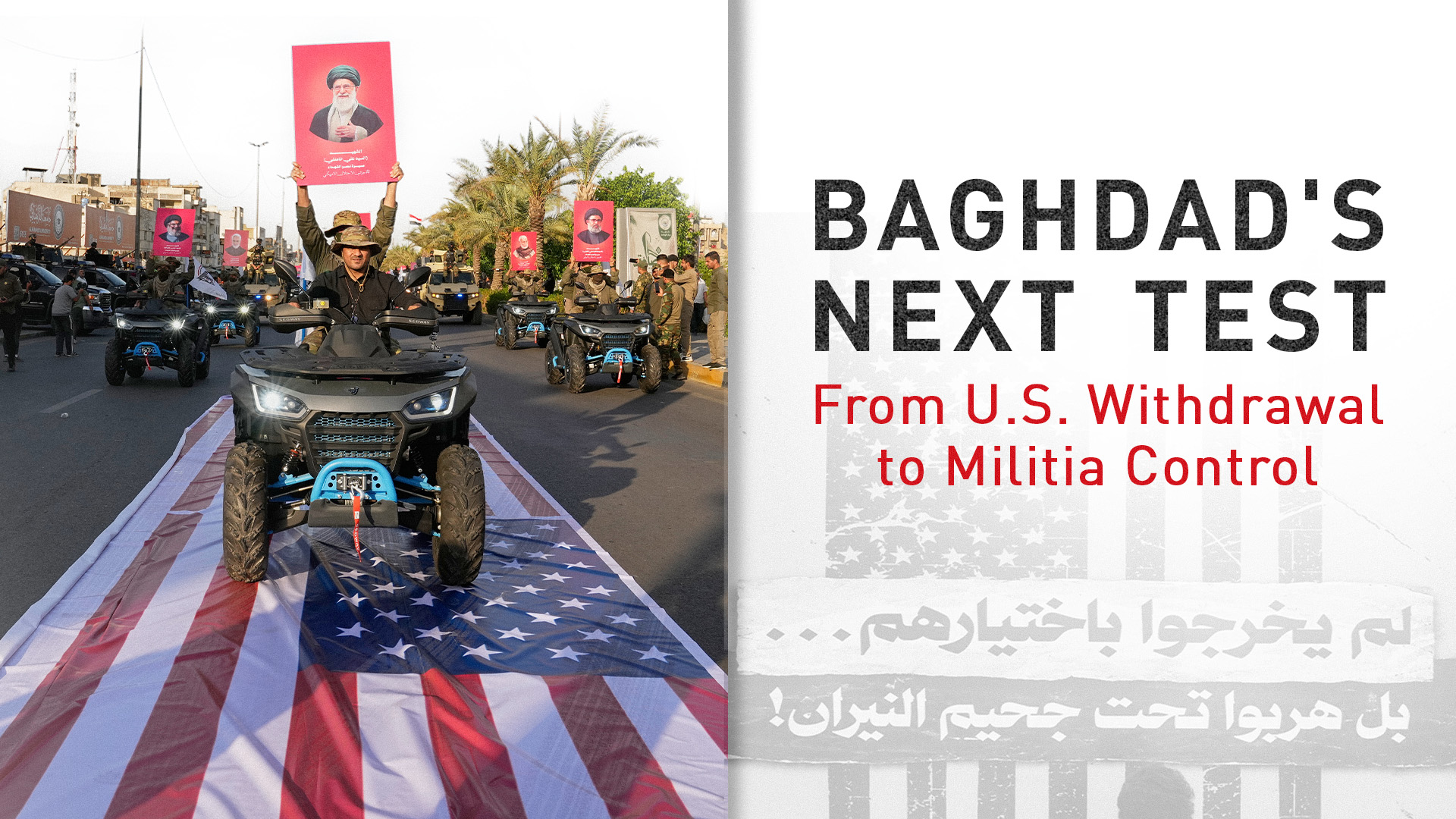
ERBIL (Kurdistan24) - When Iraqi Prime Minister Ali Faleh al-Zaidi ordered legal action against those who trampled on the U.S. flag during Iraq's Sovereignty Day celebrations, the directive was about more than diplomatic etiquette.
It was an early demonstration of what Baghdad says the post-Coalition order is supposed to mean: the Iraqi state sets the rules, state institutions enforce them, and armed actors, regardless of their political or ideological position, operate under government authority.
Akram al-Kaabi, Secretary-General of Harakat Hezbollah al-Nujaba, answered that message in his own way.
Following the prime minister's order, al-Kaabi published a video showing himself walking on the U.S. flag. The accompanying message read: "Your crimes are under our feet."
On the surface, it was another anti-American image from the leader of an armed movement with a long record of hostility toward the United States.
In the political context of post-Sept. 30 Iraq, however, the timing gave the video a wider meaning.
The commander-in-chief had just condemned an act, ordered suspects arrested and instructed state agencies to enforce the law. Al-Kaabi then publicly reproduced the same symbolism under his own name.
The result is an unusually direct test of a question Baghdad has placed at the center of its newly declared sovereignty: who ultimately has authority over Iraq's armed movements?
Following the Iraqi Prime Minister's order to punish those who stepped on the U.S. flag in Iraq, Akram al-Kaabi, Secretary-General of Harakat Hezbollah al-Nujaba, published a video of himself trampling on the U.S. flag with the caption: "Your crimes are under our feet." https://t.co/U7C6o453SB
— Kurdistan 24 English (@K24English) October 4, 2026
From Flag Dispute to State Authority
Al-Zaidi ordered an investigative committee on Oct. 4 after Popular Mobilization Forces fighters and supporters were seen driving a vehicle over a U.S. flag during Sovereignty Day events.
Sabah Numan, spokesperson for the Commander-in-Chief of the Iraqi Armed Forces, said the prime minister condemned the behavior and stressed respect for Iraqi law and diplomatic norms.
Authorities subsequently announced that suspects involved in the original incident had been arrested.
The government said respecting the symbols of states and diplomatic missions operating in Iraq was a legal and diplomatic obligation and that violations would face accountability.
Read More: Iraqi PM Al-Zaidi Orders Investigation Into U.S. Flag Incident
That makes al-Kaabi's subsequent video difficult to separate from the prime minister's directive.
The issue is not whether Nujaba shares Baghdad's view of the United States. It plainly does not.
The more consequential question is whether a powerful armed movement feels bound by an instruction issued by the commander-in-chief at all.
Al-Kaabi's decision to publish the footage after the government had moved against others for similar behavior appears less like an isolated symbolic gesture than a public assertion of political independence from the line Baghdad was attempting to enforce.
Whether Iraqi authorities take legal action against al-Kaabi himself is not something predictable yet.
But politically, the message already poses a challenge.
The Problem Withdrawal Did Not Resolve
For years, some Iraqi armed factions tied the justification for retaining their weapons to the presence of U.S. and Coalition forces.
That argument changed materially on Sept. 30 when the U.S.-led international Coalition formally concluded its military mission in Iraq.
The withdrawal removed one of the most frequently cited reasons for maintaining an armed "resistance" posture against foreign troops.
For Baghdad, that opened the way to the next stage.
On Oct. 1, Al-Zaidi said his government would address weapons outside state control, disarm non-Iraqi armed groups and seek to bring Iraqi factions' weapons under state authority by June 30, 2027.
Read More: Iraq's Shiite Framework Calls for Nationwide De-Escalation
He also reaffirmed a principle that goes to the core of sovereignty: decisions of war and peace belong to the state.
Nujaba's position complicates that roadmap.
The movement had already insisted that it would not relinquish what it calls the "resistance's weapons." Now, with the Coalition military mission over, there has been no corresponding public indication in the supplied material that Nujaba is preparing to abandon its armed posture.
Instead, al-Kaabi's video directs attention back toward confrontation with Washington.
That does not by itself prove what Nujaba will ultimately do with its weapons. But it weakens any assumption that ending the foreign military presence would automatically settle Iraq's militia question.
The external military mission has ended.
The domestic contest over armed authority has not.
Nujaba's Particular Position
Harakat Hezbollah al-Nujaba is not simply another political organization participating in Iraq's post-withdrawal debate.
The United States designated the movement and al-Kaabi as Specially Designated Global Terrorists in 2019. In September 2025, Washington also designated Nujaba as a Foreign Terrorist Organization.
The U.S. Rewards for Justice program currently offers up to $10 million for information on al-Kaabi.
Read More: US Announces $10 Million Reward for Information on Harakat al-Nujaba Leader Akram Al-Kabi
Washington accuses Nujaba of targeting U.S. personnel and installations in Iraq and Syria and describes the group as closely supported by Iran's Islamic Revolutionary Guard Corps-Quds Force and Lebanese Hezbollah.
Those are U.S. government designations and assessments.
A profile by Michael Knights, Hamdi Malik, Ameer al-Kaabi and Crispin Smith of the Washington Institute for Near East Policy similarly describes Nujaba as closely tied to Iran and operating both inside and outside Iraq's formal security structures.
Their research notes that Nujaba controls the PMF's 12th Brigade, which is formally part of Iraq's state-funded Popular Mobilization structure.
That produces one of the central contradictions facing Baghdad.
Nujaba-linked forces can exist administratively inside an Iraqi security framework while the movement's political and military leadership maintains positions that may diverge sharply from those of the government.
The Washington Institute researchers describe the formal chain of command as running through the Popular Mobilization Commission and ultimately to the prime minister, while arguing that Nujaba units have frequently operated outside that effective command structure.
It is precisely this gap between formal hierarchy and actual obedience that Al-Zaidi's post-Coalition program will have to confront.
A monopoly on weapons means considerably more than placing armed formations on a government organizational chart.
It means the state must be able to issue decisions that those formations obey.
Joe Wilson's Response
The al-Kaabi video and the earlier Sovereignty Day incident have also drawn criticism in Washington.
Republican Congressman Joe Wilson reacted to footage of the U.S. flag being desecrated by accusing the PMF of disrespecting the United States and praising Iran.
Wilson went further, portraying Iraq as effectively under Iranian domination and directing his criticism personally at Al-Zaidi.
"Free Iraq from Iran," he wrote.
The PMF, an official division of the Iraqi government’s security services, is seen desecrating the U.S. flag out of disrespect and praising the murderous regime in Iran. If you needed any more proof that Iraq is an Iranian province… @IraqiPMO Zaidi is this what you think of America? Free Iraq from Iran
— Joe Wilson (@RepJoeWilson) October 3, 2026
Sovereignty After the Americans Leave
Baghdad has portrayed Sept. 30 as the moment Iraq regained full responsibility for its security.
But removing foreign soldiers answers only one definition of sovereignty.
The more difficult definition begins afterward.
Al-Zaidi has said weapons must fall under state authority. The Shiite Coordination Framework has reaffirmed June 30, 2027 as the deadline for resolving the weapons issue. The government has stressed that there should be no armed force outside state institutions.
Those commitments now have to survive contact with the factions they are meant to regulate.
Al-Kaabi's video is significant precisely because the act itself is small compared with the issue it represents.
A flag can be walked over in seconds.
The question it raises, whether Baghdad can impose a decision on the leader of a powerful armed faction, goes to the structure of the Iraqi state.
If a commander-in-chief orders people punished for an action and the leader of an armed movement responds by publicly performing that same action, then the issue is no longer simply anti-American symbolism.
It becomes a test of hierarchy.
What Happens to the "Resistance" After Withdrawal?
Nujaba's rhetoric also presents an ideological problem for the post-Coalition period.
If the presence of U.S. forces helped justify the preservation of "resistance weapons," then their withdrawal should logically force a reconsideration of the purpose of those weapons.
But Nujaba's current posture suggests that the movement does not necessarily accept that equation.
Its armed identity has developed through a broader regional conception of resistance and close relationships with Iran-aligned actors, not exclusively through opposition to Coalition troops stationed inside Iraq.
The Washington Institute profile traces Nujaba's military activity from Iraq to Syria and describes the organization as part of wider Iran-aligned networks.
The U.S. government similarly accuses it of attacks on American forces beyond Iraq.
The distinction is critical for Baghdad.
A weapons policy built on the assumption that foreign withdrawal removes the rationale for independent armed factions may prove insufficient if those factions define their mission in regional rather than purely Iraqi terms.
That is why Al-Zaidi's insistence that war and peace are decisions for the state may ultimately be more important than the physical collection of weapons.
The state monopoly is not merely about rifles, missiles or drones.
It is about who decides when those weapons are used, against whom and for what political purpose.
An Early Test, Not Yet a Verdict
Al-Kaabi's video does not determine the outcome of Iraq's disarmament process.
The government has given itself until June 30, 2027, and negotiations with armed groups remain underway.
Some factions have moved toward government arrangements, while the broader Shiite Coordination Framework has publicly endorsed the principle of bringing the weapons issue to a conclusion.
Nor does the video establish how Baghdad will ultimately respond to Nujaba.
But the sequence of events is difficult to overlook.
|
The Coalition leaves. Baghdad declares sovereignty. The prime minister says the state must control weapons and decisions of war and peace. He orders punishment after the U.S. flag is trampled. An armed faction leader then records himself trampling on the same flag. |
That sequence places the next stage of Iraqi sovereignty in unusually clear terms.
The challenge is no longer primarily getting foreign soldiers to leave Iraqi soil. That part has been completed.
It is determining whether the Iraqi government can make its own orders binding on armed actors that remain on that soil.
If Baghdad succeeds, Sept. 30 may indeed become the beginning of a more consolidated state order.
If powerful factions can openly disregard the commander-in-chief without consequence while retaining independent weapons and regional agendas, then the withdrawal of foreign troops will have answered only half of Iraq's sovereignty question.
The other half, who actually commands armed power inside Iraq, is only beginning to be tested.