Dam and Broken Promise Burden Children's Path to School
Children in Darreh Kuleh near Sina, Eastern Kurdistan, cross mud and water daily to reach school as families say a bridge promised during construction of the Zhawa Dam was never built.
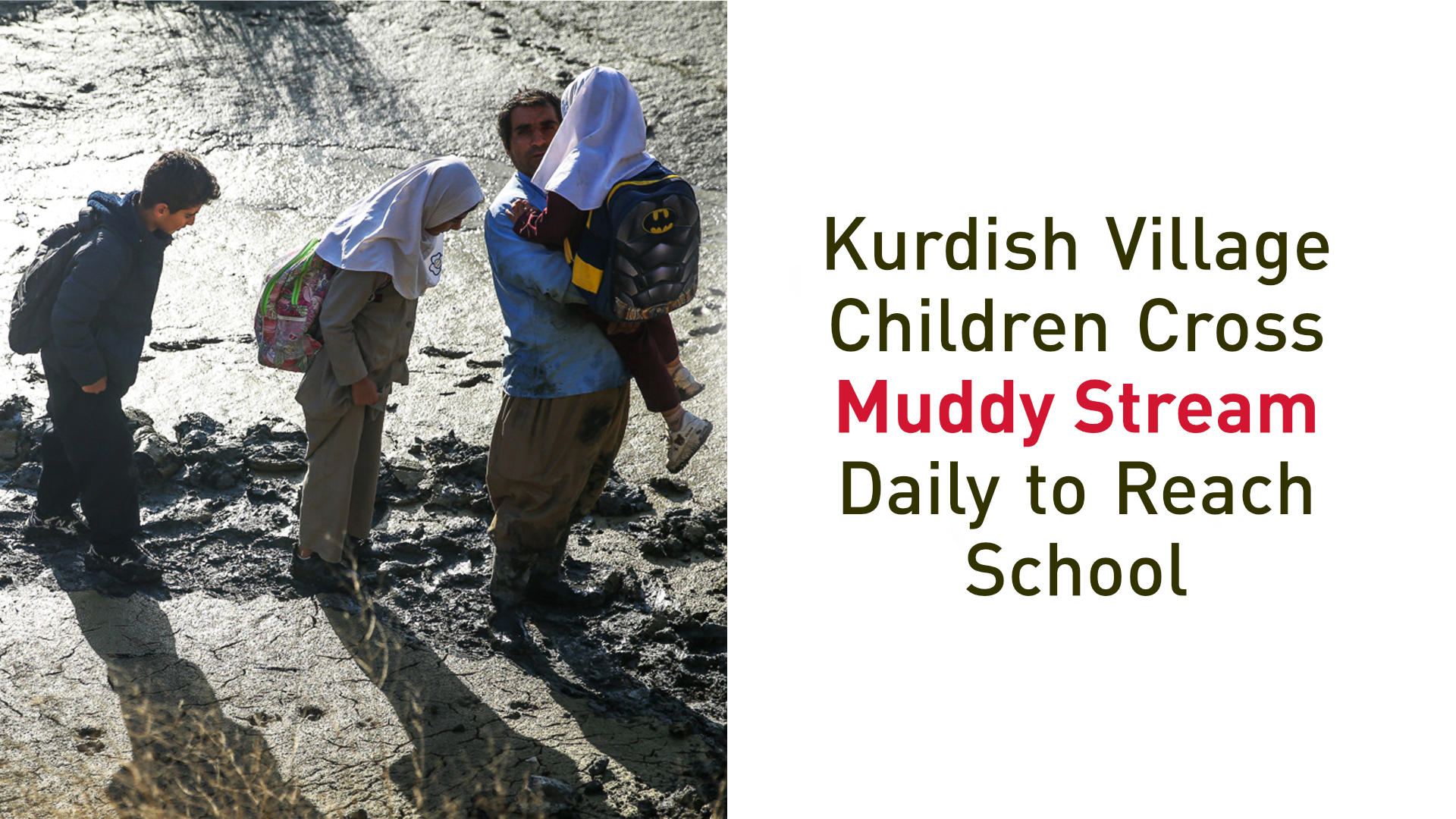
ERBIL (Kurdistan24) - Every morning around 7 a.m., children in Darreh Kuleh village near Sina, Eastern Kurdistan (northwest of Iran), begin their journey to school by holding their fathers' hands, crossing mud and sludge, and navigating a stream linked to the Zhawa Dam, a daily ordeal that residents say could have been avoided had a promised bridge ever been built.
Images published by Iran's IRNA news agency show fathers carrying children on their backs and in their arms as they move through the hazardous route in the Sarvabad area.
For families in the village, the journey has become part of the school day itself.
Among them is Abedin Zarini, 46, a father of three daughters who makes the trip every day to ensure they can continue attending school.
Residents say their difficulties began with the development of the Zhawa Dam on the Sirwan River.
When construction started, villagers say they were promised a bridge connecting their community to a safer road.
That bridge, they say, never materialized.
Years later, the immediate concern for parents is less about the promise itself than the daily risk of getting their children safely across the muddy route and watercourse without missing classes.
The images from the area also show unusually dark water and thick sludge along the route.
Residents have raised suspicions that industrial or petrochemical waste could be mixing with the water. The appearance of the stream alone does not establish the source or level of contamination, and the material does not cite laboratory testing of the specific water crossed by the children.
Concerns over pollution around the broader Zhawa Dam system, however, have also been raised by specialists.
Earlier this year, Professor Mukhtar Hashemi, who holds a doctorate in civil engineering specializing in water resources from Newcastle University in the United Kingdom, publicly urged authorities to stop impounding water in the dam.
Speaking in a video recorded beside Zhawa Dam, Hashemi said research conducted by a group at University of Kurdistan in Sina had identified serious water-quality problems.
"Studies by the research group at University of Kurdistan show that the dam has serious problems in terms of water quality," he said.
According to Hashemi, the water had reached what he described as microbiological saturation and contained phosphorus, nitrogen and heavy metals at levels above permitted standards.
He said heavy metals had been recorded at nine times the allowed level.
Hashemi questioned why impoundment was continuing despite those findings and argued that the process was not appropriate under available water-quality standards.
He also said the reservoir receives several potential sources of contamination, including municipal and village sewage, industrial effluent, waste from poultry slaughterhouses and livestock abattoirs, petrochemical waste and leachate from the Kileh landfill.
Hashemi further warned that Zhawa Dam is located in an area containing historical sites and heritage zones associated with Hawraman and said continued impoundment risked creating severe environmental consequences.
The concrete dam lies about 40 kilometers southwest of Sina, near the villages of Wasi Khwar and Dolab.
The decision to build it was made on April 22, 2009, with the stated purpose of storing water and irrigating plains in Dehgolan and Qorveh.
The project soon faced opposition.
Residents of 10 villages protested over concerns that their farmland and orchards could be submerged, delaying implementation.
Construction eventually began in 2013.
By 2021, about 72% of the project had been completed, before work was later halted.
Water impoundment has also been repeatedly postponed because of concerns over sewage and polluted waste entering the reservoir through the Abidar and Qishlaq rivers.
Despite those delays, water continues to accumulate behind the dam.
The material identifies sewage from large parts of Sina and 83 surrounding villages, agricultural runoff and waste from the Sina landfill among the major sources of pollution affecting the reservoir.
It also states that pollution from the landfill is estimated to be 60 times greater than that of the city's sewage.
For the families of Darreh Kuleh, however, the consequences are immediate rather than abstract.
Each morning, parents must guide or carry their children across a route they consider unsafe simply to reach school.
Their determination has kept the children in education, but residents say the burden should not have fallen on families in the first place.
The bridge they were promised was supposed to provide a safer connection.
Instead, years later, fathers are still carrying their children through mud and water, turning an ordinary journey to school into a daily test of endurance.