Serbian Students Challenge Ruling Party in Snap Parliamentary Election
Serbia's student-led anti-corruption movement is challenging the long-ruling SNS in Sunday's snap parliamentary election after nearly two years of mass protests.
ERBIL (Kurdistan24) - Nearly two years after a deadly railway station collapse triggered mass anti-corruption demonstrations across Serbia, the student movement behind the protests is taking its challenge to the ballot box in Sunday's snap parliamentary election, seeking to end more than 14 years of rule by the Serbian Progressive Party.
The election has become the most significant political test yet for the grassroots movement, which grew from university protests into a nationwide campaign drawing hundreds of thousands of people into the streets.
Agence France-Presse reporter Mina Pejakovic wrote that many of the activists now see the election as the culmination of their campaign against a government they accuse of entrenched corruption.
The movement began after 16 people were killed when a concrete canopy collapsed at the recently renovated railway station in Novi Sad in November 2024.
Public anger over the disaster developed into some of Serbia's largest demonstrations since the fall of Slobodan Milosevic in 2000 and eventually broadened into opposition to the political system built around former President Aleksandar Vucic and his right-wing populist Serbian Progressive Party, or SNS.
Vucic resigned as president in September to run for prime minister in the snap election.
The students have sought to distinguish their campaign from traditional opposition politics.
Most of the roughly 250 candidates on their Student List have never held public office. Many come from universities, professional occupations and academic institutions rather than established political parties.
The movement also remains deliberately decentralized.
Candidates were selected through assemblies linked to university faculties, while activists have avoided building their campaign around a single dominant leader.
The Student List's website says the movement does not want to replace one personality-centered political system with another.
Radomir Saicic, a chemistry professor running on the student ticket, described the movement to AFP as an expression of widespread dissatisfaction and hope for political change.
The governing party, however, has strongly rejected the students' portrayal of Serbia.
Vucic has repeatedly accused the movement of being supported from abroad and attempting to destabilize the country. Pro-government media have widely repeated those allegations.
Activists, for their part, say they have faced surveillance, arrests, intimidation and harassment during the protest campaign.
Dozens of demonstrators have been detained over the past two years, including some accused of attempting to overthrow the constitutional order.
Protesters have also reported violent confrontations, including incidents in which vehicles drove into demonstrations and masked groups attacked participants.
Earlier this year, the digital rights organization SHARE Foundation said phones belonging to people connected to the movement had been infected with sophisticated spyware. Serbian authorities denied knowledge of the alleged surveillance.
The political dispute is playing out in a media environment that protesters describe as heavily tilted toward the governing party.
Student activist Masa Perepeliuc, a 21-year-old political science student in Belgrade, told AFP that many people struggle to hear competing political views because of the structure of Serbia's media.
The election's competitiveness is difficult to measure.
Serbia lacks polling institutions broadly regarded as consistently independent, and surveys released during the campaign have produced sharply different results.
A survey published by the right-leaning New Serbian Political Thought put the Student List at 44.5% and the SNS at 42.7%.
A separate September survey by Faktor Plus, regarded as close to the authorities, placed the SNS at 48.6% and the student movement at 37.1%.
Those conflicting numbers underline the uncertainty surrounding Sunday's vote rather than establishing a clear favorite.
Political scientist Dusan Vucicevic told AFP that the students had succeeded in building support partly by occupying the political center and avoiding some of Serbia's most divisive foreign-policy debates.
The movement has concentrated heavily on corruption, institutional accountability and domestic governance.
It has nevertheless faced questions over its positions on foreign policy.
Critics have pointed to its opposition to sanctions against Russia, while the movement has not fully clarified how it would approach Serbia's long-running effort to join the European Union.
Its domestic platform includes proposals involving healthcare, housing and institutional reform.
Saicic said students and experts had developed a roughly 1,200-page governing program, although it had not yet been publicly released at the time of AFP's reporting.
The scale of the movement was visible again on Thursday.
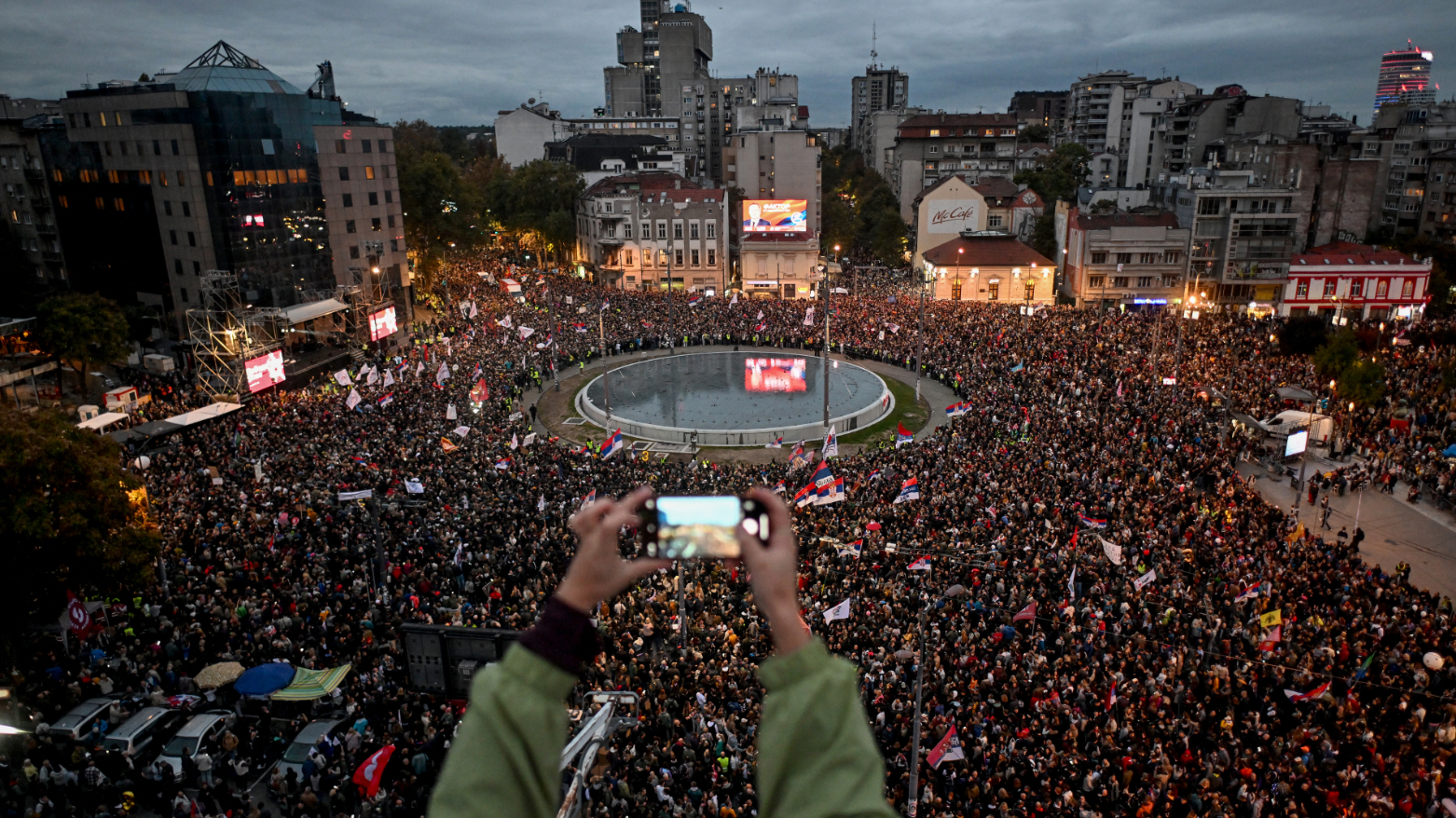
The Associated Press, in reporting by Jovana Gec, said hundreds of thousands of people gathered around Belgrade's Slavija Square for the students' final campaign rally.
Vucic held his own closing rally elsewhere in the capital.
He told supporters that the contest would be difficult but said the election result should determine which side celebrates.
The student movement's ability to build support outside university campuses has been one of its defining features.
A March 2025 demonstration in Belgrade drew around 300,000 people according to an independent estimate cited by AFP.
When students marched through smaller towns and rural communities, residents frequently welcomed them with food, flags and fireworks.
Organizational sciences student Neda Simonovic said those journeys allowed people outside the capital to encounter the movement directly rather than relying on political messaging or media coverage.
Sunday's election also comes during a broader period of youth mobilization elsewhere in Europe.
AFP reporter Paolina Palmisicano has documented student protests and occupations stretching from France and Italy to Spain, Portugal and Greece, driven by grievances including high rents, education funding, employment prospects and dissatisfaction with established political institutions.
The movements differ substantially in their national circumstances and objectives, and the material does not establish a common organization connecting them.
But researchers cited by AFP have described a wider sense among young Europeans that their political and economic concerns are receiving insufficient attention.
France has experienced large protests over living costs, public services and education, some of which descended into looting and violent clashes.
Italy has also faced demonstrations over fuel prices and living costs. After serious unrest in Milan, Prime Minister Giorgia Meloni's government approved the deployment of 500 troops and tougher security measures.
Governments have argued that public order must be protected, while student organizations have warned that focusing solely on violence risks obscuring the grievances of peaceful protesters.
Serbia's student movement differs in one crucial respect: it has already moved from sustained street demonstrations into a direct electoral contest for national power.
That transition brings a different set of tests.
The movement must persuade voters that a decentralized coalition dominated by political newcomers can not only protest against corruption but also govern a country facing difficult economic, institutional and foreign-policy choices.
The SNS, meanwhile, is seeking to convince voters that its long record in power offers greater stability than an inexperienced political movement.
Whatever the result, the election marks a significant transformation in Serbian politics.
A protest campaign that began after a fatal infrastructure collapse has evolved into an organized electoral movement competing for control of the 250-member parliament.
For the students who have spent almost two years marching, organizing and confronting the government, Sunday will determine how much of that street-level support can be converted into votes.