France Faces Student Talks After 1,314 Arrests in Weekend Protests
French PM Sebastien Lecornu will meet student leaders Monday after nationwide protests over education, living costs and policing led to 1,314 arrests.
ERBIL (Kurdistan24) - French Prime Minister Sebastien Lecornu and his government's two education ministers will meet student leaders on Monday as pressure builds over school conditions, education reform and the rising cost of living after another weekend of nationwide demonstrations.
Lecornu's office announced Sunday that National Education Minister Edouard Geffray and Higher Education Minister Philippe Baptiste would join the prime minister for talks with student representatives at Matignon, the prime minister's official residence in Paris, Agence France-Presse reported.
Geffray and Baptiste are expected to address journalists later Monday following the meeting.
The talks represent the government's latest attempt to engage with a protest movement that began in French high schools more than a month ago and has since expanded into broader demonstrations over household costs, public services and inequality. The protests have increasingly become a political challenge as France approaches a presidential election in which President Emmanuel Macron cannot seek another consecutive term.
Students have demanded improved conditions in schools, increased education funding and changes to the country's education system. Their campaign has included blockades at schools, prompting repeated police interventions that students, parents, rights groups and opposition politicians have criticized as excessive.
Several teenage demonstrators have suffered serious injuries during the unrest, while arrests have run into the thousands over the broader protest period, according to AFP.
The immediate backdrop to Monday's meeting is Saturday's nationwide mobilization, when the French Interior Ministry estimated that 410,000 people took part in demonstrations across the country, including 110,000 in Paris. The CGT trade union gave substantially higher figures, estimating close to 800,000 participants nationwide and 250,000 in the capital.
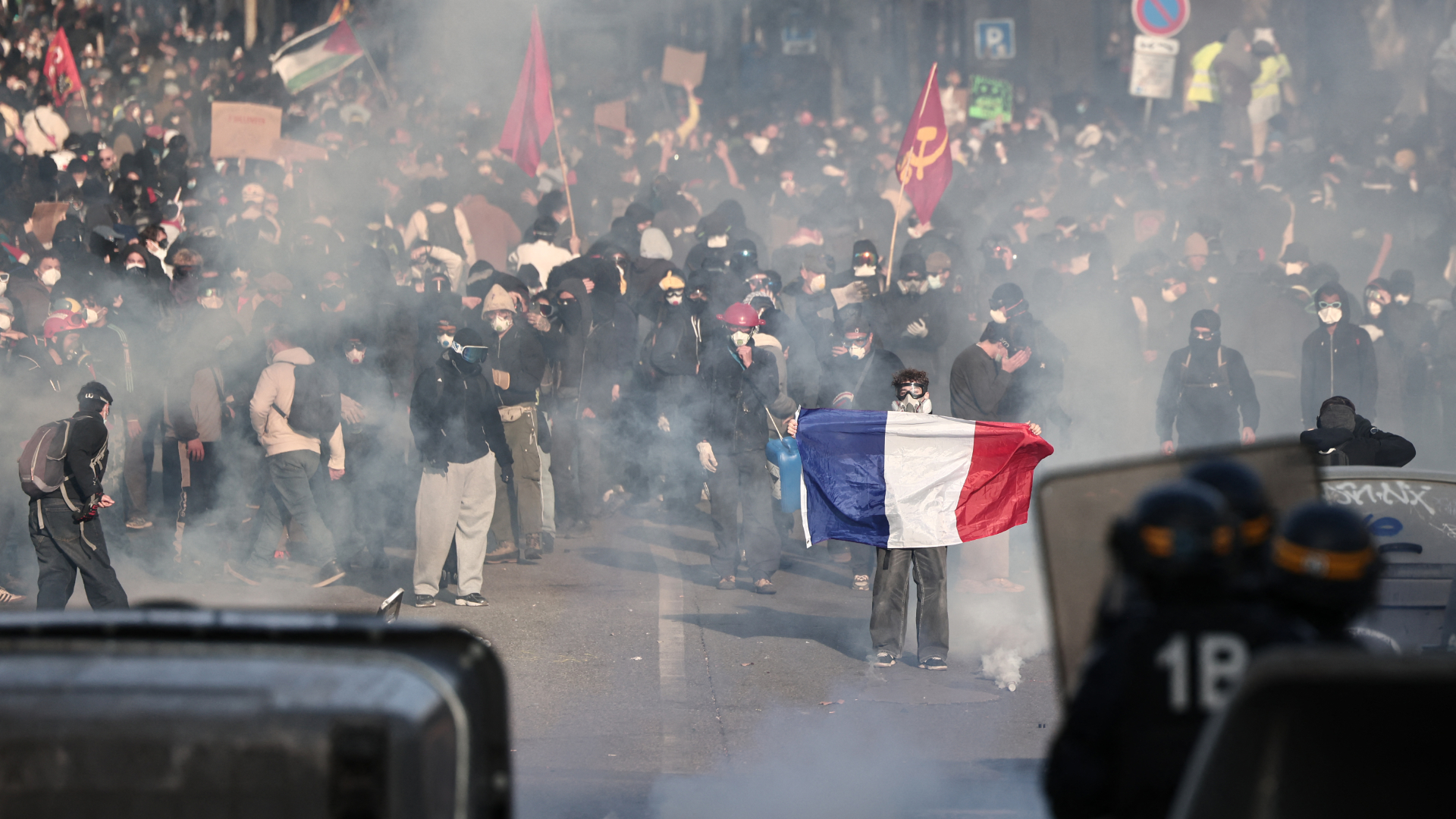
Associated Press reporters Thomas Adamson, John Leicester and Tom Nouvian reported that the Paris march began peacefully before clashes broke out toward its conclusion. Some masked demonstrators threw objects and fireworks at police, while officers responded with tear gas, sound grenades and water cannons.
Demonstrations and confrontations were also reported in several other French cities.
The Interior Ministry said Sunday that police ultimately arrested 1,314 people during the weekend protests and that 53 officers were injured. Officials also reported dozens of fires and the looting of shops.
Authorities did not provide a comprehensive number for injured protesters.
Interior Minister Laurent Nuñez said late Saturday that two protesters had sustained serious injuries, one in Toulouse and another in Clermont-Ferrand, according to AFP. In Toulouse, local authorities confirmed that a 20-year-old man suffered a serious hand injury. A street medic told AFP that several of his fingers had been lost.
A regional newspaper also reported that a 19-year-old demonstrator in Poitiers suffered an eye injury during a police operation. AFP said it remained unclear whether the injuries reported Saturday were directly caused by police stun or tear-gas grenades, and investigations have been opened into at least some incidents.
The controversy surrounding policing has become increasingly intertwined with the students' original demands.
What began with protests over staffing shortages at a high school southeast of Paris spread to schools across France before attracting university students, trade unions and people angered by the cost of living.
The student movement's demands include 250,000 additional places in higher education, changes to the Parcoursup university admissions system, increased numbers of teachers and repairs to schools and universities, according to the Associated Press.
Students are also seeking greater financial assistance, including an additional 200 euros per month in grants and a freeze on rents in public student accommodation.
Economic concerns have helped broaden the movement beyond education. Energy prices were 21.3% higher in September than a year earlier, while overall inflation stood at 3.1%, according to French national statistics cited by AP.
Macron met high school representatives on Friday, a day before the latest demonstrations. Student representatives said he had promised changes to university admissions but indicated that protests would continue until the government produced concrete measures.
The unrest is also increasingly intersecting with France's emerging presidential campaign.
Far-right National Rally figure Marine Le Pen formally launched her latest presidential campaign at a party gathering in Orléans over the weekend, where she criticized France's current direction and outlined proposals including the reversal of a 2017 prohibition on new permits for oil and gas exploration, AP reported Sunday.
The National Rally has criticized the government's handling of public order, while far-left presidential candidate Jean-Luc Mélenchon has supported the demonstrators and criticized police tactics that have left some young protesters seriously injured.
Against that increasingly polarized political background, Monday's Matignon meeting puts education policy back at the center of the confrontation.
For Lecornu's government, the immediate question is whether talks with student representatives can produce measures capable of addressing demands that have expanded well beyond the school where the movement began.
Student groups, meanwhile, have made clear that dialogue alone will not end their mobilization. With another weekend of demonstrations concluded and the government facing scrutiny over both education policy and policing, Monday's meeting will test whether the confrontation can begin moving from the streets toward negotiations.