Farmer in Eastern Kurdistan Produces Rice in Cold Mountainous Climate
Kurdish farmer Mansour Saadat successfully grows rice in mountainous Saqqez, harvesting up to 500 kilograms and inspiring other farmers to try the crop.
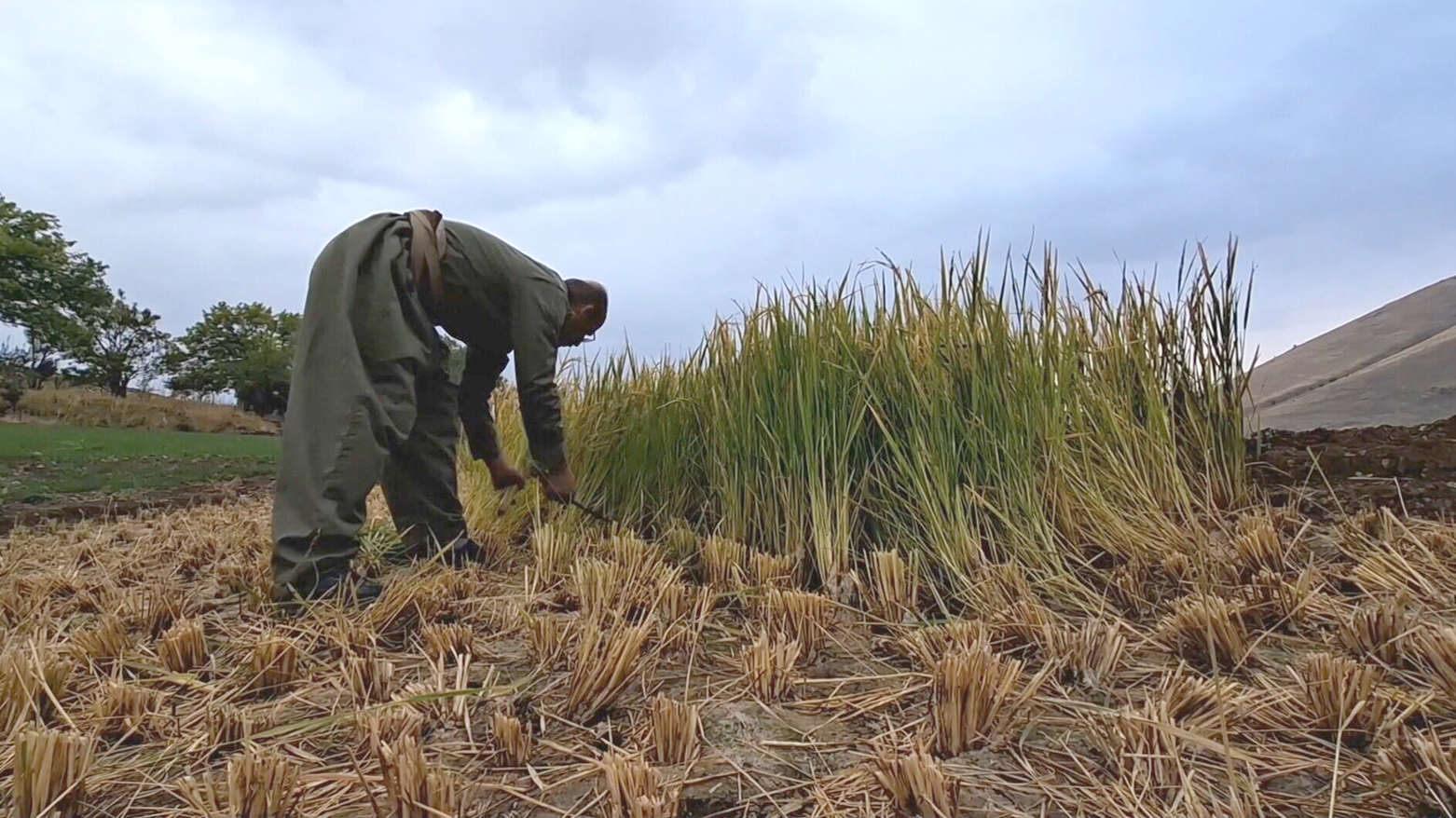
ERBIL (Kurdistan24) - A farmer in the mountains of Saqqez, in Eastern Kurdistan, has reported a successful experimental rice harvest in an area where many local growers had long considered the crop unsuitable for the cold climate, prompting neighboring farmers to consider planting it next year.
Mansour Saadat, known locally as 'Westa' Mansour, grew rice on part of his land in Saidawa Jemyani village, in Iran's Kurdistan Province, whose capital is Sine.
His experiment produced approximately 400 to 500 kilograms of rice after a growing period of about three months, according to Kurdistan24's Kamil Bokani.
The farmer said his decision grew out of experience acquired while traveling for tree grafting, orchard work and agricultural machinery services.
During visits to the mountainous Bakhtiari region, he observed that rice was being cultivated successfully in conditions he believed could offer lessons for his home area.
"For the first time, I decided to try growing rice in this area and see how it would turn out, purely as an experiment," Saadat said. "Thank God, the result has been very good."
He began by sowing seeds at the start of summer to raise seedlings. In less than a month, the young plants were ready for transplantation.
He moved them to his fields toward the end of the first summer month and harvested his crop roughly three months later.
Challenging Assumptions About Water
Saadat said he wanted to challenge the belief that cultivating rice necessarily required fields to remain flooded and used too much water for local conditions. He pointed to sugar beet, a common crop among farmers in the area, as a reason to explore alternatives.
"Rice needs much less water; what matters is providing the right planting conditions," he said, describing his own method and experience.
His comparison reflects the conditions of his particular experiment, rather than independently measured irrigation requirements. No water-use figures or comparisons across different crops were provided.
The results have nevertheless caught the attention of fellow villagers.
Mustafa Saadat, another farmer in Saidawa Jemyani, said he intends to try cultivating rice next year after seeing the harvest.
He described Usta Mansour's results as exceptional and expressed interest in the possibility of producing rice without the irrigation demands he associates with sugar beet and wheat.
Rice cultivation in Eastern Kurdistan has previously been reported around Lake Zarivar in Kurdistan Province and in the Sarableh area of Ilam.
The Saqqez experiment extends that experience to a colder, mountainous locality where growers had not expected the crop to mature successfully.
Whether the method can be repeated on larger fields, under different seasonal conditions or in neighboring mountainous areas remains to be established.
For now, Saadat plans to continue growing rice, and his neighbors are preparing to test whether his results can be reproduced in their own fields.
Kurdistan24's News Writer of Eastern Kurdistan's Desk contributed to this report.