Kurdish Artist Documents Women's Traditional Clothing in Four Parts of Kurdistan in 34-Year Project
In an exclusive interview with Kurdistan24 on Friday, Gungor said her book documents the local and national characteristics of Kurdish women's traditional clothing throughout history, preserving details of garments, accessories, jewelry, and traditional clothing-making techniques.
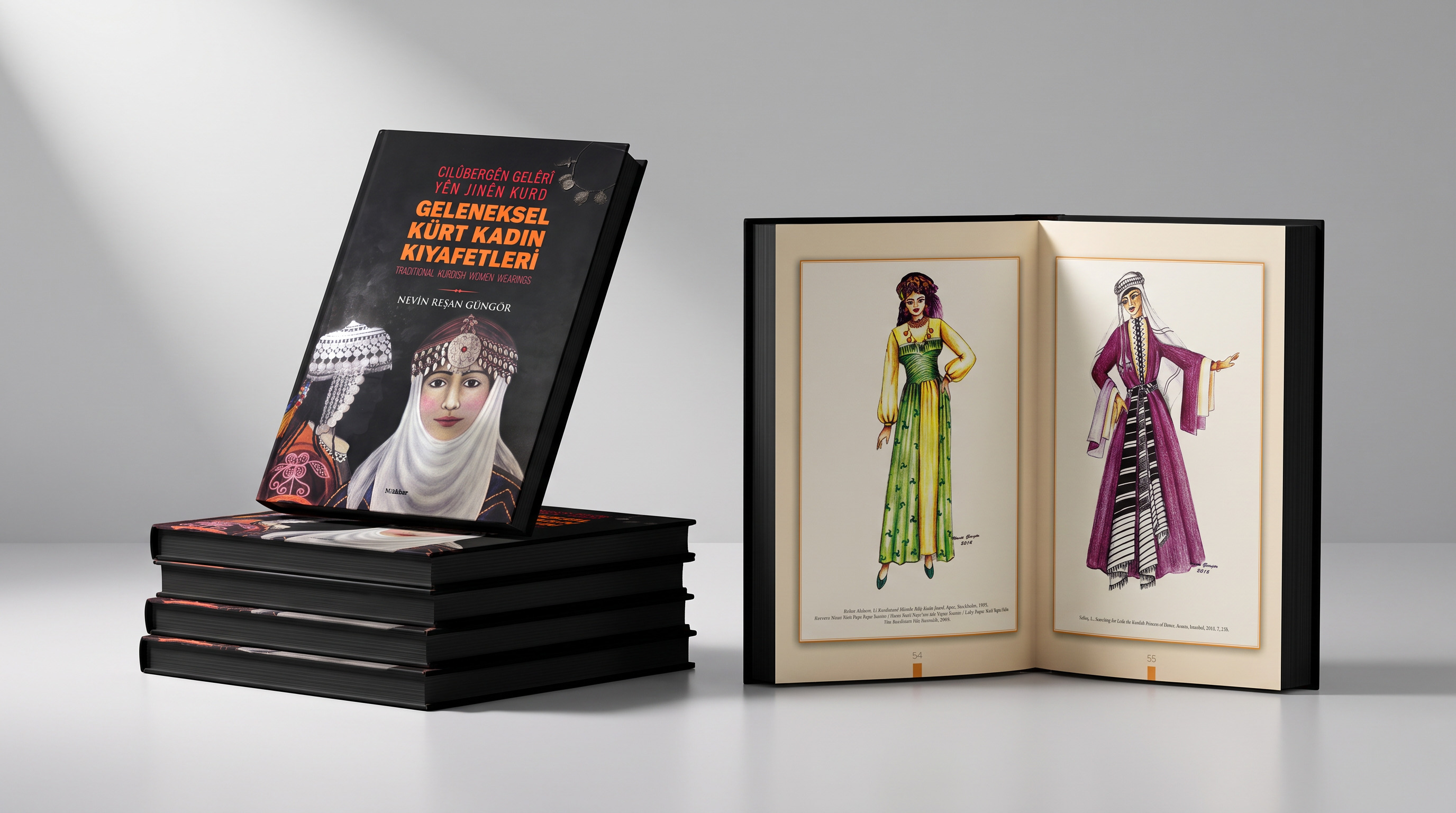
ERBIL (Kurdistan24) – Kurdish artist, designer, and researcher Nevin Rashan Gungor has revealed details of a historical book documenting and illustrating traditional Kurdish women's clothing across the four parts of Kurdistan, describing it as the result of 34 years of research and dedication.
In an exclusive interview with Kurdistan24 on Friday, Gungor said her book documents the local and national characteristics of Kurdish women's traditional clothing throughout history, preserving details of garments, accessories, jewelry, and traditional clothing-making techniques.
More than 200 hand-drawn illustrations
Gungor explained that when she began the book, historical resources documenting Kurdish traditional clothing were scarce. She therefore decided to illustrate the clothing herself, documenting everything from different styles of headscarves to undergarments, outerwear, socks, accessories, and jewelry.
Her collection includes more than 200 illustrations, each measuring 40 by 50 centimeters, covering 75 styles of women's clothing, 93 ways of tying headscarves and scarves, 13 accessory illustrations, and 48 individual pieces of traditional jewelry, including gold and silver ornaments.
She also documented traditional spinning and weaving tools, as well as equipment and techniques used to create clothing patterns, preserving them as part of her wider archive.
Historical sources and international research
Gungor said her background in fashion styling and design, along with her professional experience, helped her undertake the project.
She began considering the documentation of Kurdish traditional clothing in 1992, following her departure from her previous job. She subsequently started building an archive using historical books, photographs, paintings, and field research.
Among her sources were Kurdistan, the Land of Legends, a rare publication compiled by Soviet professors and academics; Susan Meiselas's photographic book Kurdistan; and Elbise-i Osmaniye (Ottoman Clothing), written by Osman Hamdi Bey.
She also drew on the paintings and illustrations of Sharafkhan Bidlisi, which document the period of the Kurdish principalities, and Al-Jazari's book of miniatures, published in Europe.
Another important source was the photographic archive of a photographer from Diyarbakir, documenting architectural designs and traditional motifs in mosques, houses, carpets, rugs, and fabrics across the four parts of Kurdistan.
Gungor supplemented these materials with her own photographs, taken during visits to villages, wedding ceremonies, and encounters with local communities.
A 34-year journey across five countries
Although the idea emerged in 1992 and the paintings took three years to complete, Gungor said the broader research continued for decades.
She held her first exhibition in 1996 at the Med-Kom Cultural Center in Istanbul. However, recognizing the limitations of available historical information, she expanded her research to include museums, pottery, and statues uncovered during archaeological excavations.
Her research took her to five countries: Sweden, France, Israel, Russia, and the United States.
Since 1992, she has also presented her project through media outlets, television programs, and interviews, collecting articles and documentary materials to establish a comprehensive archive.
Documenting all parts of Kurdistan
Emphasizing the geographical and cultural unity of Kurdistan, Gungor said she had deliberately included materials from every part of the region, including Red Kurdistan (a short-lived Soviet administrative unit within the Azerbaijan SSR).
"Kurdistan is one piece of land to me, and no part of it is different from another. That is why I have also collected works and illustrations from Red Kurdistan," she said.
She also expressed gratitude to Cemîla Celîl in Yerevan, Armenia's capital, for making her family's extensive archive available to support the project.
From international fashion runways to a national museum
Gungor said her original ambition was to introduce Kurdish traditional clothing to international fashion runways, with models showcasing the garments to global audiences.
She wrote to Kendal Nezan, president of the Kurdish Institute of Paris, seeking support for the initiative. However, the project could not move forward because of financial constraints.
She welcomed efforts by contemporary designers, including Lara Dizeyee in Milan, to introduce Kurdish clothing to international audiences through modern designs.
She also thanked her friend Seyda Goyan for supporting her work in the Kurdistan Region and establishing a private museum.
However, Gungor stressed that preserving Kurdish clothing heritage should be a national responsibility rather than an individual undertaking.
"A museum is not merely a personal project; it is a project for the state and the nation," she said, calling on the Kurdistan Regional Government and the wider Kurdish community to launch a joint campaign to collect traditional clothing, shoes, and jewelry preserved in family heirloom chests.
She said these items should be preserved for future generations in a large national museum.
'Famous Kurds' project and donation to Sulaimani
Beyond traditional clothing, Gungor said her artistic work has focused on Kurdish mythology, history, and genocides.
While living in Northern Kurdistan (southeastern Turkey), she noticed that many young people had become disconnected from their national history and were more familiar with the histories of other nations.
This inspired her and her husband to work on a book titled Navdarên Kurd (Kurdish Notables), featuring portraits and biographies of prominent Kurdish historical figures.
Gungor said she had many other artistic projects and ambitions for the future, expressing hope that she could pursue them despite her health difficulties.
She also announced her intention to donate all her paintings to Sulaimani.
Concluding her interview, Gungor expressed her hopes for a better future for the Kurdish people.
"From the bottom of my heart, I wish better days and success for all the Kurdish people in all four parts of Kurdistan," she said.


