'We Want a Unified Region': Communist Party Mobilizes Against Division
Kurdistan Communist Party holds rallies against division, calling for unified government institutions, better public services and national political dialogue.
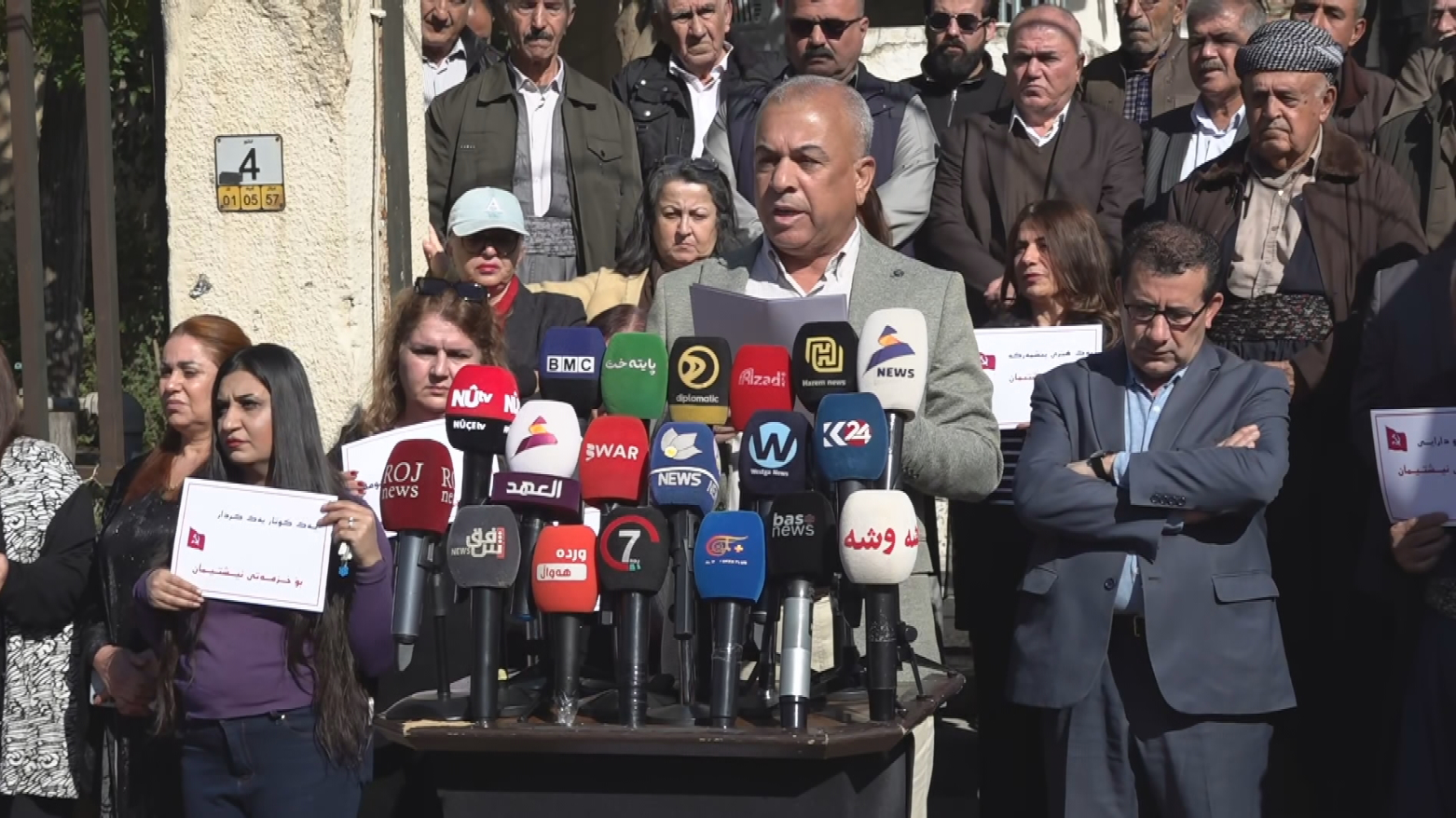
ERBIL (Kurdistan24) - The Kurdistan Communist Party organized public gatherings across the Kurdistan Region on Saturday, Nov. 14, calling for an end to political divisions and demanding unified government, security and financial institutions as disagreements over the formation of a new cabinet continue.
Speaking on behalf of the party's Central Committee, leadership member Rebaz Hashim urged citizens to oppose any fragmentation of the Region through peaceful means.
He said the party wanted a single parliament and government, alongside unified Peshmerga forces, security institutions and a financial system operating across the Kurdistan Region.
The gatherings followed a Nov. 12 appeal by the party's Political Bureau under the slogan "We Want a Unified Region."
The appeal asked residents from Zakho to Khanaqin to assemble peacefully outside party offices at 11 a.m. on Saturday.
'Unity'
Hashim described the demonstrations as a call for more than an agreement among political leaders.
He linked the party's demand for institutional unity to the everyday concerns of residents, including employment, reliable electricity, education and healthcare.
According to Hashim, the objective is a system capable of providing basic necessities, from bread and job opportunities to uninterrupted power, improved schools and fair medical services accessible to people with limited means.
He criticized what he described as the concentration of market power and the pursuit of narrow party or factional interests at the expense of the wider population.
The party's statement connected those concerns to its opposition to separate political and administrative structures, arguing that fragmented institutions cannot adequately serve the public.
Hashim called on citizens to continue peaceful and civilized forms of civic resistance until a unified institutional framework is achieved.
The appeal did not announce an agreement with other parties or a timetable for fulfilling those demands.
'Renewed Confrontation'
The Communist Party also warned against a return to the language and methods of earlier political confrontations.
Hashim said reviving factionalism, imposing power and treating political disputes as contests with winners and losers would not serve the people of Kurdistan.
Such approaches, he argued, would benefit the Region's adversaries rather than resolve its economic and political difficulties.
He urged political forces to keep channels of communication open, saying genuine national dialogue and transparent negotiations offered the route toward protecting the achievements of the Kurdish people.
His remarks did not identify a specific settlement between the main parties. Instead, they emphasized the need for compromise and shared institutions as the foundation for overcoming the crisis.
'Unresolved'
Saturday's gatherings came more than two years after elections for the Kurdistan Parliament's sixth term.
Disagreements among the Region's principal political parties have continued to delay the formation of a new Kurdistan Regional Government cabinet.
The prolonged dispute has raised questions about how political leaders will manage government formation and the institutions responsible for public services.
Against that backdrop, the Communist Party's message emphasized a single regional administration rather than competing institutions.
Its demands for unified Peshmerga, security and financial bodies also reflected the party's concern about the consequences of institutional division.
The Nov. 12 mobilization call invited residents across a wide geographic area to join the demonstrations, presenting unity as a concern extending beyond any one city or political constituency.
'KCP'
The Kurdistan Communist Party traces its origins to 1945, when it began as the Kurdish branch of the Iraqi Communist Party (ICP).
It held its first conference in May 1966 and, following the 1991 uprising, declared itself an independent political party on June 30, 1993.
Kawa Mahmoud has led the party since October 2017.
On Saturday, the party used its gatherings to reiterate its opposition to dividing the Kurdistan Region and its position that political differences must be addressed through negotiations rather than confrontation.
For Hashim, the desired outcome was clear: one regional government and set of institutions capable of responding to citizens' needs, alongside an open political process in which disagreements are settled through dialogue.