Kurdistan24 Reveals Details of Iraqi Committee's Visit to Jurf al-Sakhar
Iraq's Jurf al-Sakhar oil-smuggling investigation faces questions over security restrictions, inspection methods and the role of armed factions.
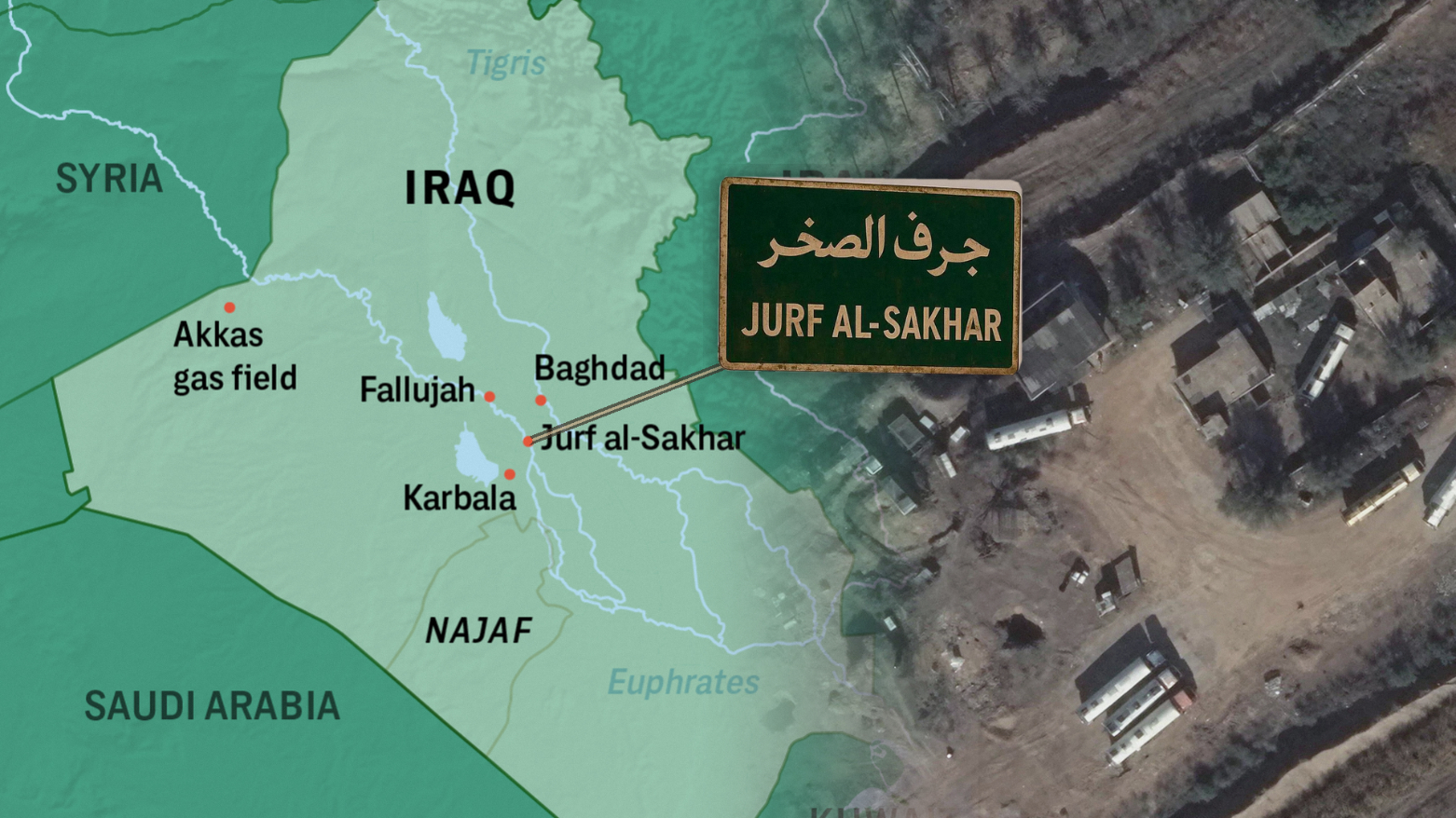
ERBIL (Kurdistan24) - An Iraqi government committee's visit to Jurf al-Sakhar in Babil province has raised questions about the extent of federal authorities' access to the heavily restricted area, after footage and information obtained by Kurdistan24 suggested that armed personnel controlled the delegation's movements during an investigation into alleged oil smuggling.
Kurdistan24 news anchor Kovan Ezzat, speaking during Saturday's noon news bulletin on Nov. 14, 2026, described restrictions imposed on the delegation during Friday's visit, questioned the methods used to search for suspected illegal pipelines and highlighted the absence of publicly announced findings.
"What happened in Jurf al-Sakhar? Did the Trojan horse enter the town, or was it a protocol visit that ended with tea?" Ezzat asked, questioning whether the inspection had fulfilled its original purpose.
His account followed several days of tension between the federal government and armed factions over allegations of petroleum theft in Jurf al-Sakhar, also known as Jurf al-Nasr, an area widely reported to be under the influence of Kataib Hezbollah.
From a Planned Security Operation to a Committee Visit
According to Ezzat, the initial government response involved preparations for a security operation intended to establish federal authority over the area and investigate suspected oil-smuggling sites.
Prime Minister Ali al-Zaidi had reportedly ordered security forces to prepare for an operation involving specialized federal units.
However, an informed source told Kurdistan24 that a security official associated with Kataib Hezbollah warned members of the Coordination Framework that the entry of Counter-Terrorism Service and Federal Police forces could trigger armed clashes.
The source claimed that federal forces would not be permitted to enter Jurf al-Sakhar without authorization from those controlling the area.
The reported warning has not been independently verified, and no official confirmation of such a threat has been released.
Ezzat said senior political figures, including Hadi al-Amiri and Popular Mobilization Forces (PMF) chairman Falih al-Fayyadh, subsequently intervened and encouraged the prime minister to pursue negotiations rather than confrontation.
The government then proceeded with an investigative committee headed by the PMF's director general of Security and Discipline.
An official directive dated Nov. 12 established the committee, comprising 11 senior officials representing security, intelligence, oversight and petroleum institutions.
Its members included representatives of the prime minister's office, the Federal Integrity Commission, Oil Ministry, Federal Police, Counter-Terrorism Service and Energy Police.
The committee was instructed to investigate the allegations and report its findings to the commander-in-chief's office.
Restrictions at the Entrance
Ezzat said footage of the delegation's arrival showed armed personnel controlling access to Jurf al-Sakhar.
According to his account, fighters he identified as belonging to Kataib Hezbollah were positioned at the entrance wearing uniforms resembling those of Iraq's Counter-Terrorism Service.
He reported that the delegation's accompanying security personnel were prevented from entering, while the committee members were permitted to proceed.
The identities and organizational affiliations of the personnel shown in the footage have not been independently established.
Ezzat also described an exchange over whether the delegation's cameraman could enter.
In the footage, an armed official reportedly demanded information about the cameraman before allowing him through.
"No entry until you introduce him," the official said, according to Ezzat's account.
A senior Iraqi military officer responded that the delegation had only one cameraman accompanying it.
The exchange, Ezzat argued, illustrated how entry arrangements were being controlled by personnel at the site rather than exclusively by the visiting federal delegation.
Other reporting confirmed that the committee entered Jurf al-Sakhar on Friday. Iraqi outlet 964media cited a source saying all 11 committee members participated, while the committee held discussions with armed faction representatives about the inspection procedures.
Those accounts do not establish that the accompanying federal security force was granted unrestricted access.
Questions Over Inspection Methods
Once inside, the delegation visited locations associated with the allegations, including areas where petroleum infrastructure and tanker vehicles were reportedly present.
Ezzat referred to images showing a refinery and approximately 30 oil tankers during the visit.
He focused particular attention on footage of an individual using equipment apparently intended to identify concealed pipelines.
According to Ezzat, the equipment was being operated incorrectly, raising doubts about whether the inspection could reliably detect the suspected infrastructure.
He questioned the manner in which the operator held the device and moved through the area, as well as the apparent absence of a transmitter that he said would be necessary for certain types of detection.
These technical criticisms were presented by Ezzat during his broadcast. The device's precise model, capabilities and operating requirements have not been independently established.
Ezzat also questioned statements in the footage suggesting that petroleum infrastructure was secure and that no smuggling was occurring before the investigation had concluded.
Such statements, he suggested, were premature given the outstanding allegations.
Tea With Armed Officials
Another part of the visit involved a gathering at what Ezzat described as a garden belonging to a Kataib Hezbollah figure, where committee members and local officials drank tea.
During the encounter, an official associated with the armed group reportedly defended its presence in Jurf al-Sakhar.
"We came here in 2013, and not out of greed or money," the official said, according to Ezzat.
The anchor contrasted that statement with allegations of substantial revenues being generated from illegal petroleum activity.
He cited estimates alleging that oil smuggling associated with Kataib Hezbollah in Jurf al-Sakhar generated approximately $2 million daily, including through shipments reportedly destined for Iran.
However, no independently verified financial records or official investigative findings were provided to substantiate that figure.
The intelligence material previously examined by Kurdistan24 did not establish the value of any stolen oil or identify conclusively which organization operated the alleged network.
Intelligence Findings and Official Silence
The controversy began after an Iraqi intelligence assessment raised suspicions about petroleum activity in Jurf al-Sakhar.
A 19-page report examined by Kurdistan24 analyzed satellite imagery collected between 2021 and 2026, identifying four locations and recording 105 tanker sightings across multiple dates.
The report described suspected pipeline breaches, petroleum collection sites, small refineries and storage facilities, along with possible transportation routes toward Baghdad.
However, satellite observations alone could not determine whether the tankers carried illegally obtained petroleum or identify those responsible.
Babil Governor Ali Turki previously disputed the allegations, describing one location as an old fuel station used by government-affiliated security forces.
Iraq's parliament has also established a separate investigative committee to examine the intelligence findings and alleged smuggling routes.
Meanwhile, the Energy Police Directorate has announced intensified anti-smuggling operations elsewhere in Iraq, including surveillance measures and the seizure of hundreds of vehicles accused of violating petroleum transport regulations.
Ezzat said the delegation returned to Baghdad following its visit without a substantive public explanation of what investigators had established.
Although the visit itself has been confirmed, no final official report identifying perpetrators, establishing the scale of alleged theft or resolving the questions raised by the intelligence findings had been publicly released.
The investigation therefore leaves two central questions unanswered: whether petroleum smuggling occurred in Jurf al-Sakhar and whether federal investigators were able to examine the suspected sites without restrictions imposed by armed personnel.