Iraq PM Faces Growing Test in Confrontation With Kataib Hezbollah, Asharq Al-Awsat Reports
Experts say backing down could carry a heavy political cost for Ali al-Zaidi, while the standoff exposes the government's difficulties in bringing armed factions under state control
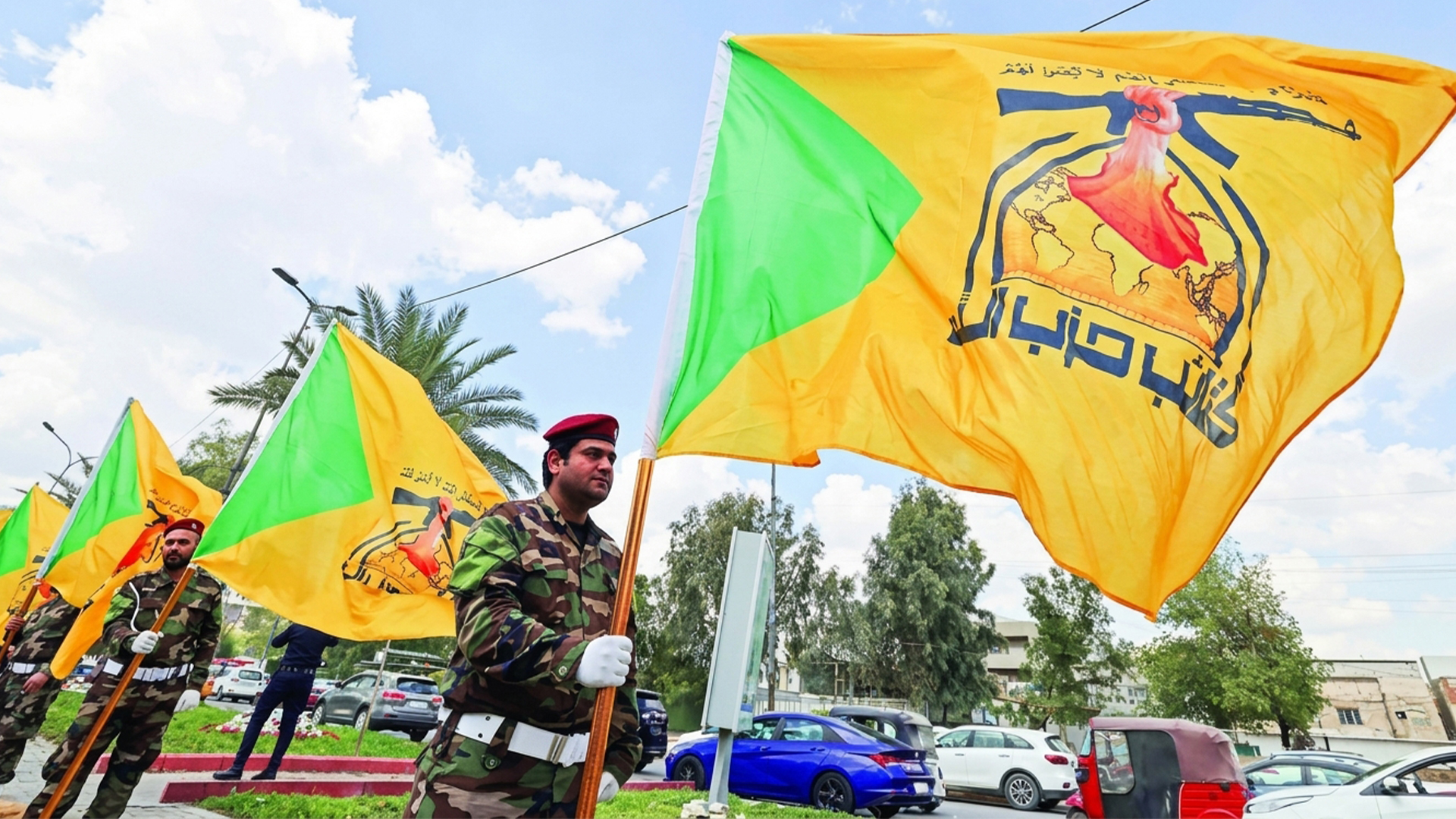
ERBIL (Kurdistan24) — Iraqi Prime Minister Ali al-Zaidi is facing an increasingly difficult confrontation with the powerful Iran-aligned Kataib Hezbollah, as a dispute involving alleged oil smuggling, the group's influence in the strategic Jurf al-Sakhar area, and the government's efforts to bring weapons under state control raises questions about Baghdad's ability to challenge armed factions, according to a report published by Asharq Al-Awsat on Saturday.
The report said tensions had intensified over the previous two weeks, with the government and Kataib Hezbollah exchanging public accusations amid broader efforts to establish state control over weapons held by armed groups.
The latest escalation followed the circulation of intelligence reports accusing the group of smuggling thousands of barrels of oil extracted from Jurf al-Sakhar, an area south of Baghdad that the faction has controlled for nearly a decade and where successive Iraqi governments have reportedly struggled to establish access.
On Friday, the government dispatched an investigative committee headed by the Popular Mobilization Forces (PMF) to examine allegations of oil and petroleum-product smuggling in the area. However, Lieutenant General Saad Maan, head of Iraq's Security Media Cell, said no political entities or armed factions were participating in the investigation committee.
A source from the Coordination Framework, the main alliance of Shiite political forces, told Asharq Al-Awsat that the committee's deployment represented the first government field operation inside the restricted area administered by Kataib Hezbollah.
The report traced Kataib Hezbollah's origins to the aftermath of the 2003 US-led liberation operation of Iraq, identifying Abu Mahdi al-Muhandis as its founder. Al-Muhandis was killed in a US strike near Baghdad International Airport in January 2020 alongside Qassem Soleimani, the commander of Iran's Islamic Revolutionary Guard Corps (IRGC) Quds Force.
A senior figure from the Coordination Framework told the newspaper that the group's influence and military capabilities could not be understood without considering its close relationship with Iran.
The source described Kataib Hezbollah as one of the most influential factions aligned with Iran's system of religious and political authority, arguing that its connections with Tehran had helped it withstand previous government attempts to challenge its control over Jurf al-Sakhar.
Although precise figures on the group's membership and weapons stockpile remain unavailable, the source said it possessed a considerable arsenal of missiles and drones.
The report also cited the source as saying that Kataib Hezbollah had developed an extensive network of financial interests in recent years, with oil-related activities potentially forming part of that network.
The faction also receives funding through the PMF, where it reportedly commands three brigades, according to the report.
The growing confrontation has raised concerns within the Coordination Framework, with the source telling Asharq Al-Awsat that influential Shiite political figures were working to prevent a direct clash between the government and the armed group.
Experts divided over the outcome
Political researcher Aqil Abbas said al-Zaidi had gone further than any previous Iraqi prime minister in confronting the issue of armed factions, pointing not only to his public dispute with one of the country's most powerful groups but also to the investigation into alleged corruption and oil smuggling in Jurf al-Sakhar.
Abbas argued that the decision to confront the faction had effectively been made, although the nature and intensity of the confrontation could change over time. He also said the Coordination Framework's traditional role as an intermediary between armed groups and the prime minister had weakened.
He described the public dispute as a significant departure from a longstanding assumption in Iraqi politics that any prime minister who challenges powerful armed factions risks being forced from office.
According to Abbas, al-Zaidi's position has been strengthened by two factors: what he described as US support at a time when Iran is experiencing significant pressure and uncertainty, and backing from Iraq's judiciary. He said these factors had helped shift the balance in the government's favor.
Nevertheless, Abbas did not rule out a political settlement, arguing that although al-Zaidi currently appeared to hold a stronger position than Kataib Hezbollah, withdrawing from the confrontation would be difficult for him.
He suggested the standoff could ultimately end in a political deal designed to prevent either side from suffering a major defeat.
Political science professor at the University of Baghdad Ayad al-Anbar, however, questioned whether the government had a coherent strategy for bringing weapons under state control.
Speaking to Asharq Al-Awsat, al-Anbar said the government's approach remained unclear and appeared to rely on temporary measures and tactical responses rather than a comprehensive plan with defined stages and objectives.
He argued that such measures, including economic pressure, often triggered reactions from armed factions before giving way to de-escalation and containment.
Al-Anbar also warned that the confrontation risked becoming a political contest and a demonstration of power rather than a serious effort to address the underlying problem of armed groups operating beyond effective state control.
He linked the challenge to the broader weakness of Iraqi state institutions and the existence of competing centers of political, security and economic influence, arguing that groups possessing weapons could seek to establish their own spheres of control.
A broader test of state authority
The confrontation comes amid persistent challenges to Baghdad's efforts to consolidate state authority over weapons and security institutions.
The PMF is formally part of Iraq's security structure, but several factions within it maintain political, military and organizational ties that complicate the government's efforts to exercise unified command.
Jurf al-Sakhar, also known as Jurf al-Nasr, has remained particularly sensitive since Iraqi forces retook the area from the Islamic State in 2014.
Its strategic location south of Baghdad and the reported restrictions on government access have made it a focal point in wider debates over the influence of armed factions and the limits of state control.
The outcome of the dispute between al-Zaidi's government and Kataib Hezbollah could therefore have implications beyond the allegations surrounding oil smuggling.
It may also test whether Baghdad can investigate powerful armed groups, enforce its authority in areas under their influence and advance its stated goal of ensuring that weapons remain under state control.