Erbil Green Belt Expansion Targets 1.8 Million Trees as Government Unveils Zone A8 Plans
Erbil's Green Belt enters a new phase with 1.8 million trees planned, landowner compensation guarantees and investments in olive oil and agricultural industries.
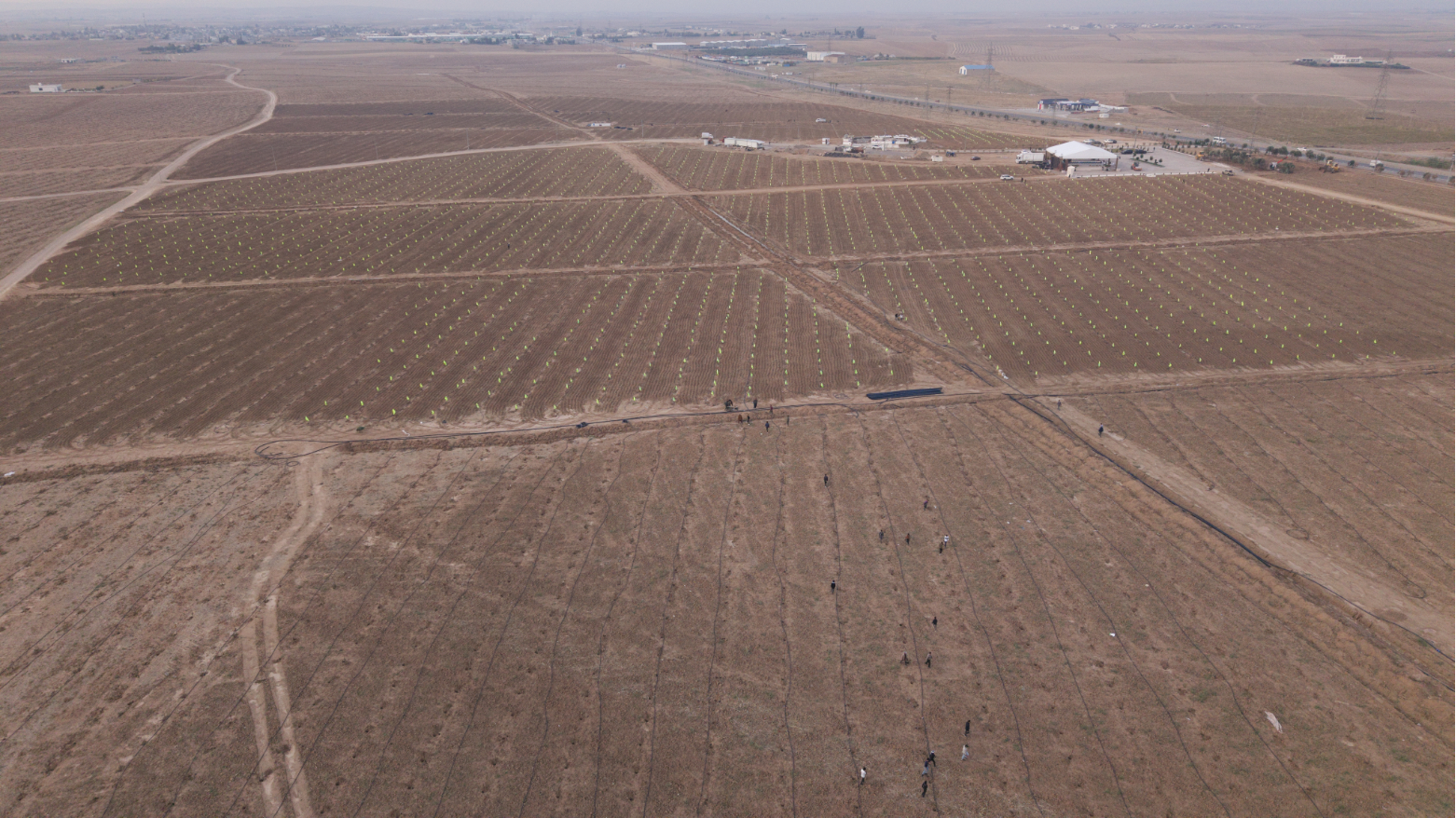
ERBIL (Kurdistan24) - Kurdistan Region Minister of Municipalities and Tourism Sasan Awni announced on Sunday, Nov. 15, 2026, that preparations are underway to plant 1.8 million trees in a new section of the Erbil Green Belt, as officials outlined measures to compensate landowners, establish agricultural industries and extend the environmental project around the capital.
Speaking at a ceremony attended by Prime Minister Masrour Barzani, Awni said work was beginning in Zone A8, an area of more than 10,000 dunams, while planting and infrastructure work in the project's first zone was nearing completion.
The announcement brought together several strands of the government's plans: expanding tree coverage, safeguarding property rights, providing employment and turning the plantations into a source of agricultural products for local industries.
New Planting Targets and Progress in the First Zone
Awni said more than 90% of the first phase had been completed, with approximately 700,000 trees planted across nearly 2,000 dunams of land and water sources provided for the plantations.
Karzan Hadi, Head of Erbil Municipality, separately placed completion of work on the first phase at 95%, describing Sunday's event as the laying of the foundation stone for the second phase.
The officials gave slightly different estimates of progress, while the minister's announcement also referred to a third stage of implementation.
Both focused on the new work in Zone A8.
Awni said initial preparations in the zone would support the planting of 1.8 million trees.
He expressed hope that work would spread to the Green Belt's remaining sections, eventually encircling Erbil with a continuous expanse of greenery.
"We hope that in the near future work will begin in all zones and that this major environmental transformation will encompass the entire ring surrounding Erbil," Awni said.
He acknowledged the difficulties of implementation, saying the project had encountered numerous challenges and that continued government support would be needed for subsequent stages.
Zone A8 lies between the Erbil-Duhok and Erbil-Mosul dual carriageways.
It encompasses Qalanchoghan, Small Sibiran and Qalatga villages, with plans identifying the area for fruit trees and orchards as well as a large park and other facilities.
Earlier project announcements described the latest expansion as covering approximately 11,000 dunams, with three irrigation ponds and olive and pistachio plantations.
The new zone is part of an eight-section project intended to form a green corridor approximately two kilometers wide around Erbil.
New Directorate to Coordinate Eight Zones
Awni announced that a dedicated Erbil Green Belt Directorate had been established within the Ministry of Municipalities and Tourism to supervise work across all eight zones.
The decision follows a directive from Prime Minister Masrour Barzani to pursue implementation across the project's different sections, rather than treating each area as an isolated undertaking.
The directorate has identified three immediate priorities. The first is to survey the entire proposed route and record existing facilities and structures.
The second is to establish ownership and property rights along the route.
The third involves marking the corridor's inner and outer boundaries, using heavy machinery where required and installing physical reference markers.
These steps are intended to clarify where work can proceed and whose legal interests must be addressed before construction and planting take place.

Compensation for Farmers and Landowners
Hadi told Kurdistan24 that people whose land falls within the designated Green Belt would be compensated in accordance with the law.
He said officials had identified affected land and prepared cadastral maps, coordinating with relevant authorities to protect the rights of residents and farmers.
The head of Erbil Municipality said compensation would apply to people with recognized legal interests, including agricultural contracts and rights to use or dispose of land.
He stressed that the legal and technical procedures were designed to ensure that no one's entitlement was overlooked.
Hadi described the overall corridor as approximately 82 to 84 kilometers around Erbil and two kilometers wide, underscoring why land identification is an important part of the expansion.
Neither the mayor nor the minister announced individual compensation amounts or a timetable for payments. Their remarks concerned the commitment to protect rights and the administrative work required to identify them.
Olive Oil, Soap and New Agricultural Industries
The Green Belt is also being developed as a productive agricultural project, not simply a planting campaign.
Kurdistan Region Investment Board Chairman Mohammed Shukri said licenses had been granted for approximately four to five factories linked to the first two phases, including facilities intended to manufacture olive oil and soap.
He also identified agricultural fertilizer production among the planned activities.
Shukri said the trees were expected to begin yielding harvests within two to three years, supplying raw materials for these industries.
The projection concerns future production; it does not mean that the licensed factories are already operating or receiving crops from the plantations.
The chairman also announced private-sector involvement by Cihan University, which is to develop a forested section bearing its name within the Green Belt, alongside other activities at the site.
For later phases, Shukri described plans to plant trees suitable for industrial use, potentially providing timber for furniture manufacturing and reducing dependence on imported raw materials.
Together, the proposals would connect planting, crop production and manufacturing, while opening opportunities for workers involved in irrigation, maintenance, agriculture and processing.

Prime Minister Masrour Barzani Links Greenery to Public Welfare
At the launch, Prime Minister Masrour Barzani emphasized the environmental and economic purposes of the project, including cleaner air and spaces where residents can spend time outdoors.
"Planting trees and forests is extremely important.
It can protect the environment, improve and clean the air, provide people with places to relax in a more suitable climate, and create a better environment for all of us," Prime Minister Masrour Barzani said.
He also drew attention to the productive varieties being planted and the prospect of olive oil processing.
"Many of the saplings and trees being planted are also productive, so they can provide benefits in terms of food production," Prime Minister Masrour Barzani said, adding that olive oil facilities could be established to serve the people of Kurdistan.
Prime Minister Masrour Barzani thanked Peshmerga personnel and volunteers participating in planting, praising their contribution outside their regular security duties.
"What makes me especially pleased is seeing how our heroic Peshmerga defend our country and the people of Kurdistan on the battlefronts, while here they are standing alongside our dear volunteers to plant these saplings," he said.
Prime Minister Masrour Barzani also thanked the Greek government and its consul general for assistance with saplings imported from Greece, as well as Doski Holding for implementing the project.
He urged other investors and businesses to undertake projects that benefit residents, pledging government cooperation and facilitation.
Read More: Prime Minister Barzani Pledges to Defend Kurdistan's Unity at Green Belt Launch
Environmental Development and Kurdistan's Security
Prime Minister Masrour Barzani connected the planting program with the Runaki electricity initiative, saying the transition away from heavy reliance on neighborhood generators was helping improve air quality.
He recalled seeing smoke over Erbil while traveling from Pirmam and argued that extending electricity services and planting more trees should reinforce one another.
His speech also addressed the Nov. 8 attack on the Khor Mor gas field, which disrupted electricity generation.
Describing the targeting of energy infrastructure as a crime against people in both Kurdistan and Iraq, he called for investigators to identify those responsible and bring them before the courts.
"Protecting the entity of the Kurdistan Region and developing the Kurdistan Region is a national duty for all of us," Prime Minister Masrour Barzani said, pledging to oppose campaigns he said were intended to weaken or divide the Region.
For the Green Belt itself, the immediate work remains practical: surveying land, protecting ownership rights, preparing irrigation infrastructure and establishing new plantations.
With 1.8 million trees planned for Zone A8, officials are presenting the expansion as a project intended to deliver environmental improvements alongside long-term agricultural production and employment.