Prime Minister Masrour Barzani: We Will Not Allow Kurdistan to Be Divided Again
Prime Minister Masrour Barzani vows to resist division of the Kurdistan Region, addresses Baghdad budget disputes and launches the Gomaspan tourism project.
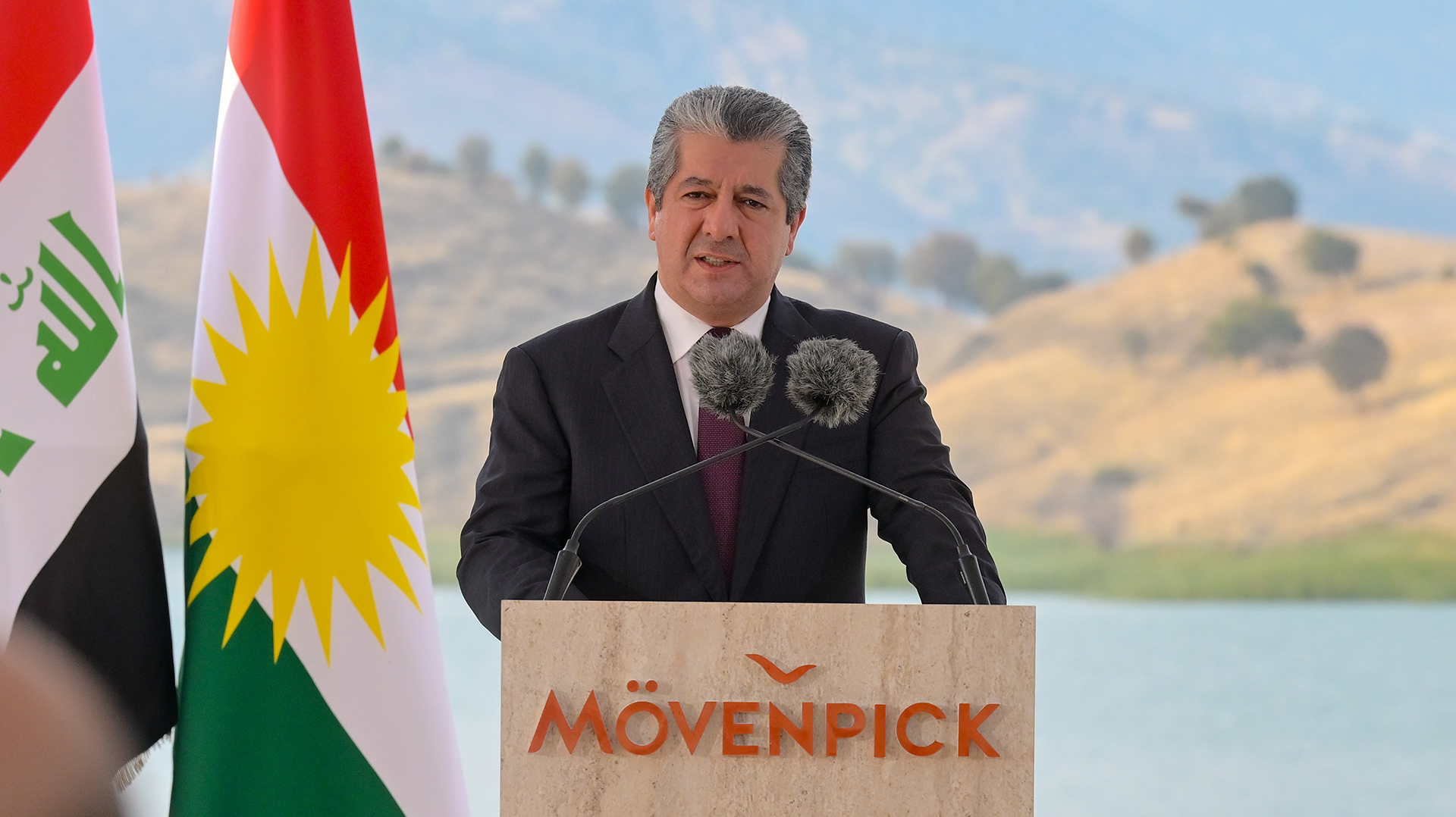
ERBIL (Kurdistan24) - Prime Minister Masrour Barzani declared on Tuesday that the Kurdistan Region "will not be divided," warning against what he described as political agendas aimed at weakening its institutions and calling on people across Kurdistan to stand with residents of Sulaimani who oppose division.
Speaking on Nov. 17, 2026, at the foundation-stone ceremony for the Mövenpick-Gomaspan tourism project near Erbil, Prime Minister Masrour Barzani moved beyond the development's economic prospects to address disputes over the Kurdistan Parliament, relations with Baghdad, public-sector salaries and fuel prices.
"With all our capabilities, we will stand with our sisters and brothers," Prime Minister Masrour Barzani said. "We will defend the rights of the people of Kurdistan and protect the entity of the Kurdistan Region, and we will not allow any agenda to divide our Kurdistan again."
He welcomed what he described as opposition among the people of Sulaimani to a campaign threatening the Region's unity and urged residents elsewhere to support them.
"The Kurdistan Region will not be divided," he said, presenting the preservation of its political and institutional status as a central government priority.
The remarks came amid disagreements over the direction of the Kurdistan Region's institutions.
Prime Minister Masrour Barzani accused unnamed political actors of attempting to prevent the Kurdistan Region from establishing its own constitution, obstructing the functioning of its Parliament and undermining the Regional Government's efforts to normalize relations with Baghdad.
He pointed to what he called a contradiction in legal challenges concerning Parliament.
According to Prime Minister Masrour Barzani, some of the same people who previously questioned why the legislature had not resumed its work later filed a case with Iraq's Federal Supreme Court challenging its reactivation.
"Previously, they asked why Parliament was not functioning. Now they ask why it has been reactivated," he said, questioning whether the purpose of such actions was to serve the public or advance what he termed a "suspicious agenda."
Prime Minister Masrour Barzani argued that Parliament's reactivation had protected the legitimacy of the Region's institutions. He said political parties should compete through democratic and peaceful means, with election results and the majority vote respected rather than obstructed.
"Democracy is not imposition," he said. He also rejected the accusation that a democratic majority was imposing its will, instead criticizing those he said sought to prevent progress after losing a vote. He did not identify the political actors he was criticizing by name in the speech.
Turning to relations with the federal government, Prime Minister Masrour Barzani reaffirmed his commitment to the Kurdistan Region's constitutional rights and financial entitlements. He said discussions with Baghdad were continuing as the federal authorities prepared the 2027 budget, with the objective of reaching arrangements benefiting people throughout the Kurdistan Region and Iraq.
At the same time, he alleged that political opponents were working to frustrate efforts to secure those entitlements and to distort public understanding of the dispute. He framed the budget discussions and the defense of the Region's institutions as connected responsibilities.
He also addressed public concerns about delayed salaries, scarce or expensive fuel and insufficient services. Prime Minister Masrour Barzani accused unnamed actors of previously pressing for responsibility over salaries, energy and oil distribution to be transferred away from the Kurdistan Regional Government and into federal hands.
Those actors, he said, had promised that the changes would resolve longstanding problems. He challenged them to explain why salary delays and fuel difficulties persisted and called on them to acknowledge what he regarded as a mistake and apologize to the public.
"Now, if salaries are delayed, if fuel prices are high, or if problems arise for the people of Kurdistan and services are not provided as they should be, who is responsible?" he asked.
Prime Minister Masrour Barzani pledged to continue seeking guaranteed salary payments but stressed that his ambitions extended beyond meeting payroll obligations. He said his government wanted economic growth, stronger institutions and a united Kurdistan Region capable of contributing to development across Iraq and the Middle East.
Prime Minister Masrour Barzani defended his administration's record, naming the Runaki electricity initiative, the MyAccount project, road construction, digital services and the expansion of services to towns, villages and rural areas. He maintained that these programs had succeeded despite repeated efforts to delay or obstruct their implementation, and claimed attempts to undermine them continued.
The speech began with the tourism project itself, which Prime Minister Masrour Barzani presented as an example of cooperation between the government and private investors. He recalled that the Gomaspan area previously lacked the present road network and water infrastructure, before the construction of a dam, lake and highways improved access from Erbil and surrounding areas.
He said the development would provide a destination for residents of Erbil, Raparin, Sulaimani and other parts of the Kurdistan Region, while attracting visitors from abroad. Beyond tourism revenue, he argued, such projects could encourage commercial activity and cultural and political exchanges with visitors from other countries.
Prime Minister Masrour Barzani thanked the Ministry of Municipalities and Tourism and the Investment Board for assisting the private sector. He emphasized that the government facilitates investment rather than financing the tourism development itself: "All of this is funded and undertaken by the private sector."
He credited Alkov with implementing the project and said Mövenpick, or Accor, would operate the planned hotel, restaurant and resort.
The development, he added, represents only part of a broader plan around Gomaspan, which includes sites earmarked for a waterfront corniche, additional restaurants and cafeterias.
The government, he said, would provide roads, planning and administrative support, while businesses would undertake the investments. He expressed hope for similar developments throughout Kurdistan, although he acknowledged that cooperation from local administrations had been uneven.
Prime Minister Masrour Barzani concluded by thanking the companies and officials involved, expressing hope that the hotel would open in the near future and returning to his broader message: a Kurdistan Region that remains united while expanding its economy and opportunities for residents.
Full Text of Prime Minister Masrour Barzani's Speech:
In the name of God, the Almighty and Merciful.
Distinguished guests, welcome to you all, and thank you for being here.
I am pleased to be with you today to lay the foundation stone for an important tourism project here in Gomaspan.
A few years ago, there was neither water here, nor were the roads in the condition they are today, nor had projects of this kind even entered anyone's mind. Thanks be to God, after some time we saw a lake created here from nothing, a dam built, and a highway constructed around the dam, which in turn has been connected to Erbil through another highway and dual carriageway. This allows the people of Erbil, the people of this area, the people of Raparin, Sulaimani and all of Kurdistan to enjoy the beauty and magnificent nature of Kurdistan.
This has been our objective from the beginning: to serve the people of Kurdistan. Our goal has been to do everything within our ability so that the people of Kurdistan can live happier lives and enjoy Kurdistan's natural beauty.
I thank the Ministry of Municipalities and Tourism, as well as the Investment Board, for supporting, assisting and facilitating the private sector so that projects of this kind can be implemented.
People often ask: With what budget are projects like these being built? Believe me, all of this is funded and undertaken by the private sector. The government provides facilitation, but these projects are implemented through the private sector, and this is the right approach.
The government should facilitate, assist and support, while the private sector should have confidence and trust in its government so that it can invest and implement projects of this kind. The private sector should benefit, the people of Kurdistan should benefit, and this also provides another means of attracting tourists from outside the country to come here.
This will contribute to Kurdistan commercially and economically, while also creating political and cultural interaction with foreign countries and with those who visit Kurdistan.
These are among the types of projects that we have seriously pursued from the very beginning, many of which have already been implemented. We hope to continue implementing similar projects in many other places.
Where assistance has been provided, or where local administrations have offered support and cooperation, these kinds of projects have developed rapidly. Unfortunately, in some places that level of cooperation has not existed.
We hope to implement projects similar to this one in every city and town across Kurdistan, because every part of Kurdistan truly possesses its own beauty and distinctive characteristics, and similar projects can be established in all of Kurdistan's cities.
I thank Alkov company for implementing this project, as well as Mövenpick, or Accor, which will operate this hotel, restaurant and resort. This project will serve the people of Kurdistan.
It will become an extremely attractive and pleasant destination where, God willing, people will be able to enjoy themselves once it is completed. But this is only one part of the project; it is not the entire project.
We have also prepared a master plan for several other sites around Gomaspan so that, in the future, a corniche and several other facilities, including restaurants and cafeterias, can be developed.
So the government provides facilitation, prepares the roads and develops the master plan. The rest is up to the private sector, to those businesspeople and investors who can come and implement their own projects in places and developments like these.
Once again, I commend everyone who has played a role and helped bring this project to fruition. God willing, in the near future we will return to inaugurate this hotel so that it can begin serving citizens.
Distinguished guests, there are several other matters I would like to address concerning the current situation in the Kurdistan Region.
Many people may have questions, and unfortunately, at times issues are misrepresented or attempts are made to convey messages to the public in a distorted manner.
Regarding relations between us and the federal government, we remain committed to defending the constitutional rights of the Kurdistan Region and the Region's financial entitlements.
We continue working on the budget and all of the Kurdistan Region's financial entitlements with the federal government as it prepares next year's budget, with the aim of fundamentally reaching outcomes that serve the interests of all the people of Kurdistan and all of Iraq.
At the same time, there is a serious effort to prevent us from securing the Kurdistan Region's financial entitlements or ensuring, in accordance with the Constitution, the constitutional rights of the people of Kurdistan. On the other hand, they also seek to mislead the public.
There are certain facts I want the people of Kurdistan to be aware of.
The same people who oppose the Kurdistan Regional Government's efforts to strengthen Kurdistan, protect the entity of the Kurdistan Region and normalize relations between the Erbil government and the Baghdad government are the same people who previously made every effort to prevent the Kurdistan Region from having its own constitution.
They are the same people who, on numerous occasions, made serious efforts to prevent the Kurdistan Parliament from being reactivated. Elections were not respected. Complaints were filed with the Federal Supreme Court asking why a Kurdistan Regional Government had not been formed and why Parliament had not been reactivated.
Then, after serious efforts were made to preserve the entity and legitimacy of the Kurdistan Region and Parliament was reactivated, the same people filed another lawsuit asking why Parliament had been reactivated.
Previously, they asked why Parliament was not functioning. Now they ask why it has been reactivated.
Therefore, people must ask this question: What is the objective?
Is the objective to serve the people of Kurdistan, or is it to serve a suspicious agenda that places the entity of the Kurdistan Region at risk?
With all our efforts and all our capabilities, we are committed to preserving the entity and legitimacy of the Kurdistan Region. Thanks be to God, following the reactivation of Parliament, the legitimacy of the Kurdistan Region's institutions has now been safeguarded.
The best path is the path of democracy and peace, where political parties can compete with one another politically.
When democracy is practiced, there are those who falsely accuse others of imposing themselves.
Is the side that holds a democratic majority imposing itself, or is it the side that, with a suspicious agenda and after losing the vote, seeks to obstruct Kurdistan's progress? Which one is imposing itself?
Democracy is not imposition.
Democracy, respecting the people's vote, respecting the vote of the majority, means serving the entity of the Kurdistan Region and serving the people of Kurdistan.
We have demonstrated in practice how much we have been able to serve the people of Kurdistan, despite the fact that every project has faced obstacles and barriers. They have attempted to prevent our projects from proceeding smoothly, properly and on schedule.
Whether it is the Runaki project, the MyAccount project, road construction, digital services, or extending services to cities, towns, villages and rural areas, all these projects have faced obstruction.
Yet the will of the people of Kurdistan, the resilience of the people of Kurdistan and the Kurdistan Regional Government's plan were focused on making these projects succeed, and thanks be to God, they did succeed.
But serious attempts continue to be made to cause these projects to fail.
For what purpose?
More dangerous than all of this is the attempt to divide the entity of the Kurdistan Region.
From here, I can speak on behalf of all the people of Kurdistan and say: The Kurdistan Region will not be divided.
I am very pleased to see the loyal and patriotic people of Sulaimani speaking out against this campaign.
I call on all the people of Kurdistan to support the people of Sulaimani and support the campaign to ensure that the entity of the Kurdistan Region remains protected, united and strong.
With all our capabilities, we will stand with our sisters and brothers. We will defend the rights of the people of Kurdistan and protect the entity of the Kurdistan Region, and we will not allow any agenda to divide our Kurdistan again.
Distinguished guests, I know that problems still exist.
I know people ask: Why are salaries delayed, or why are they not being paid? Why is fuel unavailable, scarce or expensive?
Distinguished guests, on this issue as well, rest assured that over the past several years there have been extensive efforts to transfer responsibility for salaries to the federal government, to place the energy sector under the federal government's control, and to remove oil distribution from the hands of the Kurdistan Regional Government.
The aim was that none of these matters would remain under the Kurdistan Regional Government's authority.
They promised the people that if the Kurdistan Regional Government was no longer responsible for distributing salaries and fuel, then everything would return to normal.
Now the question for those people is this:
After you made every effort and knocked on every door to transfer the salaries, fuel and energy of the people of Kurdistan into the hands of others, now that they are no longer under the KRG's control, whom are you complaining about?
This is your achievement. You yourselves demanded this.
Now, if salaries are delayed, if fuel prices are high, or if problems arise for the people of Kurdistan and services are not provided as they should be, who is responsible?
Let them have the courage to come before the people of Kurdistan once again and say: We made this mistake. Let them apologize to the people of Kurdistan.
We will continue defending the rights of the people of Kurdistan.
We will continue working to secure and guarantee the salaries of the people of Kurdistan, but this alone is not enough.
We are not satisfied merely with salaries being paid.
We want our country to progress.
We want our country to be strong.
We want Kurdistan to be united.
We want Kurdistan to become a gateway for the development of all Iraq and the entire Middle East.
Projects like the one we are launching today pave the way for Kurdistan to become a place that everyone looks toward, rather than overlooks.
People should look to Kurdistan so that our entire country can advance equally and prosper.
Once again, I thank all of you. I thank you for attending, and I thank the companies implementing these projects.
I wish you continued success, and may Kurdistan always remain strong, united and prosperous.