Iraqi Security Forces Assume Jurf al-Sakhar Security Responsibilities
Iraqi security forces announce a new security phase in Jurf al-Sakhar, with Energy Police protecting oil infrastructure and a road reopening planned for Saturday.
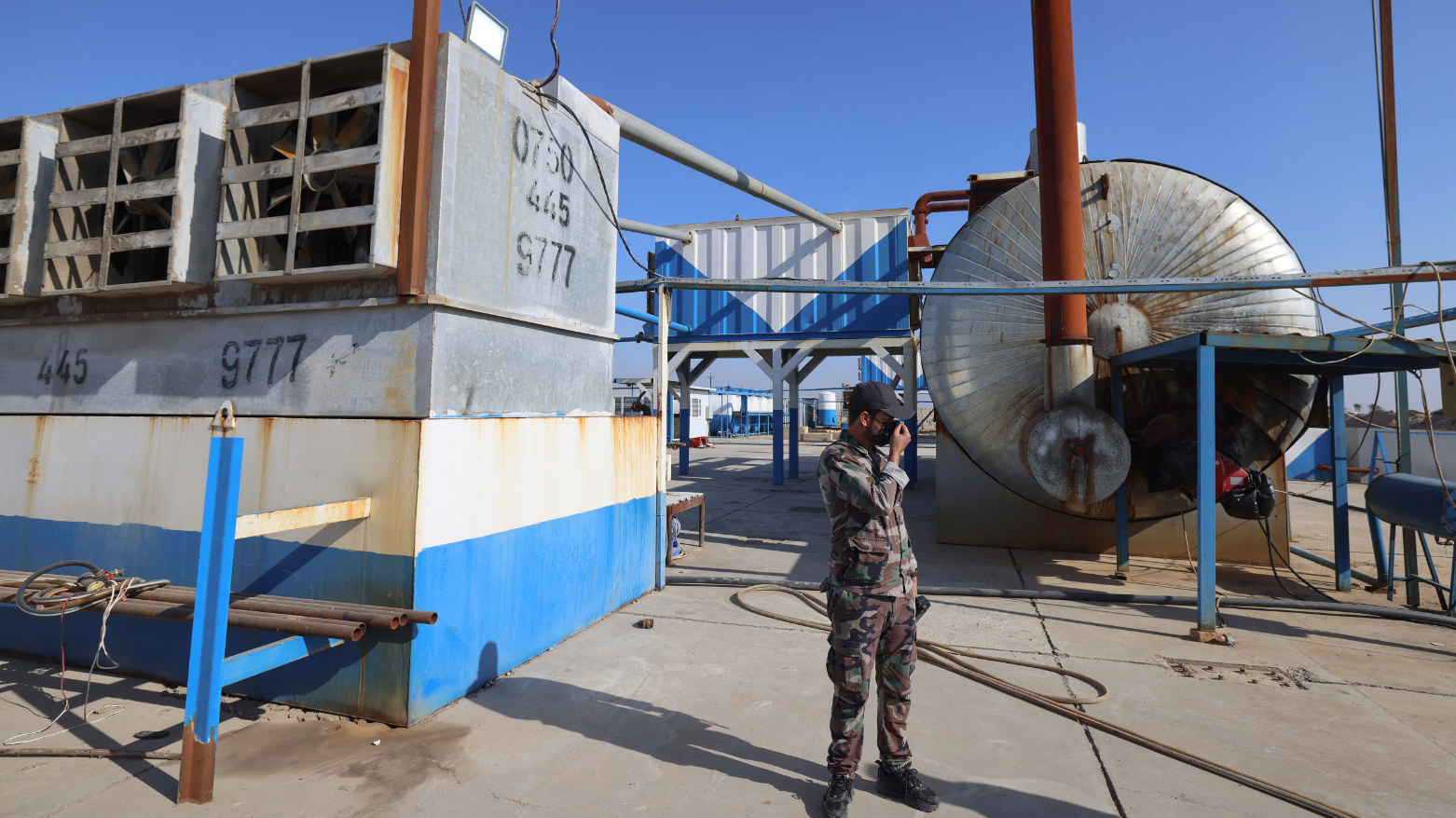
ERBIL (Kurdistan24) - Iraqi security forces announced on Friday that they had begun assuming responsibility for security in Jurf al-Sakhar, as the Energy Police pledged to protect oil and energy infrastructure and officials confirmed plans to reopen a major road to civilian traffic on Saturday.
At a joint press conference on Nov. 20, 2026, representatives of the Federal Police, Popular Mobilization Forces (PMF), Energy Police and other security agencies announced the beginning of a security reorganization across the subdistrict, southwest of Baghdad.
The announcement marks a further step in Baghdad's efforts to bring security positions and strategic oil infrastructure under government supervision following tensions over control of the area and investigations into suspected oil smuggling.
Sabah Numan, spokesperson for the Commander-in-Chief of the Iraqi Armed Forces, described Friday as "a historic day" and said Iraqi forces would carry out their assigned responsibilities with the full support of the Commander-in-Chief.
"What is taking place today is a change in sectors, and the changes are being carried out normally," Numan said. "Jurf al-Sakhar will be under our supervision, and the Commander-in-Chief of the Iraqi Armed Forces is providing us with full support."
He emphasized that the operation was intended to establish a new security arrangement while creating conditions for rebuilding the area.
"We will carry out our duties, restore security and reconstruction to the area, and a new phase, a phase of revival, will begin," he added.
The Energy Police separately confirmed their participation and said they had been assigned responsibility for protecting Iraq's energy and petroleum resources, including facilities and infrastructure in Jurf al-Sakhar.
The force announced that all its units were on full alert as the deployment proceeded.
Officials also confirmed that personnel from the oil and mineral forces had visited Jurf al-Sakhar at 6:00 a.m. Friday.
They announced that the road through the area would be fully reopened at 6:00 a.m. on Saturday, Nov. 21, allowing ordinary citizens to visit.
The planned reopening would represent a change in access to a subdistrict that has remained heavily restricted since its recapture from ISIS in October 2014. However, the announcement did not establish that all existing restrictions had already been lifted.
Earlier Friday, Kurdistan24 correspondent Dilan Barzan reported that Federal Police units had begun advancing toward an entrance to Jurf al-Sakhar, providing the first visible indication that the operation was moving forward after an initial delay.
Kurdistan24 correspondent Shivan Jabari, reporting from Musayyib district in Babil province, said the deployment had originally been scheduled for 6:00 a.m. but was postponed for approximately two hours.
According to Jabari, six military and security formations had assembled near Jurf al-Sakhar, including an Iraqi Army brigade, a Federal Police brigade, two PMF brigades, a Counter-Terrorism battalion and a unit responsible for protecting oil pipelines.
Military vehicles and personnel carriers were observed along the Baghdad-Musayyib road and near the subdistrict. Jabari reported that he had not seen tanks or missile systems among the formations visible to him.
Read More: Iraqi Forces Begin First Phase of Jurf al-Sakhar Security Operation
The initial operation was expected to involve a phased transfer of designated security positions, including locations that might come under joint administration.
Those earlier field observations confirmed that the deployment had begun, but did not establish that government forces had completed the transfer of all positions inside Jurf al-Sakhar.
The central uncertainty has concerned Kataib Hezbollah (KH), the Iran-backed armed group long established in the area.
Kurdistan24's correspondents reported earlier Friday that both Iraqi security personnel and KH fighters had been placed on heightened alert, with no confirmed agreement governing the group's withdrawal or the transfer of its positions.
Although both sides had indicated that they wanted to avoid a military confrontation, KH members remained armed, leaving questions over how the government's security reorganization would proceed.
The operation follows a government-approved deployment plan assigning separate sectors to army, police and PMF formations, alongside dedicated Energy Police personnel responsible for oil transportation infrastructure.
The broader security measures come amid investigations into alleged oil smuggling and unauthorized interference with petroleum facilities in Jurf al-Sakhar.
The official announcement on Friday signals the start of a new phase in the government's efforts to establish security oversight and protect national resources.
However, the extent to which designated positions have been transferred remains unclear. Saturday's scheduled road reopening will provide an early indication of whether the announced security arrangements have translated into restored civilian access to the area.